How Does Shame Show Up in Your Life?
I think shame is very elusive. If you ask people whether they feel shame, most will most likely say, “No, I don’t feel shame.” Yet I believe the vast majority of people carry shame unless they have consciously looked at it and let go of it.
“Shame is a very hard emotion to access. Many times we are not ready to feel it, so it shows up as perfectionism, fear of being seen, seeking validation, negative self-image, difficulty with intimacy.”
 Oliver GlozikFounder of Harmonica Retreat
Suppressed shame can show up in your life in these ways:
- Perfectionism. You keep making it look better, and in a way it becomes a topic of hiding.
- Fear of being seen. You hold back, and you do not fully express who you are.
- Seeking validation. You’re waiting for other people, especially people in authority, to tell you that you’re good enough.
- Negative self-image. You look at your body, and the thought comes in that something is wrong with you.
- Difficulty with intimacy. You get close to somebody, and then you worry they will see whatever you are trying to hide.
- Lack of creative expression. You create something, and then you hold back your creative expression and don’t share it.
- Not fully embodying yourself. You keep parts of yourself hidden, and it becomes hard to be unapologetically yourself.
- Harsh self-criticism. Your mind keeps finding something wrong with you.
- Numbing. We push the shame down through numbing so we don’t have to feel it.
- Addiction. Addiction can become another way of numbing the shame underneath.
- Repeating situations. When we push shame down, we subconsciously keep creating situations that activate it.
What I’ve seen is that these are the outer expressions of shame. Each expression can become a separate intention to explore with ayahuasca, whether the topic is intimacy, perfectionism, body image or the fear of being seen.
Toxic shame is the belief that your whole self is wrong or unwanted. Internalized shame means that an external event has become a belief about who you are.
So shame sits very deep, and a lot of it is connected to hiding. We hide from other people, and also we hide the shame from ourselves.
Where Does Shame Come From?
Shame often begins with early rejection and the internalization of that event. This can come through experiences with primary caretakers or parents, especially when the child makes the experience mean, “There is something wrong with me.”
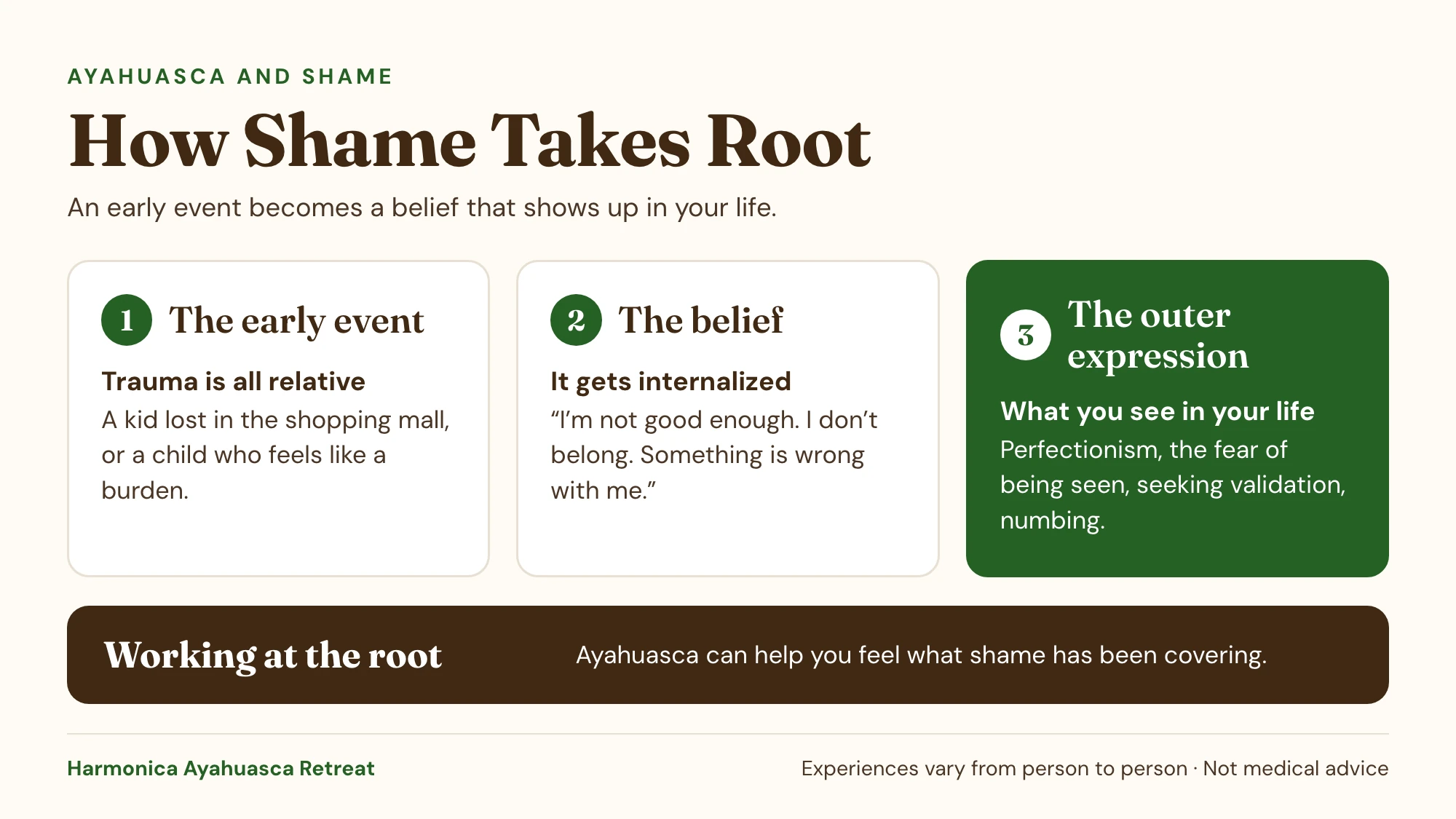
Trauma is all relative. A kid lost in the shopping mall may feel abandoned, even when the separation was short. A mother may need to leave for an event, and the child feels alone. A child may also begin to feel like a burden.
The event does not need to look dramatic from the outside. For the child, it can become early programming around not being good enough or not belonging. That programming may later show up through perfectionism, intimacy problems or the constant need for validation.
Inner child healing can involve returning to these early experiences and feeling what could not be felt then. Our guide to ayahuasca and self-worth goes further into rebuilding the image you hold of yourself.
Shame vs Guilt
Shame vs guilt comes down to the message underneath each feeling. Brené Brown describes guilt as “I did something bad” and shame as “I am bad.” Healthy shame can be a passing feeling about something you did, while toxic shame settles into how you see your whole self.
You may defend it, hide it or make it look better without realizing what you are doing. There can be an inner knowing that something is there, and it takes courage to accept it and see it.
Ayahuasca can connect you to shame and guilt that you have suppressed for a long time. I feel like this happens to the degree that you are ready to face those emotions, and also according to your inner maturity.
I like to say that healing always comes back to love, light, compassion and understanding. Shame and guilt can make us think we need a kick in the back before we finally move our life. What we often need much more is that big hug from ayahuasca. You can also ask ayahuasca to be gentle with you. There is a likelihood that it will.
Ayahuasca and Shame at the Root
Ayahuasca and shame can meet at the core memories where the belief first formed. It can obviously help with the individual expressions of shame, such as body image, creative blocks or the fear of being seen. I think the even deeper power is that you can transform the experience at the core through reprogramming those core memories.
I like to say that ayahuasca is a conversation you are having with yourself in an extraordinary state of consciousness through the plant. In that conversation, you may understand something with your mind. But I think the ayahuasca also helps by allowing us to feel, making that shift from the head to the heart.
This is also related to shadow work with ayahuasca. The shadow often includes what you learned to hide because it felt unacceptable, embarrassing or dangerous to show.
A 2022 exploratory study looked at 45 volunteers before and within 24 hours after an ayahuasca ceremony. Self-compassion and self-reassurance increased, while self-criticism decreased. The study was small and had no control group, and most volunteers had taken ayahuasca before, so the authors called for larger controlled studies. One study cannot tell you what your ceremony will be like.
What Happens When the Group Sees You Cry or Purge?
I feel like one of the ways shame comes up is being seen by the group in the ceremony room. We sometimes talk about ceremony consciousness: whatever happens in the ceremony happens in the ceremony, and how you react to it is your process.
Somebody may be laughing during their own process. Another person hears the laughter and starts thinking, “Hey, they’re laughing at me.” Then the mind moves into “I’m doing something wrong” or “There is something wrong with me.”
That can become a shame spiral inside the ceremony. It’s kind of like the internalization of those external events: the person makes the laughter about themselves. The person who is laughing may be going through something completely unrelated.
The same fear can come up around crying, why you purge in ceremony or making noise. Somebody wants to hide while vomiting. Another person thinks, “I hope I don’t disturb anyone.” This can add another layer when the person is already being afraid of ayahuasca.
Ayahuasca has always been drunk in community. I feel like there is something very beautiful about being witnessed in one’s own struggle without being judged for it. We’re all just people trying to heal.
In the sharing circle the next morning, somebody may say, “You didn’t disturb me at all. When you started crying, it made me emotional and it helped me in my process.”
I remember my second ceremony as a participant. I moved around a lot and made a lot of noise. Somebody commented on it the next day, and I felt that I had done something wrong.
At our ceremonies, 4 to 7 people support the group, depending on its size, and a physician is on the team. Support is available while each person goes through their own process.
Perfectionism Can Be a Topic of Hiding
Shame and perfectionism have been closely connected for me. Perfectionism can sound more acceptable because I can say, “Hey, I just have very high standards.” Underneath, there may be a topic of hiding and trying to make everything look better before anybody can see it.
The next layer may be, “I’m afraid of being seen.” The deeper layer may be, “I carry shame that doesn’t allow me to fully express myself.” I think it has been about coming to terms with how I stand in my own way through perfectionism.
When I first started drinking ayahuasca, I was lost. I did not have self-love, I did not know who I was, and I did not accept or forgive myself. I am happy ayahuasca showed me that I was lost because it allowed me to re-examine my life and start making changes.
Perfectionism is a topic I’ve worked through myself as well. I remember putting a lot of energy into recording and editing content, only for it to end up somewhere gathering dust in a file.
People care a lot less than we think. It is better to start and put the content out than to record it, edit it and never post it. And by sharing it, I also have to accept that people may have their own response.
For me, this has been part of the work of self-acceptance. There is fear around how people may judge what I create, how I speak or how I present myself.
Letting go of some perfectionism has helped me fully embody myself and be more unapologetically myself.
Working With What Opens After the Retreat
Healing shame can continue gradually after the ceremony. I can think of one guest who was very self-critical. Around four months later, he noticed that he had changed a lot and was less self-critical.
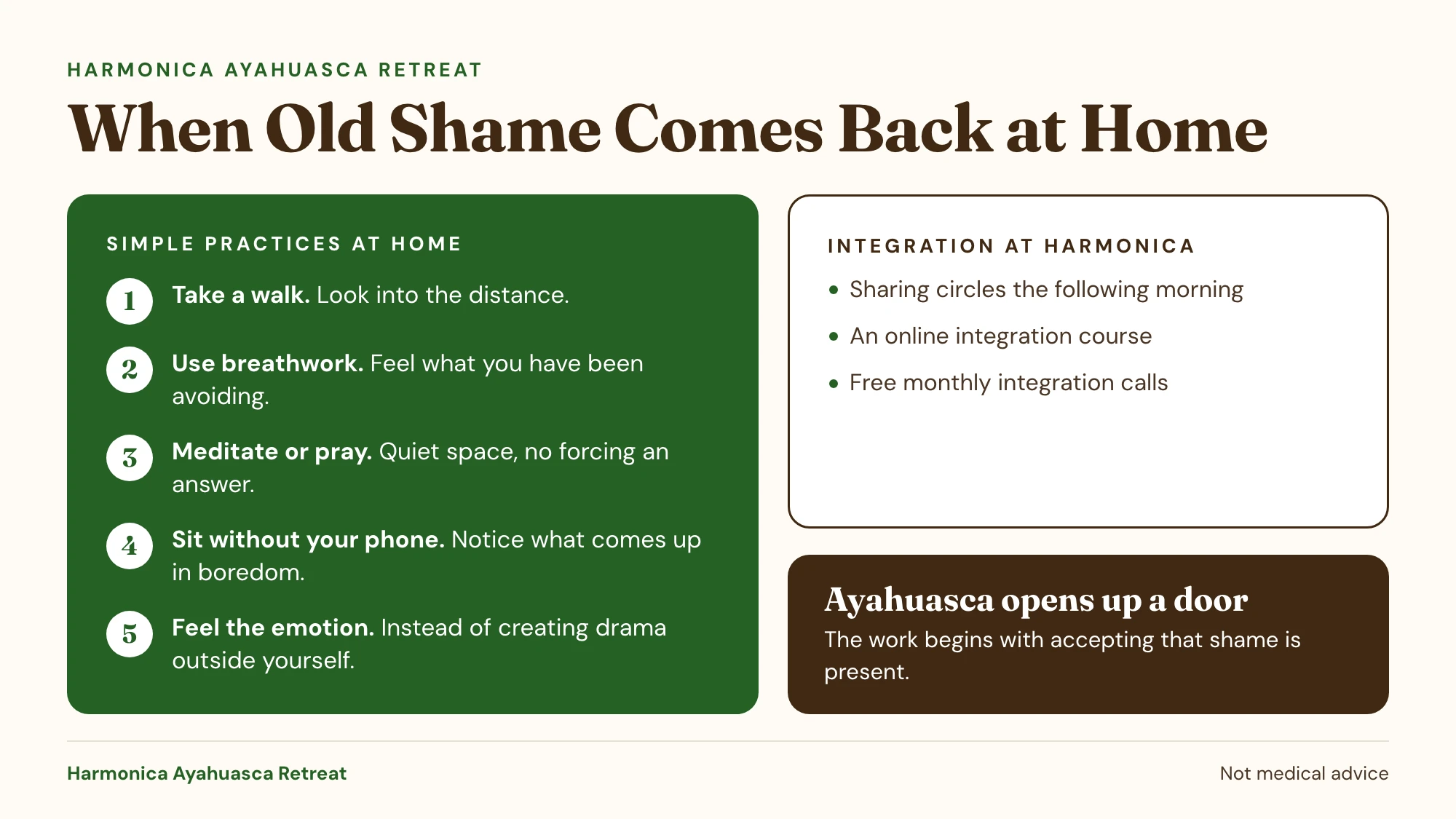
The change had been gradual and partly subconscious. He was even surprised when he realized he had reached a different point from where he had been before.
I think ayahuasca opens up a door. The quote-unquote easiest thing is to ignore what came up, return to day-to-day life and pretend it was not there. Yet part of you knows it is there.
When people ask how to overcome shame, I think the work begins with accepting that shame is present. You may first notice a secondary expression, such as seeking validation, struggling with body image or getting caught in perfectionism. Then you can work with that expression and begin to see the belief underneath it.
I also think we need to increase our capacity to feel and regulate our nervous system. That can begin with very simple practices at home:
- Take a walk. Go outside, look into the distance and notice what begins to settle or come up.
- Use breathwork. Spend some time breathing and allowing yourself to feel what you have been avoiding.
- Practice yoga. Let movement help you reconnect with your body.
- Meditate or pray. Give yourself quiet space without trying to force an answer.
- Sit without your phone. Notice what comes up when boredom arrives and there is nothing available to distract you.
- Feel the emotion. Allow the shame to be present so you do not need to create drama outside yourself to activate it.
At Harmonica, preparation and integration happen around the ceremonies, including sharing circles the following morning. Past participants also receive an online preparation-and-integration course and free monthly integration calls. You can read more about integration after the retreat.
The process can take time, especially when shame has been hidden for many years. I think the direction is eventually arriving at a point of acceptance of oneself.
Therapy Can Go Together With Ceremony
Therapy and ayahuasca can support the same process in different ways. Shame can run deep, and ayahuasca does not replace professional support. A therapist may help you work with shame in a safe relationship while you continue making sense of what came up in ceremony.
Ayahuasca is also not suitable for everyone because some medications and physical or psychiatric conditions can create serious risks. Read who should not drink ayahuasca and speak with a qualified doctor about your individual situation. If shame comes with thoughts of harming yourself, speak to a doctor or therapist before considering a ceremony.
If you want to talk through whether ayahuasca is right for you at this point in your life, book a free consultation call.