Why People Ask Us Before They Book
People in senior positions ask us about an ayahuasca drug test because their job, professional licence, or another formal process may involve testing. They want to be sure before making a decision, and I think that is understandable.
The way I see it, there are three separate questions. Which compounds are present after ayahuasca? Has the laboratory been instructed to look for those compounds? And how long after the ceremony was the sample taken? Without the second part, the first part does not automatically produce a positive result. The third part matters because the body breaks DMT down quickly, and the controlled studies we found only followed people for the first 24 hours.
What Ayahuasca Contains and How the Body Handles It
Ayahuasca combines a DMT-containing leaf with a vine containing harmine, harmaline, tetrahydroharmine, and related harmala alkaloids. The vine’s alkaloids inhibit monoamine oxidase (MAO), which allows DMT to remain active when swallowed.
This combination is also why ayahuasca and DMT are related but are not identical subjects for drug testing. A laboratory might look for DMT, for the vine’s alkaloids, or for what the body turns them into.
A 2003 controlled pharmacology trial followed 18 volunteers who received encapsulated, freeze-dried ayahuasca or a placebo. The median DMT peak in blood occurred 1.5 hours after dosing, around the same time as the strongest effects.
When I looked into the 2012 urine study, the part that surprised me was how little DMT left the body unchanged. The researchers collected urine for 24 hours from 10 healthy male volunteers after a dose containing 1.0 milligram of DMT per kilogram of body weight. Less than 1% of the DMT dose appeared unchanged.
Around 50% was recovered as indole-3-acetic acid, while about 10% appeared as DMT-N-oxide. DMT and its measured metabolites accounted for 68% of the dose. What this shows, I feel like, is that the body had already changed most of the DMT into other compounds before the urine was analysed.
The vine produced a different pattern. Its breakdown products were abundant in urine, and recovery of each harmala alkaloid varied widely, from 9% to 65%. For me, that explains why a laboratory trying to identify ayahuasca use may look beyond DMT. The vine’s alkaloids and their breakdown products can give the laboratory additional targets.
What 5-Panel, 10-Panel, and 12-Panel Tests Look For
A US federal workplace urine test checks five drug classes and does not include DMT or harmala alkaloids. The five-class panel is commonly called a 5-panel test.
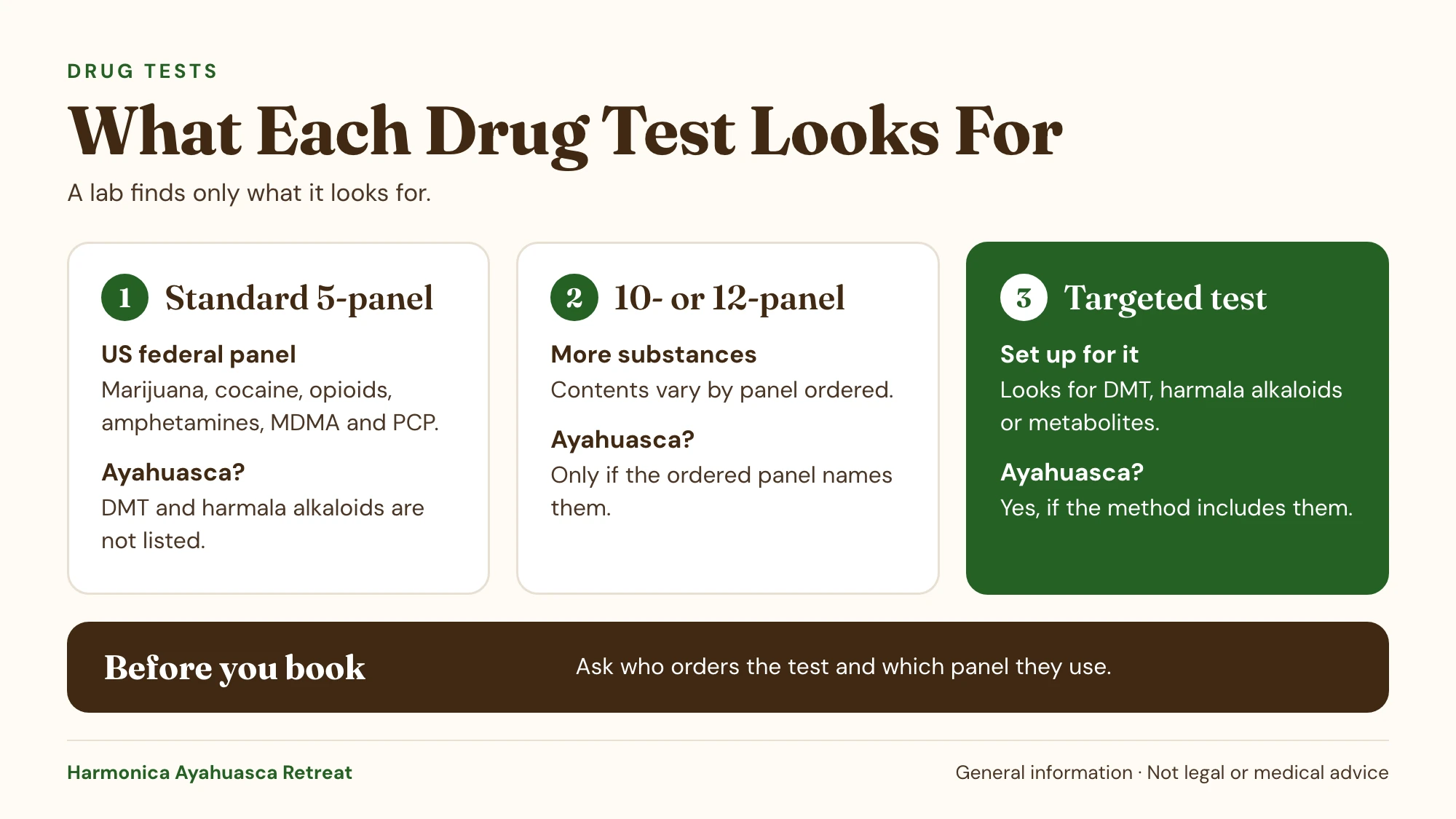
Under 49 CFR 40.85, laboratories test for:
- Marijuana metabolites (THCA, the main metabolite of THC)
- The cocaine metabolite benzoylecgonine
- Opioids, including named prescription opioids and 6-acetylmorphine
- Phencyclidine
- Amphetamine, methamphetamine, MDMA, and 3,4-methylenedioxyamphetamine (MDA)
A 10-panel or 12-panel drug test adds named substances beyond the federal panel. There is no single universal 12-panel list, so you need the exact panel ordered by the employer, court, sports body, or licensing organisation.
Obviously, an extended panel tests for more compounds, but it still follows a defined list. DMT and the harmala alkaloids need to be named in the method for the laboratory to identify them.
When a Laboratory Can Detect Ayahuasca
A laboratory can detect ayahuasca when its method includes DMT, harmala alkaloids, or their metabolites. A standard panel and a targeted laboratory analysis are different tests.
The 2019 hospital paper gives a concrete example. Researchers added harmine, harmaline, and tetrahydroharmine to a non-targeted high-resolution mass spectrometry urine screen. The laboratory then detected harmaline and tetrahydroharmine in urine from a patient suspected of drinking ayahuasca.
The authors note that DMT has a short half-life and can be hard to find in a urine screen, so they suggest adding the vine’s alkaloids to screening libraries.
| Test | Does it look for DMT or the vine’s alkaloids? | What we know |
|---|---|---|
Standard workplace panel (US federal 5-class panel) | No | The federal panel names marijuana, cocaine, opioids, amphetamines including MDMA, and PCP. DMT and harmala alkaloids are not listed. |
Extended panels (10- or 12-panel) | Only if the ordered panel names them | Extended panels add substances, but their contents vary. A laboratory reports the compounds included in its method. |
A test ordered specifically for DMT or harmala alkaloids | Yes, if the method includes them; timing and sample still matter | A hospital urine screen found harmaline and tetrahydroharmine after those compounds were added to its screening library. |
Hair test | We found no published data | Some websites claim up to 90 days. We found no published study behind that figure. |
Blood or saliva | Only if the analysis is set up for the relevant compound | A controlled study measured DMT in blood, with a median peak at 1.5 hours. No published study gives a reliable detection window for blood or saliva. |
How Long Ayahuasca Stays in Your System
DMT itself is broken down quickly, but a lab may also look for its breakdown products or the vine’s alkaloids. That, I think, is why one simple detection window is hard to support.
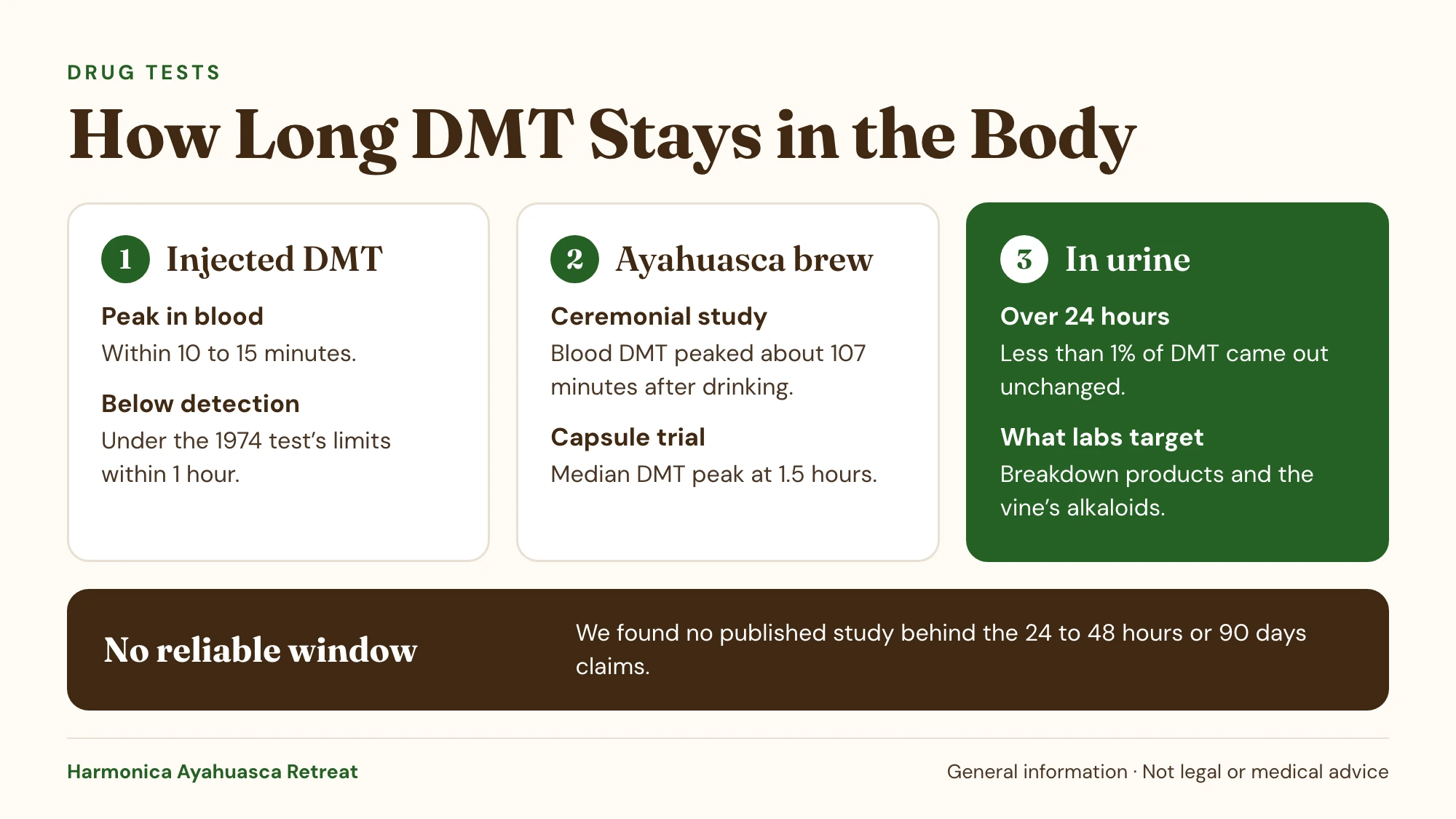
In a ceremonial study from 1999, Callaway and colleagues followed 15 volunteers who drank the brew. DMT in blood peaked on average about 107 minutes after drinking. A peak time is not a detection window, though.
The faster timeline appeared when DMT was injected on its own. In the 1974 study by Kaplan and colleagues, as summarised in Barker’s 2018 review, blood levels peaked within 10 to 15 minutes. DMT was below the limits of detection within 1 hour. That study, obviously, examined injected DMT rather than an ayahuasca brew.
The 2012 urine study points the same way. Most of the DMT is changed before it leaves the body, so laboratories may look for its breakdown products or the vine’s alkaloids instead.
Some websites claim that ayahuasca can be found for 24 to 48 hours in urine or for up to 90 days in hair. We found no published study behind those figures, so we do not repeat them as fact.
Our ayahuasca dosage guide explains the experience and dosage side separately.
Does the Body Make DMT Naturally?
The human body makes small amounts of DMT itself, which is why researchers call it endogenous DMT. Barker’s 2018 review in Frontiers in Neuroscience reports that enzymes capable of making DMT from tryptophan, through tryptamine, have been found in mammalian tissue, including the human brain. DMT produced by the body has also been measured in both human blood and human urine.
The review covered 69 studies and thousands of people. People without any psychiatric diagnosis also tested positive for endogenous DMT, and what surprised me is that their measurements were sometimes higher than those of people with a diagnosis.
Many early studies that reported high DMT levels probably misidentified the compound. Barker also found that nobody has yet linked the body’s own DMT levels to everyday physiology. Measuring endogenous DMT does not tell us what role it has in ordinary body function.
In practical terms, the way I see it, a lab looking for traces of DMT has to distinguish the body’s small endogenous amount from an outside source. This is one more reason, I think, that the vine’s alkaloids are a more useful target for a lab looking for ayahuasca.
Work, Licensing, and Probation Testing
Employment, licensing, probation, and sports testing depend on the panel ordered by the responsible organisation. If the outcome could affect your work or legal position, I think you need to get the panel name and policy before you book.
A medical review officer can explain which compounds the laboratory tests for and how results are handled. An employer can provide its written policy. A lawyer who works in the relevant jurisdiction can advise you when a licence, court order, probation condition, or visa process is involved.
This information is general and is not legal or medical advice. Guessing creates unnecessary risk, the way I see it, especially when your income or professional licence depends on the answer.
DMT is a controlled substance in many countries, and the rules around ayahuasca can differ by place and context. Our guides discuss whether ayahuasca is legal and ayahuasca’s legal status in the US.
Medical Screening Matters Beyond Drug Testing
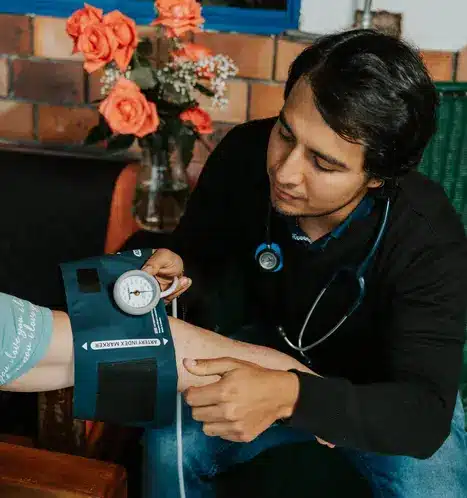
I think medical screening should come before the drug-test question because medication interactions and existing health conditions can affect whether someone should drink ayahuasca. For us, this is the first layer of physical safety.
“We turn down about two to five participants a month for the safety and well-being of all involved. Obviously for our end but even more also for the participants because we don't want to assume any risks.”
 Oliver GlozikFounder of Harmonica Retreat
We screen for psychiatric history, epilepsy, heart health, and medication use. Antidepressants require particular care, including selective serotonin reuptake inhibitors (SSRIs) and other medicines that affect brain chemistry. Medication prescribed for attention deficit disorder (ADD) also needs an individual medical review.
To be honest, a person should not stop medication based on a retreat website. The doctor prescribing it needs to advise whether any change is appropriate and how much time would be required. Ideally, the doctor should also understand ayahuasca and MAO interactions.
Our guide to ayahuasca and SSRIs explains why this combination needs medical attention. We also have a separate screening guide for who should not do ayahuasca.
A physician is part of our team. Our retreats near Medellín are capped at 12 participants, and ceremonies follow the Kamsá Biyá tradition of the Putumayo. You are welcome to contact us with a medical screening question even if you are not planning to attend our retreat.
Check the Test Before Making Your Decision
The practical step, I think, is to identify who orders the test, which panel they use, and whether the policy names DMT or ayahuasca. If your work, licence, or probation depends on the result, speak with the employer, medical review officer, or lawyer before booking.
When guests in senior roles first asked me about this, my answer was:
“To be real honest, I don’t know.”
So I went to the federal regulation and the laboratory studies, and this page is what I found. For me, that makes more sense than repeating a number from another retreat blog.
If you want to discuss whether ayahuasca is suitable for you at this point in your life, you can book a free 30-minute consultation call. Bring the ayahuasca drug test question to the call before you make travel or ceremony plans.