Why Grief Gets Pushed Down
Grief gets pushed down because the loss creates an overwhelming amount of feeling. We push it down, we numb it, and in a way this makes sense at the time. But the feeling does not simply leave because we stopped looking at it.
I remember a woman in her late 50s or early 60s who came to ceremony without grief as her intention. A loss from 20 to 25 years earlier came up, and she understood how much grief she was still carrying. For me, this is one example of how ayahuasca shows us what we need to look at.
When grief is pushed down like this, it goes into the subconscious and affects us in many different ways. Ayahuasca is able to work exactly at the root cause of it.
Sudden death can also carry a particular kind of unresolved grief. When an elderly person dies, the loss can be deeply painful, but I think it is more understandable. When life suddenly takes away somebody you love, there may also be unfairness, anger at God and even anger at the person for leaving.
“Grief has its own timing. It’s a process with many stages, and ayahuasca can help you work through them. Because if not, suppressed grief deeply impacts our life in ways we don’t even realize.”
How Does Suppressed Grief Show Up in Your Life?
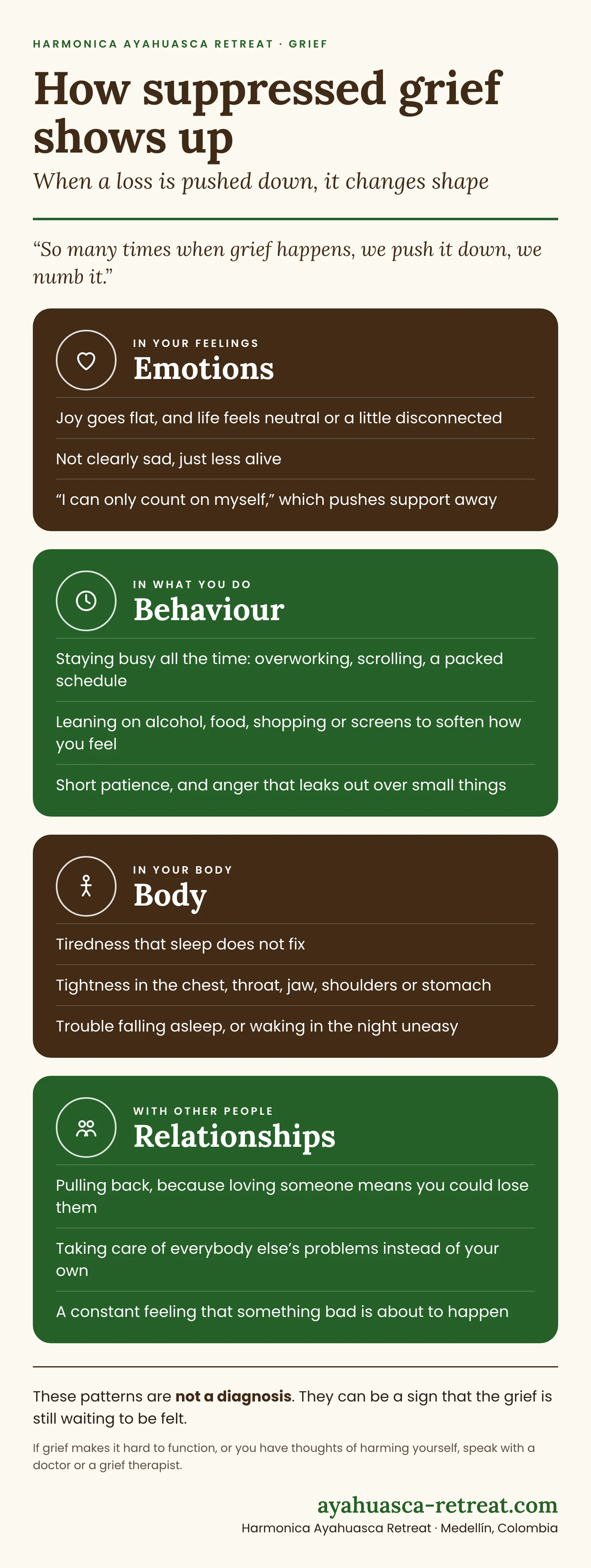
The signs of suppressed grief often appear in ordinary parts of life rather than as constant crying. Joy may go flat, and life starts feeling neutral or disconnected. You may also start believing that you can only count on yourself, which pushes away people and support.
Then there is the busy version. You work all the time, scroll for hours or fill every part of your schedule. Alcohol, food, shopping or screens may also become ways to soften whatever starts coming up.
Sadness can sit underneath irritability. You become impatient, and anger leaks out over small things.
And also, the body can carry some of it. You may feel tired even after sleeping, wake during the night feeling uneasy or notice tightness in your chest, throat, jaw, shoulders or stomach.
In relationships, you might pull back because loving somebody also brings the fear of losing them. Or you take care of everybody else’s problems so you do not have to sit with your own. These patterns are not a diagnosis, but I feel like they can show that the grief is still waiting to be felt.
What Can Come Up in Ceremony?
A ceremony may bring emotional release, old memories and feelings that were too much to face when the loss happened. You may meet anger, sadness and forgiveness.
The stages of grief are often described as denial, anger, bargaining, depression and acceptance. People do not pass through them in a straight line. You also cannot lose somebody and then demand acceptance, serenity and peace from yourself a few weeks later.
You are going to need to go through the unprocessed things, step by step. That can include the disappointment you may have felt with that person. Forgiveness through ayahuasca can become part of the process, but forgiveness cannot be forced either.
I remember a man who had lost several siblings within a short time. He lost his spark. After the retreat, he was able to see his grief as a measure of the love he had experienced, and he became grateful for those moments together.
“How much grief you feel also shows how much love you had in your life.”
Can You Connect With a Loved One Who Has Passed?
During ayahuasca, some people experience a connection with a loved one who has passed, but nobody can promise that experience. People sometimes arrive hoping for a message from their mom. It can happen, but it can also not happen. Obviously, nobody is able to say which it will be.
I have also met people who asked why a sudden loss had to happen and felt that they received an answer. Those answers were deeply personal, so I will leave them private. Experiences like this can carry meaning for the person without proving anything about the afterlife.
The 2019 OMEGA study also recorded participants’ reports of experiences of contact with the deceased.
What I also tell people is to trust in the wisdom of the ayahuasca and to not force it. You can work with setting an intention, but an intention is different from demanding a result. Searching for signs from deceased loved ones is natural, but try not to pressure the experience to be a certain way.
How to Deal With Grief Spiritually
The part of David R. Hawkins’ teaching that I find useful is letting go.
In Letting Go, Hawkins describes letting a feeling be fully present without resisting, judging or trying to change it. You stay with the feeling until the pressure behind it runs out and it releases on its own. In a way, this is close to what I tell people after ceremony.
On Hawkins’ Map of Consciousness, grief sits at 75 and represents regret and despondency. Courage is placed at 200, acceptance at 350, love at 500 and peace at 600. This is Hawkins’ map, and I do not present it as science.
What Does the Research Say About Ayahuasca and Grief?
Research on ayahuasca and grief reports lower grief severity, more acceptance and less avoidance, but the studies remain preliminary. The samples are small, and the study designs cannot establish that ayahuasca caused every improvement.
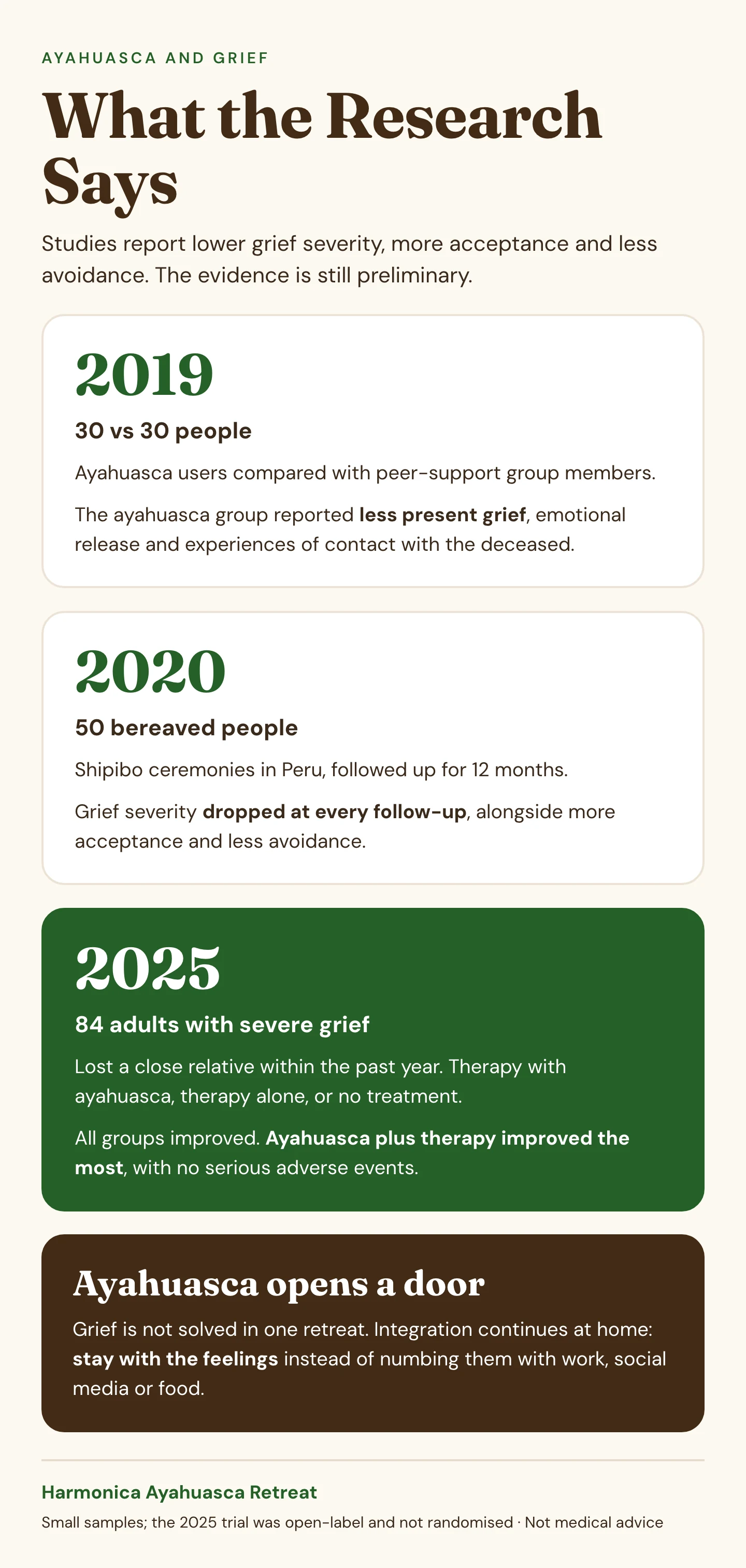
A 2019 study compared 30 people who had taken ayahuasca with 30 people attending peer-support groups. The ayahuasca group reported less present grief and benefits in some psychological and interpersonal areas. Participants described emotional release, biographical memories and experiences of contact with the deceased.
A 2020 observational study followed 50 bereaved people who attended Shipibo ayahuasca ceremonies in Peru. Twenty-seven were still answering at 12 months. Grief severity had dropped at each follow-up, which took place after 15 days and then after 3, 6 and 12 months.
Less avoidance of painful inner experiences and more decentering went together with that change. Decentering means stepping back from thoughts and feelings so you can observe them without being completely pulled into them. The researchers saw acceptance as an important part of the process, but the study had no control group.
The 2025 trial included 84 adults with severe grief after losing a first-degree relative within the previous 12 months. One group received meaning-reconstruction therapy with ayahuasca sessions, another received the same therapy without ayahuasca and a third received no treatment. All three groups improved, while the ayahuasca group improved the most.
Ayahuasca was well tolerated in that trial, with no serious adverse events reported. The trial was open-label and was not randomised, so the authors called the results preliminary. Larger randomised trials are needed.
How We Hold Grief in the Room
Holding grief in ceremony means allowing somebody to be seen without trying to solve their pain. People need to be seen, witnessed and held without being judged or fixed.
I think, as a facilitator, it is very important to refrain from giving advice, especially because I have not lost somebody very close myself. I remember sitting beside somebody who was speaking about several losses. I gave him a tap on the shoulder and stayed with him.
There was discomfort in me too, obviously. The work was to sit in that uncomfortable moment rather than escape into advice. As a facilitator, you need to stop the tendency of trying to fix the situation.
What Happens After the Retreat?
So I think what people need to understand is that grief is not solved during a retreat, and it is not something that needs to be solved. In a way, the ceremony lets off a little bit of steam from that valve. The pressure may change, but the process continues.
Ayahuasca can amplify internal states. If you feel emotional after the retreat, what I also tell people is that it is actually a good sign. You are feeling what was previously pushed down.
When those moments come, stay with them as much as you can. Try not to numb the feeling through work, social media or food. The more you allow yourself to feel, the more you may be able to let go.
At our retreats, preparation and integration take place on either side of the ceremony. Our guide to integration after a ceremony explains how that continuing work can look.
Ayahuasca opens a door. You still have to continue walking through it, and I feel like that is where the real transformation and healing happen.
When Is Ayahuasca Not the Right Tool?
Ayahuasca is not the right tool when you want a quick fix or need the ceremony to unfold in one particular way. I always like to say that you are ready for ayahuasca if you are ready to look at the unresolved topics of your life.
I think the sooner grief is addressed, the better. Reaching out can show that part of you is ready, and a recent loss by itself does not mean you must wait. The 2025 study also worked with people who had lost a close relative within the previous year.
Still, readiness includes accepting that you cannot control the experience. A ceremony might be gentle, or you may need support through a difficult ceremony. Our guide to drinking ayahuasca in difficult times can help you think through the timing.
Medical and psychiatric screening also matters. Some medications, including certain antidepressants, can interact with ayahuasca. Some health and psychiatric conditions also make ayahuasca unsuitable, which we explain in who should not drink ayahuasca.
If grief is so heavy that you cannot function, or you are thinking about harming yourself, speak with a doctor or grief therapist before considering a ceremony. That support can also continue alongside any later retreat work.
You can read about the ayahuasca retreat for grief if you want the retreat details. If you are unsure whether this is the right moment for you, use the free consultation call to talk through your situation.