
How to Set Your Ayahuasca Intention, Step by Step
Questions and journaling can obviously help, but I think they can also turn into over-intellectualising. Deep down, your heart usually knows why you want to drink, often before your mind finds the right sentence.
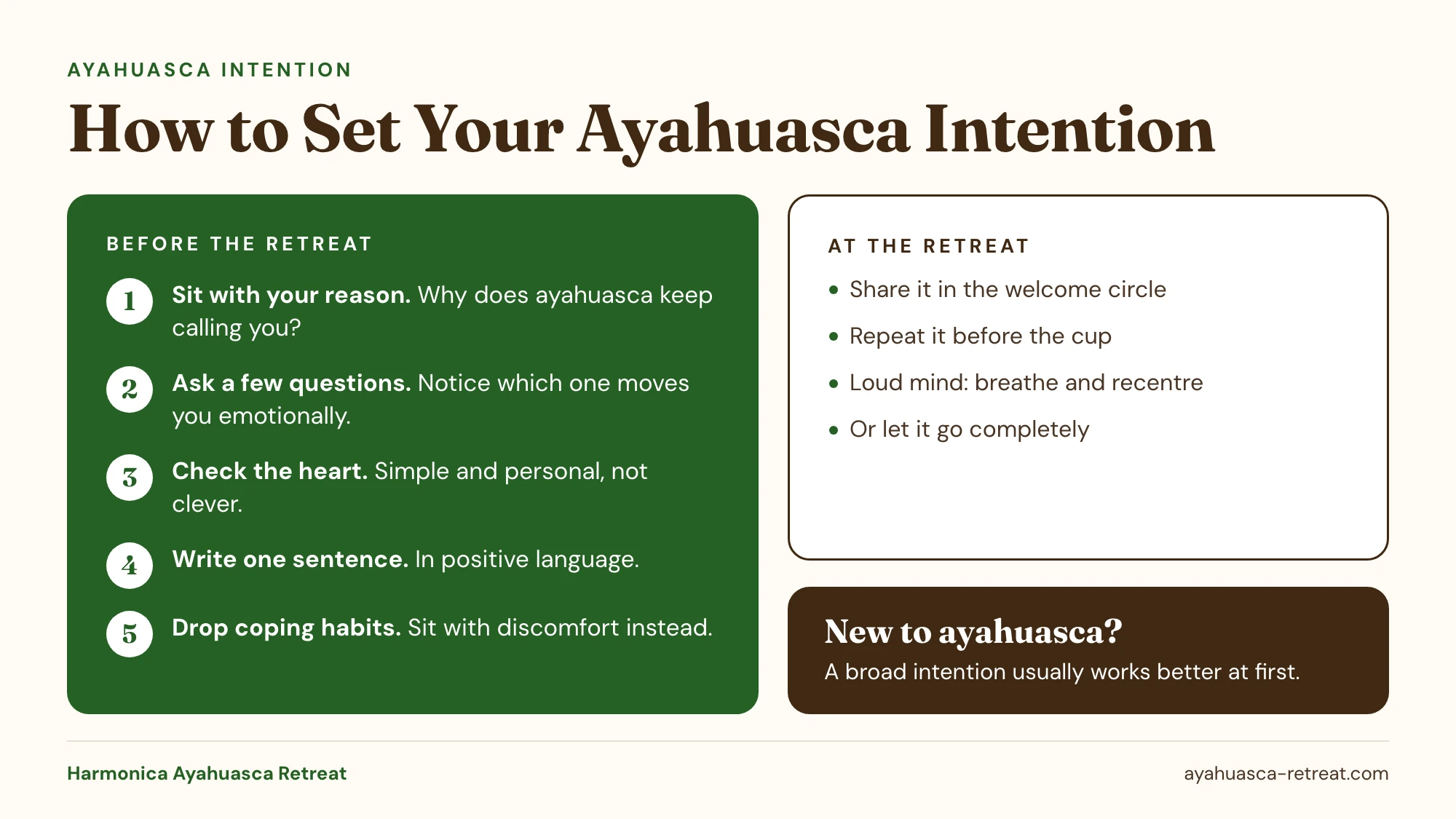
- Sit with your reason for drinking. Ask why ayahuasca keeps on coming into your mind and which part of your life needs care. Notice the challenges you face and the emotions that keep returning. Your soul healing work may involve grief, forgiveness, fear, relationships, or something you cannot put clearly into words yet.
- Ask yourself a few direct questions. Notice which question creates an emotional response instead of trying to answer every one perfectly.
- Check where the answer comes from. A heart-centred intention often feels simple and personal. A head-centred intention can sound clever, but also feel far away from you.
- Write one positive sentence. Name what you want to feel, understand, or welcome into your life, for example "I intend to release my limiting beliefs about abundance," "I intend to connect with my inner child and change my negative self-talk," or "I intend to heal my relationship with my mother by releasing old beliefs." Then picture how living with more freedom, peace, or connection may feel, without deciding how the ceremony has to bring you there.
- Reduce your usual coping mechanisms. Sit with some discomfort for a few days and notice what you may have been avoiding.
- Bring the intention into the retreat. Share it in the welcome circle if you feel comfortable, and then repeat it quietly before drinking the cup.
Questions to Find Your Ayahuasca Intention
These questions can help you move beneath your first answer and find the feeling or unresolved topic under it.
- What is the wish of your soul?
- What do you want to let go of?
- What unresolved issue are you carrying with you?
- What keeps you awake at night?
- Who or what triggers you?
- Which part of your life do you want to tidy up?
- With whom or what do you want to make peace?
- What do you feel you need?
- What would you tell your eight-year-old self?
- What do you wish for yourself in five or ten years?
- Which feelings or situations are you running away from?
- What kind of person do you want to be in your work, friendships, or romantic relationships, and what is holding you back?
Sitting with these questions before an ayahuasca retreat can show you which part of your life is asking for attention.
If you prefer to watch, I go through the questions that help you find your intention in this video.
Is Your Intention Coming From the Heart?
A useful ayahuasca intention feels connected to your heart instead of being constructed completely in your head. Obviously, you still need words and thoughts to express it, but the sentence should point toward something you feel within yourself.
Some participants work with rapé before ceremony, an Amazonian plant medicine traditionally used to settle mental noise and bring attention back to what someone carries emotionally.
Use Positive Language
Positive language brings your attention toward the state you want to develop. Instead of saying, "I don't want to be anxious anymore," you might say, "I want to feel calm and at peace." This does not mean pretending the fear is not there; you are naming the direction you want to move in.
Leave Out Your Coping Mechanisms Before Ayahuasca
Reducing your usual coping mechanisms can reveal the feelings behind your intention. If stress appears and you normally reach for a drink or snack, try sitting with the feeling for a little while instead.
You may notice sadness, anger, loneliness, or another emotion that the habit was covering. The ayahuasca ceremony preparation guide explains how to prepare your body and mind in the days before a retreat.
Hearing the Call of Ayahuasca
The call of ayahuasca is a persistent feeling that something within you needs attention. It can be a wish for healing. It can also be a desire to understand yourself, or a pull toward the medicine that is difficult to explain with logic.
You still need to examine your reasons and decide with responsibility. Our guides on the call of ayahuasca and the purpose of ayahuasca can help you put that pull into clearer words.
Should Your Ayahuasca Intention Be Broad or Specific?
A broad ayahuasca intention usually works better for a first retreat, while more precise intentions can become useful with experience.
“I remember my first ayahuasca retreat. I showed the shaman my list of intentions, five or six different things, and asked him what to do. Do I go through it one by one? What do I focus on? He smiled a bit, said it was pretty head-focused, and recommended I set a broader intention of healing.”
 Oliver GlozikFounder of Harmonica Retreat
I think the shaman gave me good advice, especially at the beginning of the journey, because beginners rarely know which issue needs to be approached first.
Broad Ayahuasca Intention
A broad ayahuasca intention gives the conversation room to move across connected parts of your life. You might ask to heal emotional wounds, release old patterns, or connect with something bigger than yourself.
A broad intention also helps when several concerns seem connected. Instead of bringing six separate questions, you can place them under a word such as healing, forgiveness, trust, or growth. And by doing this, you loosen that need to control the ceremony.
Procrastination is a good example. You may arrive wanting to stop delaying your work, but underneath this pattern there might be unresolved feelings toward your parents, your father, or emotions you have been avoiding.
If you fixate only on procrastination, it can be like staring at a tiny ball on your left while a huge ball on your right is waiting to be seen. Sometimes we bring questions that sound urgent, but they are not the questions moving our spirit at a deeper place.
Specific Intentions
A specific intention brings your attention toward one relationship, behaviour, or decision. Examples include looking at your relationship with a family member, understanding an addiction pattern, or finding clarity about your career.
I always remember what Taita Miguel shared:
"The clearer your intention, the clearer the messages in your Ayahuasca ceremony." Taita Miguel
This focus gives you direction, but also helps you observe progress over time. It can be especially useful after 10, 20, or 30 ceremonies, when you understand more about how your mind distracts you from difficult topics.
I might drink with the intention of looking at a struggle in my relationship. Then a business idea appears, and I notice this is a distraction from the topic I came to look at. I can see it and gently bring my attention back toward the relationship.
Which One Is Better?
Choose a broad intention when this is your first retreat or when several areas of your life feel tangled together. Choose a specific intention when you have ceremony experience and already know which topic needs your attention.
In the end, ayahuasca does what ayahuasca does, and your responsibility is to stay open enough to notice where it takes you.
How an Intention Differs From an Expectation
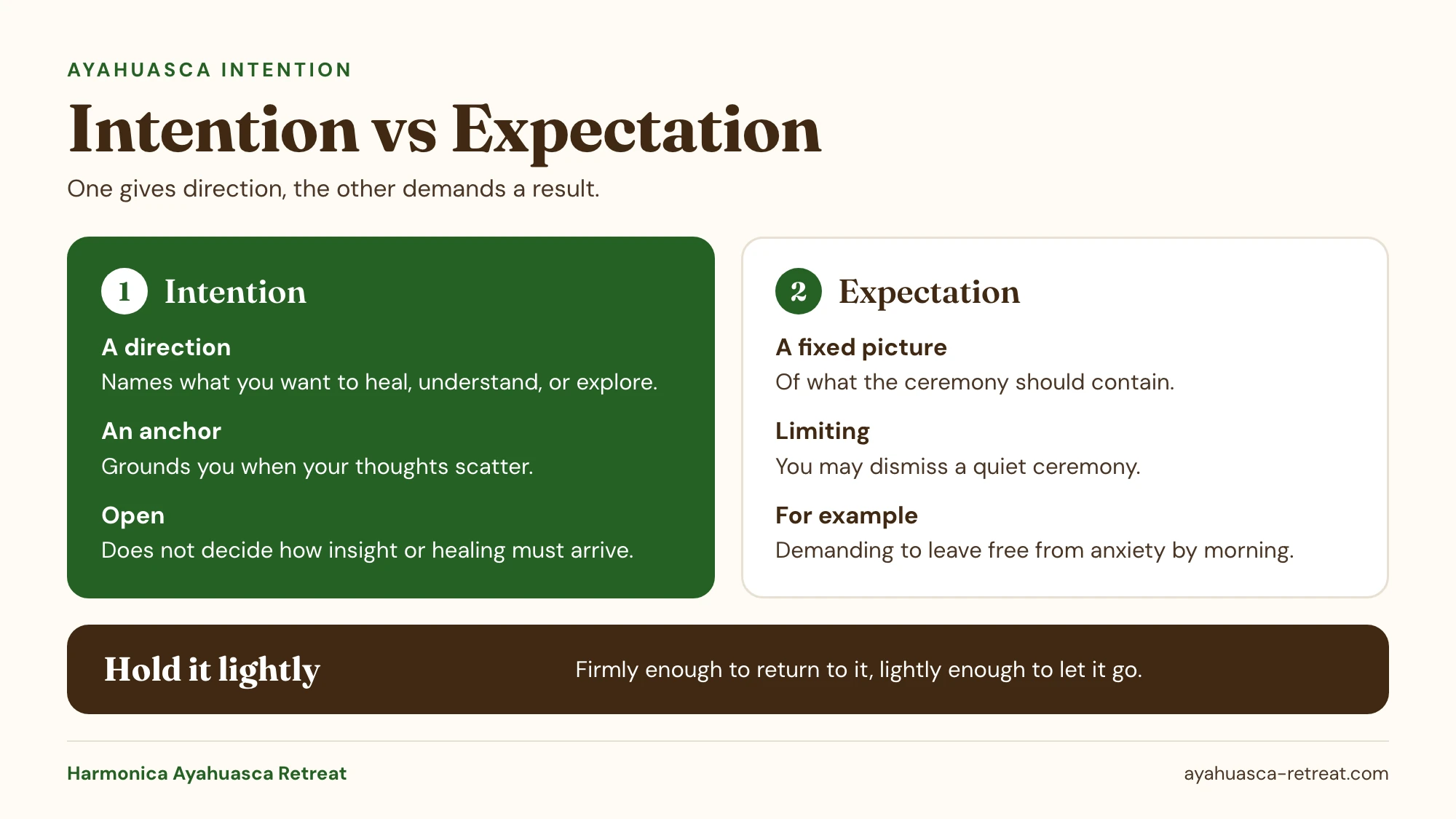
An intention gives your ceremony a direction. An expectation demands that one particular result has to happen. You can hold the intention firmly enough to return to it, but also lightly enough that the ceremony can move somewhere else.
An Intention Is the Direction You Want to Go
An intention names what you want to heal, understand, or explore. It can be releasing an old wound, connecting with your inner self, or finding clarity around a decision. It reminds you why you came, without deciding how healing or insight must arrive.
Expectations Can Limit Your Experience
Expectations create a fixed picture of what the ceremony should contain. If you expect detailed ayahuasca visions or one specific realization, you may dismiss a quiet ceremony that works through emotions, memories, or the body. Expectations often come from past ceremonies, videos, or other people's stories.
Ayahuasca may bring your attention toward something you did not know needed care. Sometimes several ceremonies are needed before a pattern becomes clear, which is one reason people ask how many ayahuasca ceremonies they need.
Trust the Process and Stay Open
Trust means staying open to how your intention develops, including when the ceremony approaches it from an angle you did not expect. If you want to release an old wound, focus on the freedom or lightness you hope to feel instead of designing every step toward it.
Fear, sadness, or resistance may become part of the homework rather than proof that something has gone wrong. If anxiety is getting louder before the retreat, read our guide for people who feel afraid of ayahuasca. At our retreat in Colombia, we ask you to bring a clear reason for drinking and enough trust to be surprised by what comes up.
Be Open to Discover the Root of Your Intention
Your first intention may name a symptom, while the ceremony brings your attention toward the deeper source. At first this can feel unrelated. Then the connection may become clearer during ceremony or in the days afterwards.
Your Shoulder Pain Has Its Origin in Your Knees
The shoulder, hip, and knee metaphor shows how one visible problem can begin somewhere else. Shoulder pain may come from misaligned hips, while the hips may be compensating for a knee that does not extend properly.
An intention around self-confidence can work in a similar way. You may expect to examine work or social situations, and then realize that forgiveness toward a family member needs attention first. And also, you may discover that you need to feel unconditional love towards your parents.
Treating the knee can change the hips and ease the shoulder. In the same way, working with the root may affect several parts of your personal and professional life.
When to Focus on Your Ayahuasca Intention
Come back to your ayahuasca intention before the retreat, during the welcome circle, before drinking, and whenever your mind needs an anchor in ceremony.
In the Days Leading Up to the Ceremony
The days before ceremony give you space to notice why you are coming. Preparation involves food and other practical choices, but also observing your emotions, reducing distractions, and sitting with your intention. You do not need to repeat it all day; return to it when an old coping mechanism shows up.
In the Welcome Sharing Circle
The welcome sharing circle gives each participant a chance to say why they came. At Harmonica, we first explain the retreat and group dynamics, and then the team and participants introduce themselves.
People can then share their intentions. This helps everyone understand why each person is present, and it is a great way to open up within the group.
Before You Drink the Cup
The moment before drinking is a natural time to return to your intention. You can mentally introduce yourself to the medicine and share your sentence with the cup.
It may sound silly, especially if you have never done anything like this before. Still, that small moment can calm you and settle your attention before the ceremony begins.
Before the Effects Come: Ask Open-Ended Questions
Open-ended questions can bring you closer to the intention while you wait. If your intention concerns procrastination, you might ask yourself:
- Which topics do I procrastinate on most?
- Why do I avoid them?
- What would happen if I stopped procrastinating?
- What am I afraid of?
Do not force an immediate answer. Give each question some space, and notice which memories, emotions, or physical feelings appear.
In the Ceremony Itself
Your intention can recentre you when your mind feels expanded, scattered, or very loud. Take a deep breath, bring your attention toward your heart centre, and quietly repeat the sentence.
Sometimes you let ayahuasca do what it needs to do and forget the intention completely. That is also fine. Something may be unfolding beneath the surface, even when you cannot make sense of it yet. Progress is often slow and steady rather than sudden.
The guides on what to expect in an ayahuasca ceremony and navigating a difficult ayahuasca experience offer more support for these moments.
What If Your Intention Changes?
It is normal for your intention to change, and often the change shows that your first question was too narrow. We once had a lady who wrote down her intentions before ceremony. Later that night, she burned the paper in the fire and said she had been too stiff and had asked herself the wrong questions.
An intention can evolve during the retreat, but also in the days afterwards, and that is part of the homework. Stay curious about the change, and then decide what actions or conversations need to follow from it.
Drinking Ayahuasca Out of Curiosity
Drinking ayahuasca from curiosity alone carries a risk, because you may encounter parts of yourself you were not prepared to examine. I think I have a bit of a difficult relationship with curiosity as the main reason for drinking.
I think of it like getting on a roller coaster. Once you are on it, the experience can become intense, and simple curiosity may give you very little grounding when difficult emotions appear. The same goes for wanting to see colours or geometric figures, or to enter a trance. These images can be beautiful, but somebody who comes only for the spectacle may meet emotions or memories they were not ready to face.
Curiosity can also lead somebody toward a part of themselves that needed healing, and the ceremony may be very beneficial for that person. It can also be that curiosity is covering a deeper calling that someone is not ready to put into words.
Ask yourself what sits behind the curiosity. Is there grief, fear, a relationship, or a repeated pattern that you already know needs attention?
Inappropriate Intentions for Ayahuasca
Inappropriate intentions treat ayahuasca as entertainment or demand a spectacle from the medicine. This work deserves preparation, respect, and a willingness to look at yourself, including your shortcomings and coping mechanisms.
Ayahuasca Is Not a Recreational Experience
Ayahuasca should be approached carefully and with preparation. A ceremony can become physically and emotionally intense, even when somebody arrives expecting a gentle evening.
People with certain health conditions, psychiatric histories, or prescriptions should not drink, so read who should not do ayahuasca and complete the retreat's screening process.
Respect and Humility
Respect and humility mean accepting that you do not control every part of the ceremony. You can prepare well and state a clear intention, but the medicine may still bring you toward a different topic.
Humility also means doing the work afterwards, because a realization in ceremony does not repair a relationship or make a difficult decision for you.
A Business Intention for Ayahuasca
Ayahuasca is not a business tool for improving conversion rates or finding the next disruptive idea. If your entire intention is centred on gaining a commercial advantage, you may be avoiding the human being underneath the business role.
Old emotional wounds and unresolved conflicts consume a lot of energy, and healing may free some of it, so you could later make clearer decisions or show up differently in your work. Obviously, that benefit is indirect, and the ceremony may just as well bring your attention to your family, your body, or your relationships.