Ayahuasca visions are images and wider inner experiences that can arise during ceremony. Sergio Henao, the yagecero I train under, uses the word more widely than many people expect: a vision can also be a thought, a feeling, an insight, or a physical release. The common mistakes are reducing visions to visuals, treating them as prophecies, and giving somebody else control over their meaning.
Key Points About Ayahuasca Visions
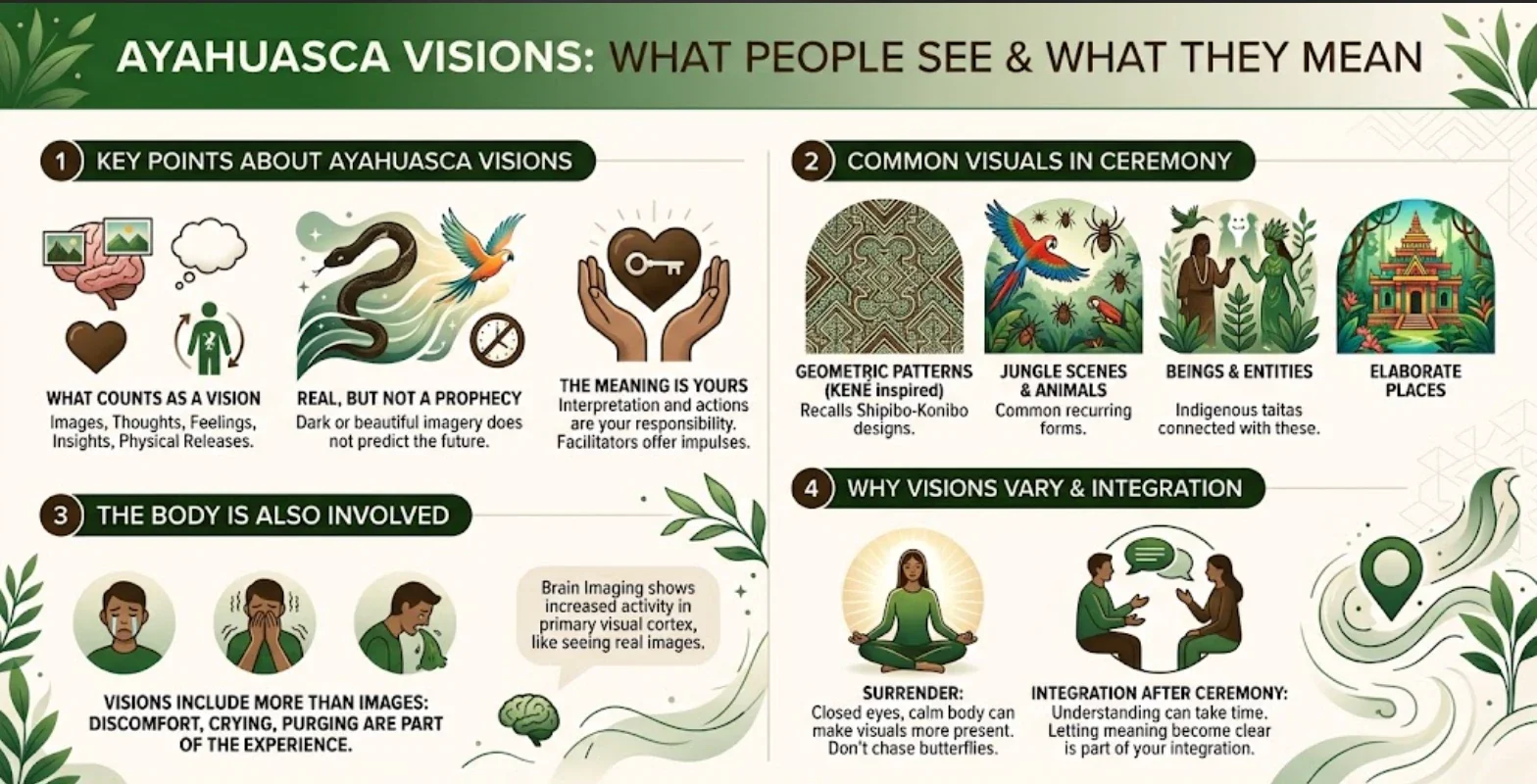
- Visions are more than visuals. What you see is only one part of a vision.
- Not every vision is a prophecy. Visions can show your hopes, desires, and fears, and they do not automatically predict the future.
- The meaning is yours. A facilitator can give a perspective, but interpreting your vision is your responsibility.
Looking to attend a Ceremony? Book a free 30-minute phone call.
Common Themes of Ayahuasca Visions
These are themes people commonly report, and Benny Shanon documented many recurring forms in The Antipodes of the Mind.[2] No image is guaranteed.
- Kaleidoscopes and fractals. People describe geometric patterns and colours moving or changing.
- Ancestral imagery. People sometimes describe ancestors, family members, or older generations appearing.
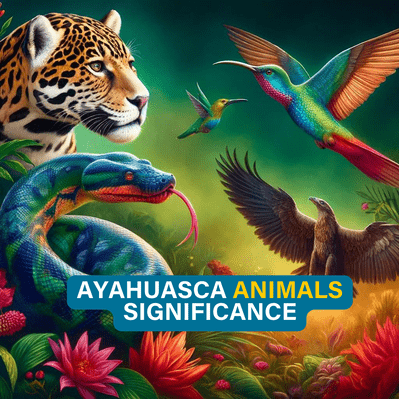
- Animals. Our guide explores what animals in ayahuasca visions can mean.
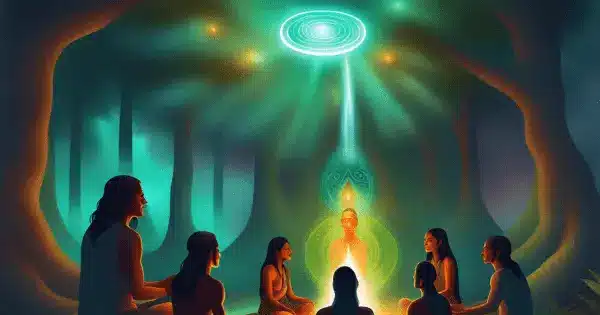
- The spirit world. Some people describe entering a spirit world, meeting beings or entities, or feeling the presence of plant spirits.
- Your hopes and desires. A scene may bring forward something you want or hope for.
- Your fears. Frightening or uncomfortable material can take a visual form.
- Symbols such as eyes, a heart, or doors. Their meaning is personal, and Mistake 3 looks at how to work with them.
For Indigenous taitas and shamans, connecting with the spirit world and plant spirits was the original reason to drink ayahuasca. These experiences cannot be forced. I go further into this in ayahuasca and the spirit world.
What matters is less the theme than what it means to you.
Ayahuasca Visuals: What People See During Ceremony
Ayahuasca visuals look different for everybody, and a few personal stories from our ceremonies show how varied they can be.
I mostly see fractals and kaleidoscopes myself. Sometimes I have fuller visions, but they are less frequent for me.
One of my clearer visions came while I was rebranding our retreat. Our previous name was Guacamayo. I saw the guacamayo bird flying, then burning, and finally disappearing. I understood it as a sign of renewal and felt that changing the name to Harmonica was the right path.
I remember a recent participant who felt insects moving in the ground. He connected the movement with his grandmother, who lived on another continent. For him, it meant that she might not have much time left and that he should visit her.
That meaning came from him. Another person could read the same insects completely differently.
Another participant was very afraid of spiders and saw many spiders during her journey. She later said the experience helped her overcome that fear.
This is why I do not give people a fixed dictionary of symbols.
The Shipibo-Konibo people of the Peruvian Amazon make geometric designs called kené. Women paint and embroider them on textiles and ceramics, and men carve them into wood. Many people who drink ayahuasca describe geometric patterns that remind them of kené. According to Peru's Ministry of Culture, the Shipibo-Konibo consider plants such as rao and ayahuasca necessary for seeing and making these designs. Peru declared kené Cultural Heritage of the Nation in 2008.
Some researchers argue that the designs are older than the Shipibo’s use of ayahuasca, so kené is not simply a copy of visions. Our own ceremonies follow the Kamsá Biyá tradition of Colombia, not the Shipibo one.
The paintings in Luis Eduardo Luna and Pablo Amaringo’s Ayahuasca Visions show how detailed these scenes can become.[3] The book also appears in our guide to books about ayahuasca.
If you want to talk through your expectations or concerns before ceremony, you can book a free 30-minute consultation.
Mistake 1: Thinking Ayahuasca Visions Are Only Visual
Many people arrive expecting a vision to be a picture.
The visual image is only one form an ayahuasca vision can take. Sergio has more than 16 years of experience as a yagecero, and this is something he always reminds us of.
I think a lot of people reduce ayahuasca to the visuals. Somebody might see no elaborate scenes and spend the night feeling grief that has been held back for years. Somebody else may recognize a harmful thought pattern without seeing any image connected to it.
The body can be involved too. There may be discomfort, crying, shaking, or purging. All of this can be part of the experience. So the visions are secondary. Ayahuasca is a holistic medicine, and it is a lot more encompassing than what you see with your eyes open or closed.
In Spanish, we call the visions pintas. In the Santo Daime tradition in Brazil, they are called mirações. Different traditions use different words, but the visual stories receive so much attention that people sometimes miss everything happening around them.
One of the things we always stress is that ayahuasca is not a recreational activity. You are not there to collect beautiful images and compare them with the person sitting beside you. Our guide to what to expect in an ayahuasca ceremony explains more about the whole night.
When No Visuals Come
When people see little or nothing, the disappointment usually comes from the expectation that ceremony needs to look like somebody else’s story.
I remember a woman coming to drink a second cup after seeing many fractals and kaleidoscopes. She told Sergio that the insights were not coming. Sergio laughed a little and said that the insights can come afterwards as well.
And this happens. You might understand part of the ceremony the next morning. Another part might become clear much later, when something in your daily life brings it back.
I think people can become so focused on seeing something that they stop noticing what is already developing. Maybe grief is coming up. Maybe the body is releasing.
If ayahuasca feels like it gave you nothing, read our guide about when ayahuasca feels like it did not work.
Mistake 2: Treating Every Vision as a Prophecy
I think it is important to say that not every ayahuasca vision is a prophecy, and not everything you see is necessarily true. Visions can also show your hopes and desires.
We do not like to use the word hallucination. A hallucination is something random, disconnected from reality. With ayahuasca, you are in an extraordinary state of consciousness, and you start to become aware of things that are there but that you do not notice in a normal state.
Ayahuasca may also show your fears, worries, doubts, or darker material that you have carried into the ceremony.
Maybe you watched disturbing content, and your mind is now bringing those images back while you purge. A frightening scene does not mean your life is doomed.
This can become tricky when somebody leaves ceremony and says, “Ayahuasca showed me this will happen.” Maybe the vision carries something useful. Maybe a fear that was already there became louder.
I have heard from people who later recognized a vision as a warning when a related situation appeared in their lives. I keep those stories vague because the details are vulnerable.
In the end, you decide how you understand it and what you do afterwards.
Mistake 3: Letting Someone Else Decide What It Means
After ceremony, it can be tempting to find somebody who sounds certain and ask them to decode everything for you. That certainty may feel comforting when the vision was intense or confusing.
Interpreting a vision remains the responsibility of the person who experienced it. The facilitators can give certain impulses, but in the end, it is always up to you.
Somebody may say, “Hey, I saw many eyes during my ceremony.” A facilitator might ask whether the person feels observed or judged in daily life. That may fit, or the eyes may mean that the person needs to pay more attention.
A heart gives another example. One person may associate a heart with love. For somebody whose father died from a heart attack, the same image can carry a completely different meaning.
I would also be careful about sharing every vision with your friends. Each person adds an interpretation, a fear, or an idea about what you should do. It can dilute your own inner knowing.
In this video, I talk about how to understand your own ayahuasca vision and what it really means.
Dark Visions and Support in the Room
Dark visions can bring up fears, painful thought patterns, and parts of yourself that you would prefer to avoid.
Sergio says that through the darkness we encounter the light within. Sometimes we need to see our own nonsense, our bobadas, before we become willing to change it.
Ayahuasca can also place somebody in a loop. The person experiences the same pain or negative thought again and again, sometimes in an exaggerated form. Purging or vomiting can often help in those moments.
Later, a person may notice the same thought pattern beginning in daily life. The ceremony comes back to them, and they remember where that pattern led when it was allowed to run without interruption.
In a way, ceremonies in the Kamsá Biyá tradition of the Putumayo are a lot about fortifying and strengthening one’s spirit. Life is difficult, ceremonies can be difficult too, and they prepare the person to have the strength to meet difficulties in life.
Our guide to getting through a difficult ayahuasca experience gives more preparation for these moments.
How You Are Supported During a Frightening Vision
The support you receive depends on how you are handling the experience. Two people may see equally disturbing images and need completely different help.
Some people stay calm and can observe the difficult moment while remaining centred. In that situation, there may be nothing to do. We stay present and allow the medicine to follow its natural course.
Another person may become frightened, move intensely, or become very disharmonised. Sergio and the team may then work with the waira, the soplo, tobacco, sahumerio, or ortiga, depending on the person and the intensity.
The waira is a bundle of leaves used to move energy like wind, sahumerio is cleansing smoke, and ortiga is stinging nettle. These are ways of harmonising the ceremony within this tradition.
I remember a participant saying, “I feel like ayahuasca hates me.” I asked, “Are you sure ayahuasca hates you, or is it showing you where you carry self-hatred?”
When somebody says that ayahuasca dislikes them, I sometimes replace “ayahuasca” with “I” in my mind. In a way, projecting the pain onto the medicine is easier than looking at the deeper part of yourself that carries it.
What Makes Ayahuasca Visuals More or Less Likely
Closed eyes, a calm body, and a relaxed mind can make visuals more present. I notice this especially later in ceremony, when there is less conscious thinking and I am no longer trying to create an outcome.
Opening my eyes often brings me back to the ceremonial room, and the intensity goes down. At other times, the imagery continues regardless of whether my eyes are open or closed.
Trying to force visions can have the opposite effect. I feel like ayahuasca can hide the visions to show you that the ceremony is not about getting what you expected.
I like to compare it with chasing a butterfly. Don’t chase the butterflies. Chasing them only creates tension.
So do your best and forget the rest. Full surrender sounds easy before you drink, but ayahuasca may bring you directly to the place where you cannot surrender. That internal battle is also part of learning to let go.
What we see is that preparation can also affect the depth of the experience. Eating fewer processed foods is one part of the ayahuasca diet.
We also work with Azuvactoto, a strong plant purgative from the Putumayo that cleans the body before ceremony. Our guide explains more about purgatives used before ayahuasca. A cleaner body may make visions more likely. And again, those visions can be very revealing, very interesting, very fascinating, and they are still a secondary part of ayahuasca.
What Brain Imaging Shows With Closed Eyes
A small brain-imaging study found increased activity connected with mental imagery after ayahuasca. The 2012 Human Brain Mapping study used functional magnetic resonance imaging (fMRI) with nine participants who already had experience with ayahuasca.[1]
With their eyes closed, activity in the primary visual cortex during mental imagery rose to levels comparable with seeing real images. The activity also followed how strongly participants rated the changes in what they saw.
That fits what I notice in my own ceremonies when my eyes are closed. You can read more about how ayahuasca affects the brain in our separate guide.
Working With a Vision After Ceremony
At our retreat near Medellín, participants have a sharing and integration space with the facilitators. Preparation and integration activities also run around the ceremony. Past participants can use our online course and join free monthly integration calls.
Understanding can take time. Somebody contacted me about two years after a ceremony and said that part of the symbolism finally made sense. I do not remember the exact symbol, but I remember that it took two years.
Letting the meaning become clear through your own life, rather than through somebody else’s theory, is part of your ayahuasca integration, and it is also your homework.
FAQs
Are ayahuasca visions hallucinations?
No. A hallucination is something random and disconnected from reality. With ayahuasca, you are in an extraordinary state of consciousness and become aware of things that are there but go unnoticed in a normal state. In Spanish these visions are called pintas, and in Brazil's Santo Daime tradition they are called mirações. If you are curious how this compares with DMT, read our guide to ayahuasca vs DMT.
What do ayahuasca visions look like?
Ayahuasca visions may include geometric patterns, fractals, kaleidoscopes, jungle scenes, animals, beings, or elaborate places. Some people see complete scenes, while others notice colours, movement, or brief images.
Are ayahuasca visions real?
Ayahuasca visions are real experiences for the person having them, but they are not automatically prophecies or literal facts. A vision may express a fear, worry, memory, or personal association. You decide how much meaning to give the vision. You are also responsible for any action you take afterwards.
Why didn't I have visions on ayahuasca?
Some people have few or no visual experiences during ayahuasca. The ceremony may involve emotions, bodily releases, thought patterns, or insights that become clearer later. Expectations can create disappointment. No visuals does not automatically mean nothing happened.
Can you control ayahuasca visions?
You cannot reliably control ayahuasca visions. Closing your eyes, relaxing, and becoming calmer may make them more present, while trying to force them can create tension. Even the struggle to surrender can become part of the ceremony.
What is an ayahuasca experience like?
An ayahuasca experience may include imagery, emotional material, altered thinking, physical discomfort, purging, music, and quiet periods. The experience varies between people and between ceremonies. Preparation, ceremonial support, and ayahuasca integration help you work with what arises.
How is ayahuasca used spiritually?
Ayahuasca is used within different ceremonial traditions for singing, inner reflection, and strengthening the spirit. At Harmonica, ceremonies follow the Kamsá Biyá tradition of the Putumayo. The ceremony may bring difficult and supportive experiences. Afterwards, the responsibility returns to you through integration and the choices you make in daily life.