The Plant at a Glance
| Ortiga | |
|---|---|
Botanical family | Urticaceae, the nettle family |
Also called | Ortiga brava, pringamosa, ishanga, chichicaste |
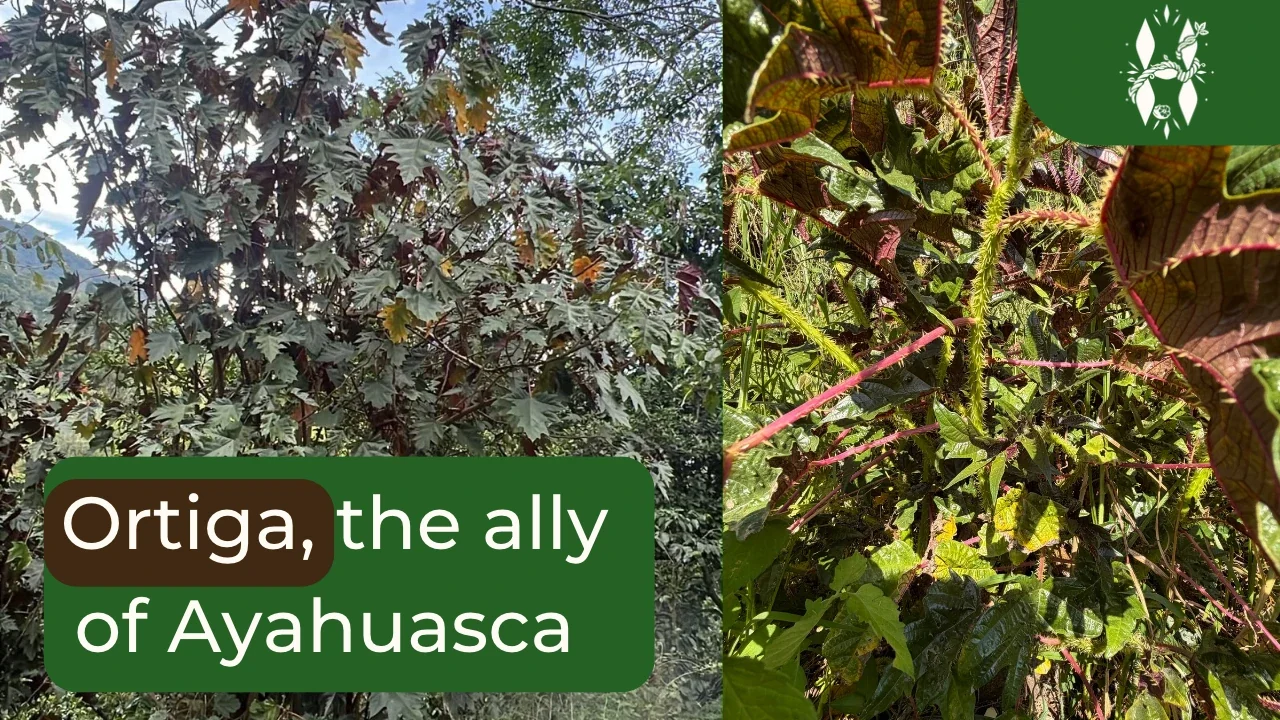
Looks like | Large green leaves with purple backs and a spiny stem |
Grows | Moist tropical forest, often near streams |
Used for in ceremony | Physical awareness, circulation, and energetic cleansing |
How it is applied | Light strokes from the ceremonial team |
How it feels | Sharp normally, settling during strong ayahuasca |
The ortiga plant we use belongs to the genus Urera. It is from the same group as Urera baccifera, but we do not claim that our plant is this exact species.
Urera baccifera is a shrub or small tree in the nettle family. It can grow up to five metres tall, with toothed leaves up to 25 centimetres long. Spines and stinging hairs cover the plant.
When you first see it, with the purple backs of the leaves and all the spikes on the stem, I would say it looks pretty crazy.
Stinging Nettles in Many Cultures
Stinging nettles have been part of daily life in many cultures for a very long time, and people have found many different uses for them. The European stinging nettle (Urtica dioica) has a long history as traditional medicine, food, tea, and fibre for cloth, from ancient societies such as the Saxons through to modern use. Nettle is one of the nine plants named in the Anglo-Saxon Nine Herbs Charm, recorded in the 10th century.
This relationship goes back even further. Cloth woven from nettle fibre was found in Bronze Age graves in Denmark and dated to around 3,000 years ago. In a 2000 paper, Randall and colleagues noted many published references to people deliberately stinging themselves with nettles for arthritis pain.
Those uses are very different from one another, obviously, but I think that is part of what makes these plants so interesting. People have eaten nettle, brewed it, woven it, named it in an old charm, and sought out the sting itself. In a modern example, the Czech fighter Jiří Procházka, a former UFC light heavyweight champion, shared a video of himself walking shirtless straight into a patch of stinging nettles.
The plant we are talking about here is one specific Amazonian ortiga used in the indigenous tradition. It belongs to Urera, a different genus from the European Urtica, and it looks very different from the garden nettle many readers know.
In a way, the history of European nettle gives some context for the power that people in different cultures have recognized in these plants. Its role during strong ayahuasca comes from the indigenous tradition around that specific plant.
How We Use It During Strong Ayahuasca
Again, there are two different ceremonial uses, and the first one is when someone is very strong on the ayahuasca.
“Ortiga is a powerful plant used within the ceremonial context of the Yagé traditions in the Putumayo. It is very effective when people feel the ayahuasca strongly, to help ground them.”
 Sergio HenaoYagecero at Harmonica Retreat
I learned to work with the plant from Sergio Henao, a yagecero with more than 16 years of experience. For me personally, I feel like ortiga is the best, the safest and the most consistent tool to get people back when they are very strong on the ayahuasca.
Sometimes a person begins losing motor function. Their body may shake uncontrollably or move suddenly through the joints. We might bring in the ortiga when we see these movements.
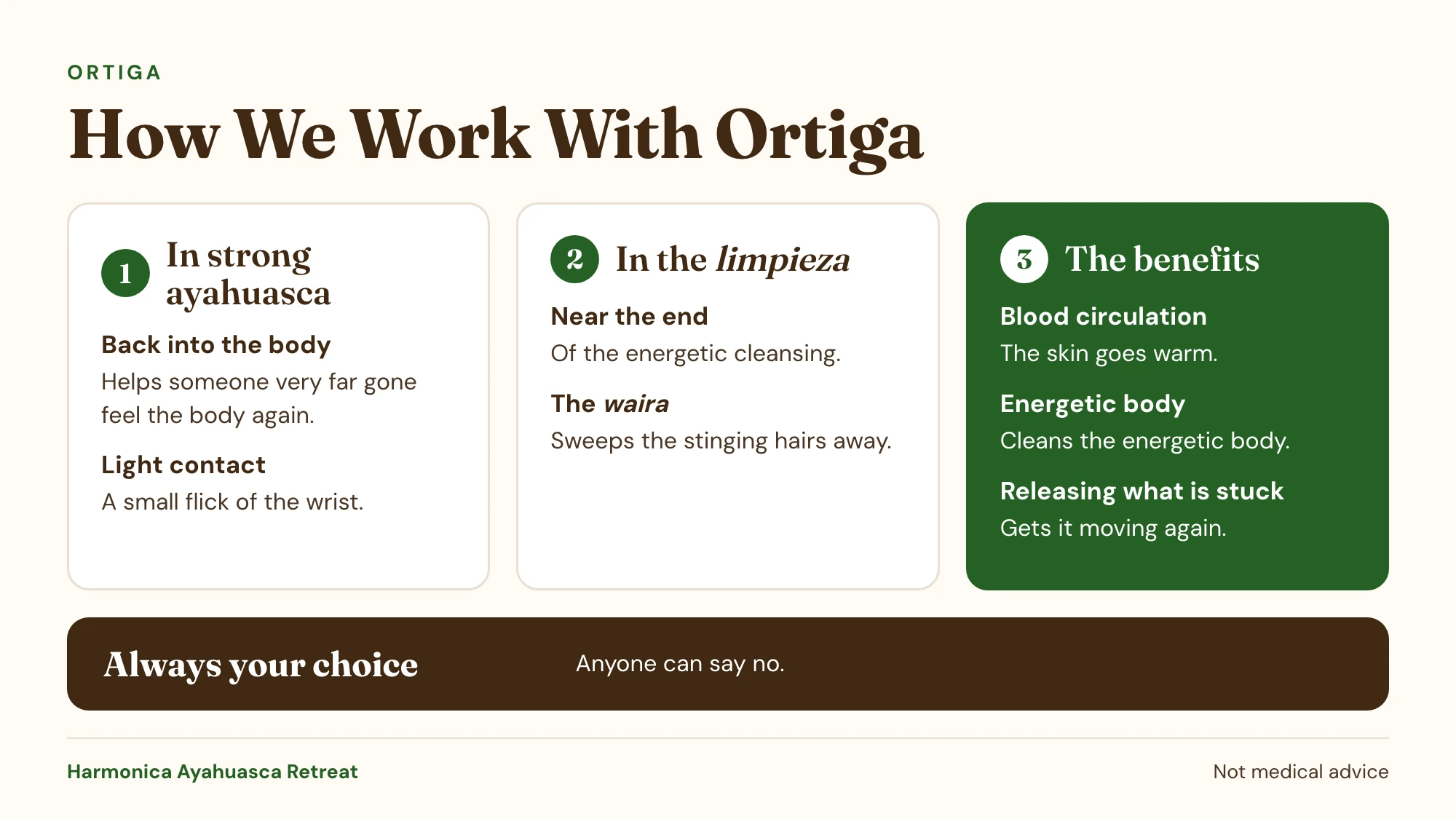
The application uses light contact with the skin. It is less about hitting and more about a small flick of the wrist. In a way, the fresh sensory impression helps the person feel the body again.
When you are very strong on the ayahuasca, the ortiga can feel very soothing.
When someone is very far gone, we may use the plant on the soles of the feet. The feet are very sensitive.
One woman later told us that she had been floating through the universe. All of a sudden she thought, “Oh my, the bottom of my feet are stinging. What is happening here?” And that slowly got her back.
Our guides explain how we support someone through a difficult ceremony and what happens in an ayahuasca ceremony.
Its Role at the End of a Limpieza
A limpieza is an individual energetic cleansing, and ortiga is usually applied near the end.
We do not apply it automatically to everybody. Anyone who wants to receive it can ask, and somebody who does not want it can say no.
After the application, we use the waira to sweep the stinging hairs away. The waira is a fan of leaves used during energetic cleansings.
What Ortiga Does for the Body and Energetic Body
Blood Circulation
After the ortiga, the skin becomes warm, and honestly, you can feel that warmth where the plant touched you. In the tradition, it is used to improve circulation and blood flow in the body.
Cleansing the Energetic Body
At the end of a limpieza, I feel like the plant is really good to clean the energetic body.
Releasing What Feels Stuck
What we also say is that if something is stuck in the body, you also need a powerful plant to help release it, and I think ortiga is one of them. In a way, it loosens what is stuck and gets it moving again.
And also, the indigenous communities in the region use the plant a lot, and people in the tradition also use it around aches in muscles and joints. The research section below explains what small studies on European nettle have found about joint pain.
How It Feels With and Without Ayahuasca
When somebody is deep in the ayahuasca, the sensation can arrive almost like relief. Obviously, without ayahuasca, my reaction is closer to, “Ooh, it stings.”
The plant may leave visible marks on the skin. In our experience, those marks are usually gone by the next day.
My skin is sensitive to different conditions right now, so I have a little bit of a love-hate relationship with ortiga. But also, I acknowledge that it is a very powerful plant, a great plant.
What Research Says About Nettle Use
Research on nettle and joint pain is small and mixed. The published trials concern European nettle, Urtica dioica, rather than ceremonial Urera.
A 2000 double-blind crossover trial included 27 people with osteoarthritis pain at the base of the thumb or index finger. Participants applied European stinging nettle each day for one week. Pain and disability scores fell more with the nettle than with a non-stinging placebo leaf.
A 2008 feasibility study involved 42 people aged 55 to 80 who had knee pain. Participants used either European nettle or a placebo plant for one week. The study found no clear difference in pain between the two groups.
These studies examined another nettle genus in a different setting. Neither looked at ortiga in ceremony.
I watched a TikTok from a woman who said she had taken ayahuasca in Ecuador. She said a shaman had used ortiga around the arthritis in her knees. Her account is a personal story and does not show that ortiga treats arthritis.
There is no peer-reviewed study of ceremonial ortiga that we know of. The uses described on this page come from the tradition and from our direct work with the plant.
Safety and When to Decline Ortiga
People with very sensitive skin, dermatitis, open wounds, or a known nettle allergy should tell the ceremonial team. They can decline the plant.
The face and eyes must be kept away from contact.
Do not try to apply the plant to yourself or a friend during or after ayahuasca. Shaking, sudden joint movements, or loss of motor function require attention from people who can observe the entire situation.
At our retreats near Medellín, each retreat is capped at 12 participants. Depending on the group size, 4 to 7 people support the ceremony, and a physician is on the team.
More About the Ortiga Plant
Its Names Across Latin America
The names change across countries and regions. They include ortiga brava, pringamoza, mala mujer, chichicaste, and ishanga. In Colombia, people usually spell the name pringamosa.
People around us also use cobija de los indios and “acupuncture of the jungle.” These are everyday local names for the plant and the physical sensation it creates.
Where the Plant Grows
This Amazonian stinging nettle prefers moist tropical forest. It likes areas near streams with a mixture of sunlight and shade.
The plant is especially common in the Putumayo region, home to Kamsá and Inga peoples. The Kamsá Biyá tradition we follow comes from this region and has a close relationship with yagé in the Putumayo tradition.
I have also seen ortiga in Ecuador. The ceremonial traditions there share many practices with traditions from the Colombian Putumayo.
How the Stinging Hairs Work
The hairs on Urera work like tiny hypodermic syringes. Contact with the skin releases liquid from the hair, creating the nettle sting. This deliberate contact is called urtication.
Researchers found potassium chloride in dried stinging-hair fluid from Urera baccifera. The finding does not tell us the full chemistry of the ceremonial plant. The Amazonian ortiga stings more than a garden nettle.
Where It Fits Among Other Ceremonial Plants
Other plants have their own roles in the tradition. You can read about rapé, the tobacco snuff, how tobacco is used with ayahuasca, and ambil and mambe.
If you are considering ayahuasca and want to ask about ortiga or anything else that may happen in ceremony, bring your questions to our free 30-minute consultation call before deciding.