Where the Andes Meet the Amazon
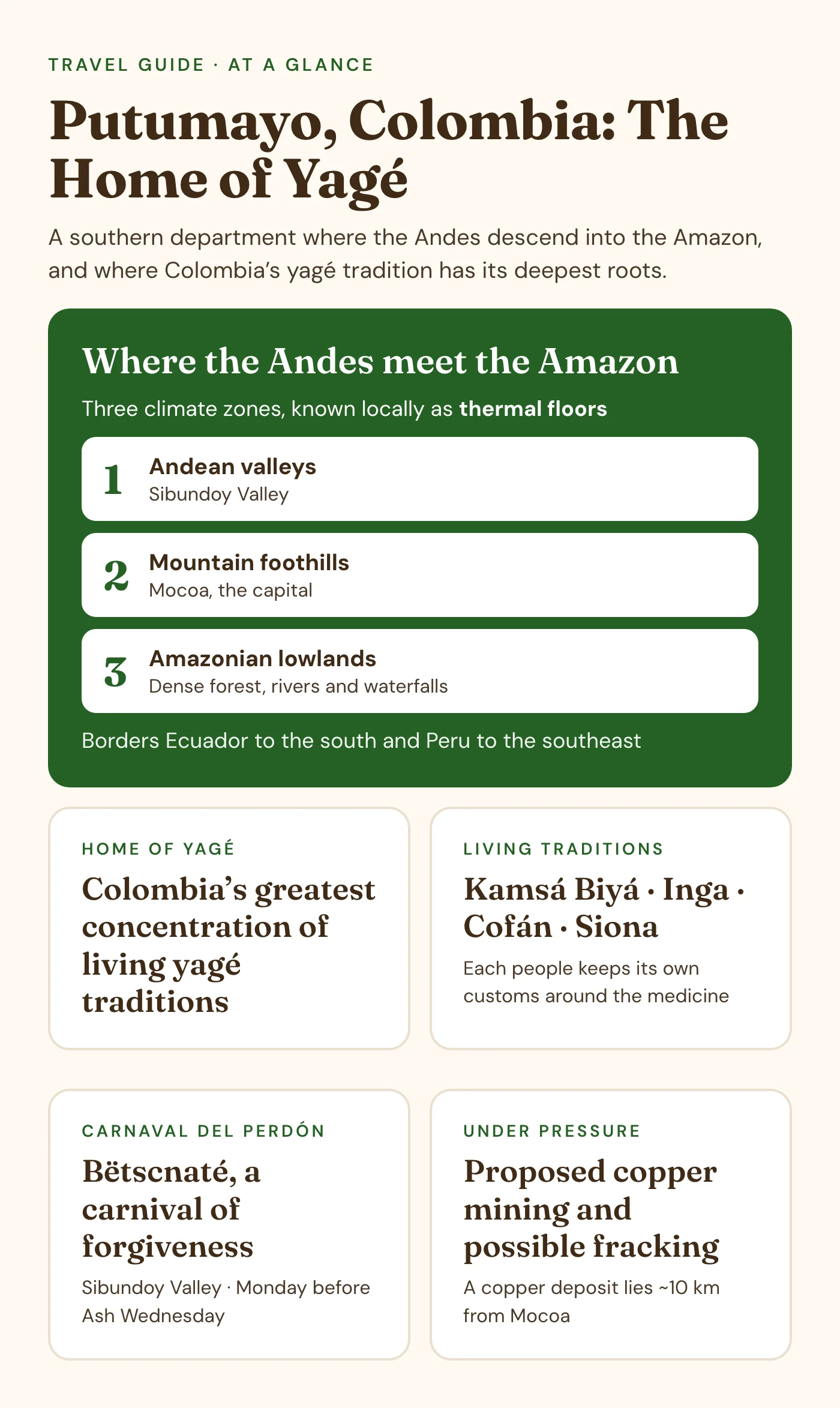
Putumayo lies in southern Colombia, with Ecuador to the south and Peru to the southeast. The Caquetá River marks much of its northeastern boundary.
Most of the department consists of forested lowlands. In the west, the land rises sharply into the Andes, creating three climate zones known locally as thermal floors. This meeting of mountains and Amazonian forest gives the region its rivers, thick jungle and many waterfalls.
Mocoa is the departmental capital. Higher in the Andean part is Sibundoy and the Valle de Sibundoy, an area closely connected with the Kamsá Biyá and Inga peoples.
For me, my first arrival looked very close to how I had imagined the Colombian jungle. There were waterfalls, dense green forest and an abundance of nature everywhere. It was also my first time in Colombia.
Why Putumayo Is the Home of Yagé
Putumayo has the greatest concentration of yagé traditions in Colombia. Ayahuasca is also present around Leticia and elsewhere, but Putumayo holds many communities that have worked with yagé across generations.
The Kamsá Biyá, Inga, Cofán and Siona each have their own customs around the medicine. Some also maintain their own Indigenous languages. There are other peoples in the region as well, and I think it is good to remember that “the Putumayo tradition” is not one identical ceremony repeated everywhere.
My first ceremony in Colombia happened there. The mama there welcomed us with these words.
“Putumayo is at the heart of the world. All humans are welcome here to connect with Mother Nature.”
For me, that was a beautiful entrance into the world of ayahuasca in Colombia.
A taita holds a specific role within these traditions, although the way ceremonies are led varies between peoples and families. Our separate guide explains what yagé is and how it compares with Peruvian ayahuasca without repeating that full comparison here.
What a Yagé Ceremony Feels Like There
Yagé in Putumayo often includes more music and individual energetic work than people expect from Peruvian traditions. Peruvian traditions lean more on silence and the icaros.
Colombian ceremonies also have silence, but there is more music. The music in an ayahuasca ceremony can guide the atmosphere, accompany a cleaning or support somebody during a difficult moment.
What I notice is the attention given to individual energetic cleanings. The taita or ceremony team may work directly with one person through chants, plants and other traditional tools.
The leaf used in Putumayo also appears different from the one used in Peru. People who have seen and drunk both preparations have told me the Colombian leaf feels stronger, and that has also been my experience. I would treat this as a personal and ceremonial observation rather than a fixed rule for every cup.
Some nights are softer and some are very strong, wherever you drink.
Should You Travel to the Putumayo to Drink Yagé?
Going to the Putumayo to drink yagé is obviously great. I think the important part is that you find a reputable place and understand the journey involved. An ayahuasca retreat in Putumayo can bring you close to the living source of the Colombian tradition, but access is less simple than around Medellín.
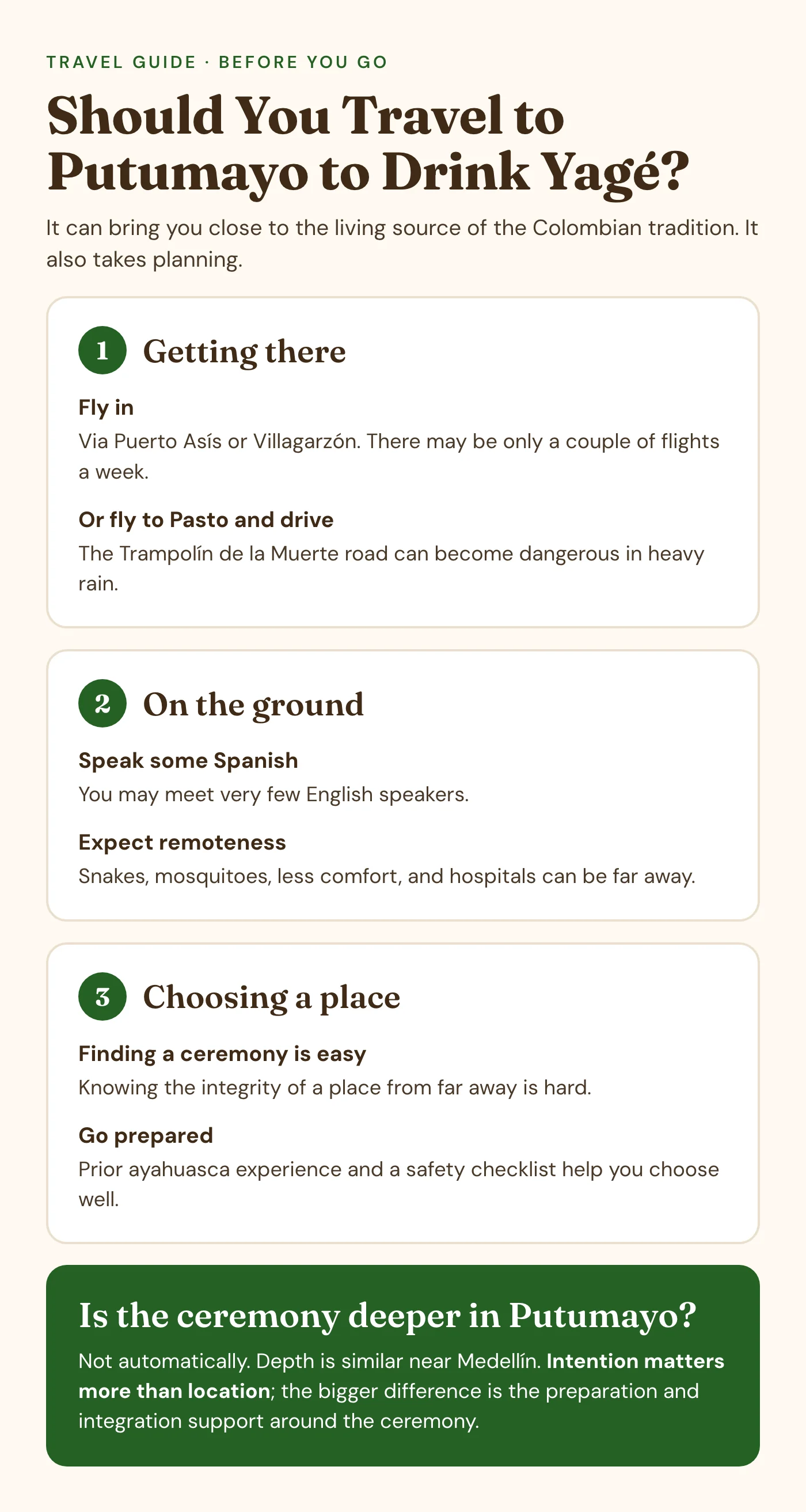
Obviously the travel time is a lot longer. You can travel through Puerto Asís or Villagarzón, and in my experience there may be only a couple of flights during a week. Another route is to fly into Pasto and take the long road known as the Trampolín de la Muerte, which can become dangerous during heavy rain.
I think it is possible to go without knowing where you will drink. Ideally, though, you already have some experience with ayahuasca and a good inner sense of whether a place is the right one for you.
Ayahuasca is very present there, but knowing the integrity and the personal reputation of a place is obviously a lot harder to verify from far away. A safe ayahuasca retreat checklist gives you concrete questions to ask before committing.
I remember one participant who went with a taita to a remote place around a 30-minute walk from the road. The place was nice, but he kept thinking about how far the nearest hospital was. Because that thought stayed with him, he could not go as deeply into the process.
There are also snakes, mosquitoes and much less personal comfort in remote areas. Spanish is highly recommended because you may meet very few English speakers.
Ayahuasca in Mocoa and the rest of the department is very present, so finding a ceremony is not the hard part. Knowing the integrity of the place is.
Does the Depth Change Between Putumayo and Medellín?
A ceremony in Putumayo is not automatically deeper than a ceremony near Medellín. I have had strong and soft experiences in both places.
Travelling a long way may increase your commitment. You are there in the jungle after a difficult journey, and then the inner discussion starts: “Should I drink the second cup or not?” Being so far from home may help you take the opportunity more seriously.
I feel like the depth of the experience is pretty similar in Medellín and in the Putumayo. I think the intention matters more than the location. The larger practical difference is often the preparation and support around the ceremony.
I once saw somebody asking Mama Concha many questions about what to expect in the ceremony. Her response was simple: “Toma la medicina.” Drink the medicine and you will see.
Traditional support can be direct. In a way, the message is: “I share the medicine with you. You have your experience. Now go figure your life out.” The Indigenous facilitators may not discuss personal experiences afterwards or see ongoing aftercare as their responsibility.
I like to say that a software engineer drinking for the first time may suddenly be catapulted into the spirit world. Afterwards, that person may wonder what happened and how any of it connects with daily life.
Understanding the messages of the medicine is always your own responsibility. There’s also a limit to how much responsibility any facilitator can take for somebody’s process. Having someone available for ayahuasca integration after a ceremony can help you work through an overwhelming or confusing experience.
Things to Do in Putumayo
The waterfalls, hot springs and Indigenous cultural events give you plenty to visit outside ceremony. Around Mocoa, several places can be reached through short drives followed by walks.
- Fin del Mundo waterfall: The entrance area is about six kilometres from Mocoa. Reaching the falls involves a walk of around an hour and a half along a moderately demanding stone trail.
- Hornoyaco: This 55-metre waterfall falls in two veils near the Mocoa to Villagarzón road. The walk takes around an hour.
- Centro Experimental Amazónico: About eight kilometres from Mocoa, this centre receives wild animals seized from illegal trafficking. The animals receive veterinary care and may be rehabilitated or released.
- Mocoa market: I recommend visiting the market while you are in the capital.
- Termales de Colón: These hot pools sit around 20 minutes from Sibundoy, with pools from 38 to 45°C.
Bëtscnaté, also called the Carnaval del Perdón, takes place in the Sibundoy Valley on the Monday before Ash Wednesday. Its date changes each year and usually falls in February. Forgiveness begins within families and then extends across the community.
Extraction Pressure Around Mocoa
Putumayo is facing pressure from possible fracking and a proposed copper project. The department already has an oil economy, with crude transported from Puerto Asís across the Andes toward Tumaco on the Pacific coast.
In his inauguration address on 7 August 2026, President Abelardo de la Espriella committed to authorising fracking in Colombia. No decree authorising fracking had been signed by late August 2026. The Caguán-Putumayo basin has been named as one of the Colombian basins with fracking potential.
A large copper-molybdenum deposit lies about 10 kilometres from Mocoa, near the Inga resguardo of Condagua. The deposit is estimated at around one billion tonnes and has been modelled as a large open-pit operation. Copper Giant, previously called Libero Copper, is studying the project.
Colombia’s Consejo de Estado annulled Mocoa’s municipal mining ban on 31 July 2024. That ruling removed a local barrier, although it did not approve construction of a mine.
Across the border in Ecuador, the Mirador open-pit copper mine has raised concerns about water contamination, acid mine drainage and the safety of its tailings dam. Human rights groups also report that more than 30 Shuar families were forcibly evicted.
For me, this subject is very present around Putumayo right now. People speak about the richness of the Amazon and connection with Mother Nature, and also about the extraction of resources and its impact on the environment. Our guide to the sustainability of ayahuasca in Colombia looks more closely at responsibility around the plants and the places they come from.
What We Carry into Our Ceremonies Near Medellín
Our ceremonies near Medellín follow the Kamsá Biyá tradition of the Putumayo. Sergio Henao is a yagecero with more than 16 years of experience, and the ceremony keeps the traditional structure, prayers, chants and harmonica.
I feel like it very much keeps the essence of the ceremony. The attentiveness also carries over. We observe when somebody may need support and use the traditional forms of harmonisation we have learned. These include tobacco, soplo, saumerio, ortiga, songs, chants and energetic cleanings.
Our guide to tobacco in ayahuasca ceremonies explains its ceremonial role. Azuvactoto is a purgative from the Kamsá Biyá tradition, and you can read more about Azuvactoto and other ayahuasca purgatives.
We have also adapted parts of the setting over time. What I notice is that for a lot of participants, silence and as few interruptions as possible are very important. In some public Colombian ceremonies, somebody may call across the room and request a song as casually as they would at a gathering.
We keep groups to a maximum of 12 participants. Everyone keeps their own chair, so you do not return from the bathroom and find that somebody else has sat on your chair. Depending on group size, four to seven people support the ceremony, and a physician is on the team.
I’m not saying one is righter than the other. We found that small groups, familiar faces and preparation before the ceremony work well in our setting. Integration activities continue afterwards through an online course and free monthly calls for past participants.
If you want to ask about the Kamsá Biyá tradition, travelling in Colombia or whether a retreat near Medellín fits you, the next step is a free 30-minute consultation call.