Ayahuasca and Tobacco in Our Ceremony
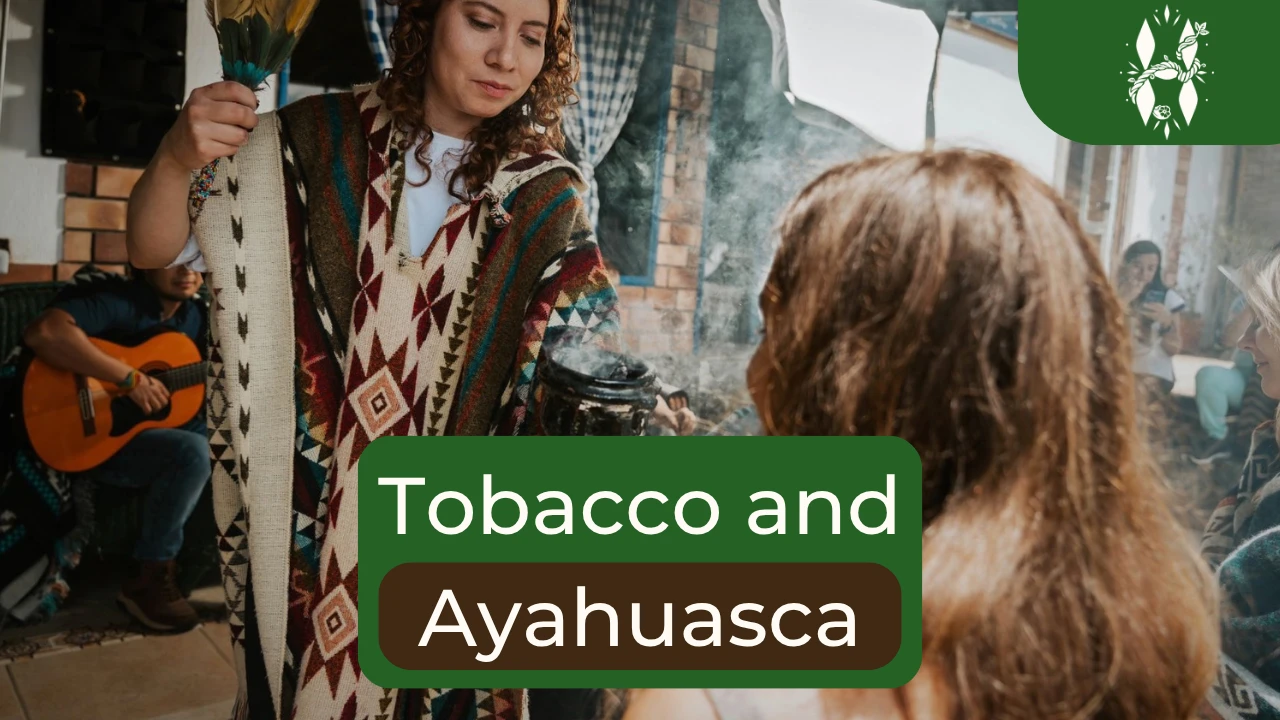
Tobacco first enters our ceremony before we share the ayahuasca. We pray to the medicine, sing certain chants, and I play the harmonica. I then smoke tobacco and blow the smoke over the medicine.
While I do this, I ask for protection. I think about each participant, send them good energy, and consider whether our team needs to keep anything in mind for that person.
I ask for the medicine to be powerful and deep, but I also ask it to be calm.
The evening then continues with the medicine, music, and individual support. Our guide to what to expect in an ayahuasca ceremony explains how the wider evening develops. We also have a separate guide about the role of the ayahuasca shaman and the responsibility that comes with holding that space.
This work comes from the Colombian Kamsá Biyá tradition of the Putumayo. Our guide to yagé in the Colombian tradition explains more about that background. Mapacho has a more specific significance in Peruvian traditions, while our tradition works with tobacco more broadly.
What Is Mapacho?
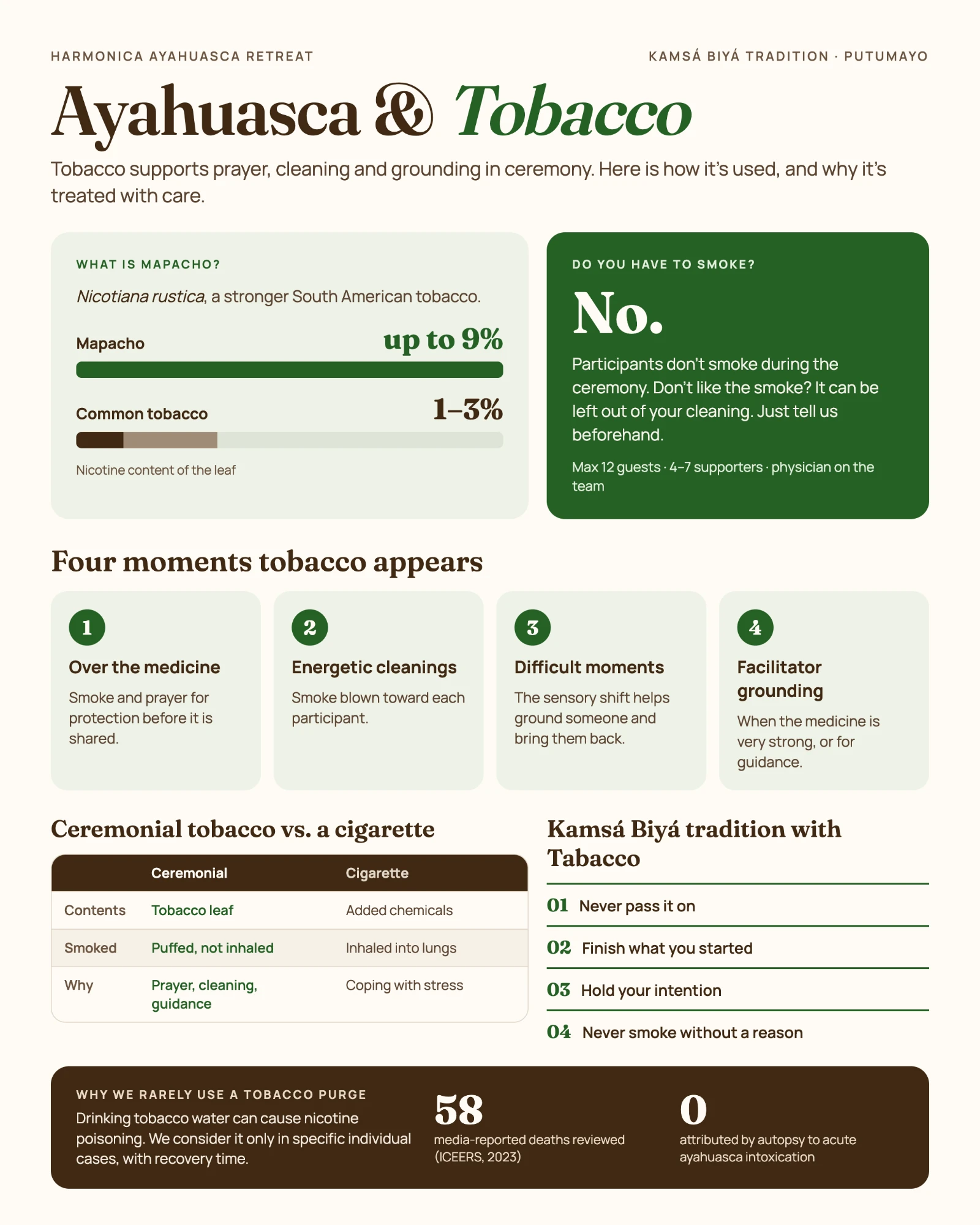
Mapacho is a South American name for Nicotiana rustica, a rainforest plant native to South America. In Peru, people may smoke it in pipes or drink it as a juice, and South American shamans often use it in ceremonial work.
The phrase mapacho tobacco refers to this species. Compared with common tobacco, Nicotiana tabacum, N. rustica carries several times the nicotine.
When people compare mapacho vs tobacco, they are usually comparing Nicotiana rustica with common tobacco. Mapacho already belongs to the wider tobacco family.
A lot of Indigenous traditions work with tobacco, and they work with it in different ways.
| Ceremonial tobacco / mapacho | A cigarette | |
|---|---|---|
What it is | Tobacco leaf; mapacho is N. rustica | A commercial cigarette |
What’s in it | Tobacco leaf | Tobacco with added chemicals |
How it’s smoked | Puffed without inhaling into the lungs | Smoke inhaled into the lungs |
When | At specific ceremonial moments | Often during stress, frustration, or anxiety |
With what intention | Prayer, cleaning, grounding, or guidance | Often used as a coping mechanism |
Shared or not | Not shared in Kamsá Biyá practice | Not part of a ceremony |
People sometimes use the term sacred tobacco for this ceremonial relationship. The term describes how the tobacco is approached through prayer, concentration, and responsibility.
“Tobacco is considered a grandfather energy, giving protection, clarity, order and guidance in the ceremony and in the process with the ayahuasca.”
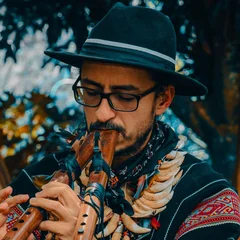 Sergio HenaoYagecero at Harmonica Retreat, with 16+ years of experience
How We Use Tobacco at Harmonica
Tobacco plays a big role in our ceremonies, and it shows up at different moments of the night.
- Before sharing the medicine, I blow tobacco smoke over the ayahuasca and pray for the group.
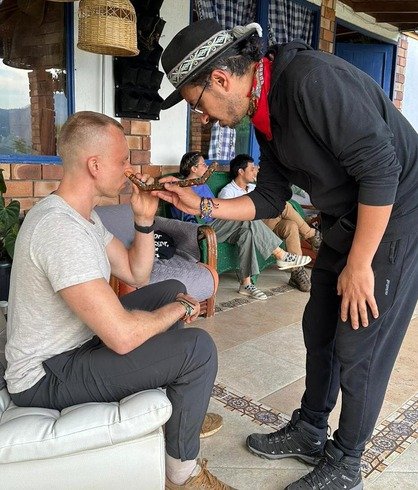
- During individual energetic cleanings, we blow tobacco smoke toward each participant. Within the tradition, we use this as part of cleaning and preparing the person.
- During a difficult moment, I watch for someone becoming very afraid, moving involuntarily, or no longer responding coherently. I sometimes use the word “deharmonized” for this state, meaning that the person appears disoriented and disconnected from the ceremony around them. In those moments, we blow tobacco smoke toward them.
- In my own process, I may smoke tobacco when the ayahuasca becomes very strong and I need grounding. I may also use it while asking for guidance or clarity around a personal subject.
Tobacco can also change the sensory impressions of somebody who is struggling. In a way, the smoke helps ground them and bring them back.
I’ve seen people in very difficult moments do much better after we blew tobacco smoke toward them.
Tobacco is one part of the support we use. Our guide to getting through a difficult ayahuasca ceremony explains the wider process of asking for help and working with the people holding space.
Do You Have to Smoke Tobacco?
You do not have to smoke tobacco during an ayahuasca retreat.
Before ceremony, we explain the different ways we may support you. Tobacco smoke is one of those ways. Sometimes someone tells us, “I don’t like the smoke,” and we can leave it out of that person’s energetic cleaning.
A very difficult moment can be different. Someone may dislike the smoke while also responding well to the sudden sensory change.
I know from my own experience that when ayahuasca becomes very strong, you may lose track of what you need and even what you want. You may also be unable to tell what will help you in that moment.
Discussing these forms of support beforehand tells you how the team may respond if you become very afraid or stop answering coherently. What we tell people is that in those moments, you need to trust that we know what helps.
Our ceremonies are capped at 12 participants. Depending on the group size, 4 to 7 people support the group inside the ceremony, and a physician is on the team. If smoke is a concern for you, bring it up before the ceremony so we can speak about your situation directly.
How to Use Tobacco in a Ceremonial Context with the Kamsá Biyá Tradition
The Kamsá Biyá tradition has clear rules for whoever smokes tobacco in ceremonial work. It is treated as a medicine with an intention.
- The person smoking it does not pass it to anyone else.
- You finish the tobacco you started.
- You maintain your concentration on your intention while smoking.
- You ask for guidance or clarity instead of smoking without a reason.
I always tell people that this is not a recreational activity. When you smoke for guidance or clarity, certain insights or ideas may start developing.
For me, it is always with an intention and always for a reason. I have used it countless times, in many different situations.
One example from my own life: when I was thinking about buying the land where I later built our retreat centre, I smoked a tobacco in ceremony with that question as my intention. Should I do it or not, and if I do, what should the conditions be? For me personally, it was a very big decision, and the tobacco helped bring clarity to my thoughts.
Ceremonial Tobacco and Cigarette Habits
I think there are some key differences between ceremonial tobacco and smoking cigarettes during stress, frustration, or anxiety. A cigarette has many other chemicals added to it, and the smoke is usually inhaled into the lungs. In ceremony, the tobacco is puffed rather than inhaled in that way.
There is also an Indigenous teaching that addiction grew when people removed intention from their relationship with these medicines. Within that teaching, tobacco increases the potency of the thoughts held while smoking.
If somebody reaches for a cigarette whenever anxiety appears, the tobacco may amplify those anxious thoughts. The person feels anxious, smokes, and gives even more attention to the same inner conversation. Ceremonial intention does not remove nicotine or the risk of dependence.
Why We Rarely Use a Tobacco Purge
A tobacco purge involves cooking tobacco in water and drinking the liquid to provoke a strong purge. In the practice I know, people drink around three liters of the preparation.
I have done the tobacco purge myself several times. It is an intense practice, and we do not routinely offer it during our retreats.
I think you need to take into consideration who is coming to these traditions today. Many Indigenous practitioners are in good physical condition, live close to the jungle, and come from communities with an ancestral relationship to these medicines.
Our guests come from all over the world. They also arrive with different health conditions and very different relationships with purging, tobacco, and ayahuasca.
A traditional practice can be unsuitable for a particular guest. Tobacco water can be dangerous when it is used too close to an ayahuasca ceremony or when the person cannot recover properly afterwards.
When I read media reports of deaths linked to ayahuasca, a tobacco purge keeps coming up. One documented case involved Matthew Dawson, a 24-year-old New Zealander who died at a centre in the Iquitos region in September 2015.
Early reports blamed ayahuasca. Later reporting stated that he died following a tobacco purge. Nicotine poisoning from tobacco water can cause organ failure and, in some cases, death.
A 2023 ICEERS report examined 58 deaths linked to ayahuasca in worldwide media reports. No autopsy attributed any of those deaths to acute ayahuasca intoxication. The report also found that the majority could have been prevented through minimum safety standards.
There are rare situations in which we may consider additional preparation. During our calls, we may speak with someone who is carrying many difficult experiences and ask them to arrive one or two days earlier.
That extra time can include additional practices or purges to prepare the person’s mind, body, and spirit before ayahuasca. A tobacco purge is considered only in specific individual situations, with recovery time before the ceremony.
Our guide to ayahuasca, purging, and purgative practices explains the wider place of purging. We also discuss the reported deaths in our guide to whether you can die from ayahuasca.
Rapé and Ayahuasca
Rapé is a snuff made with tobacco mixed with other plants. For me, rapé is a great medicine.
Before an ayahuasca ceremony, rapé can help someone feel grounded. During a ceremony, it can activate the ayahuasca, calm its effects, or make the effects develop faster. The response depends on the person and the moment they are in.
The person serving needs to know what they are doing with both medicines.
Our separate guide explains what rapé is and how it is used in more depth.
Smoking Cigarettes Before a Retreat
Smoking before ayahuasca is something I would discuss during preparation, especially when cigarettes are one of your main coping mechanisms. What I usually tell people is to set aside their coping mechanisms before the retreat, the things they do when they feel stressed, frustrated, or upset.
In many cases, the cigarette is one of them. If you leave it out, you can become more sensitive to yourself and notice the feeling that normally sends you toward the cigarette.
The same conversation can apply to weed and ayahuasca or another habit used to avoid an uncomfortable emotion.
Obviously, stopping cigarette dependence is not as easy as deciding one evening that you will stop smoking for good. If stopping raises concerns about withdrawal or your health, speak with a qualified medical professional and tell our team about your tobacco use.
We have also had guests who were curious about their relationship with tobacco. After we explained how we smoke it within the tradition, and in certain cases offered them one to smoke outside the ceremony, some told us that the experience helped them change their relationship with tobacco.
That is something people reported after their own experience. We cannot promise that ayahuasca will end a cigarette habit, and the choices after the ceremony remain the person’s responsibility.
Our guide to preparing for an ayahuasca ceremony covers the wider preparation process. If you want to ask anything about the ceremony, including the tobacco, the next step is a free 30-minute consultation call.