Ambil and Mambe at a Glance
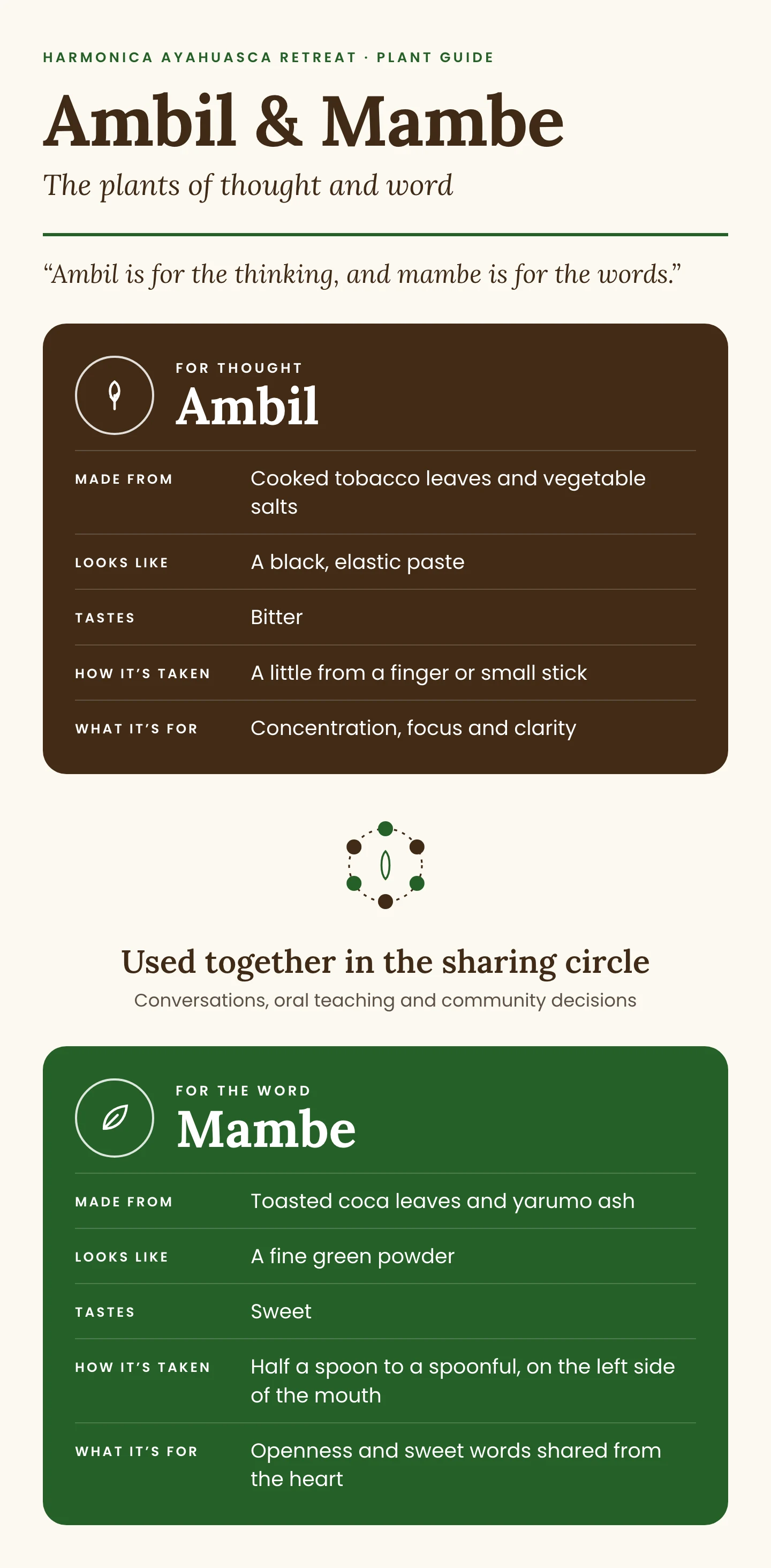
Ambil and mambe have different ingredients, tastes and roles inside the circle.
What Is Ambil?
Ambil is tobacco cooked down with vegetable salts into a black, elastic paste. It tastes bitter.
Traditionally, leaves of Nicotiana rustica are boiled, strained and reduced. Salts made by burning selected plants are added, and the mixture is cooked further until the paste reaches its finished form.
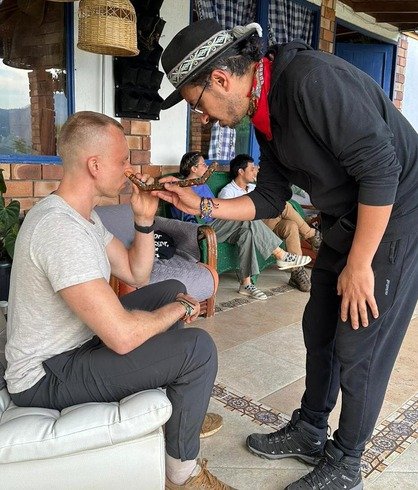
A person takes a little ambil with a finger, a small stick or a spatula. It can be licked or held inside the mouth. I usually tell people that ambil is pretty easy to take.
Ambil carries a masculine energy and is connected with concentration, focus and clarity.
In certain contexts there are also ambil cleanses. They work a bit like the tobacco water purges, but they are stronger. That is a very different thing from the little bit of paste we share in the circle. You can read more about how tobacco is used with ayahuasca, including the tobacco purge, and about rapé, the tobacco snuff.
What Is Mambe?
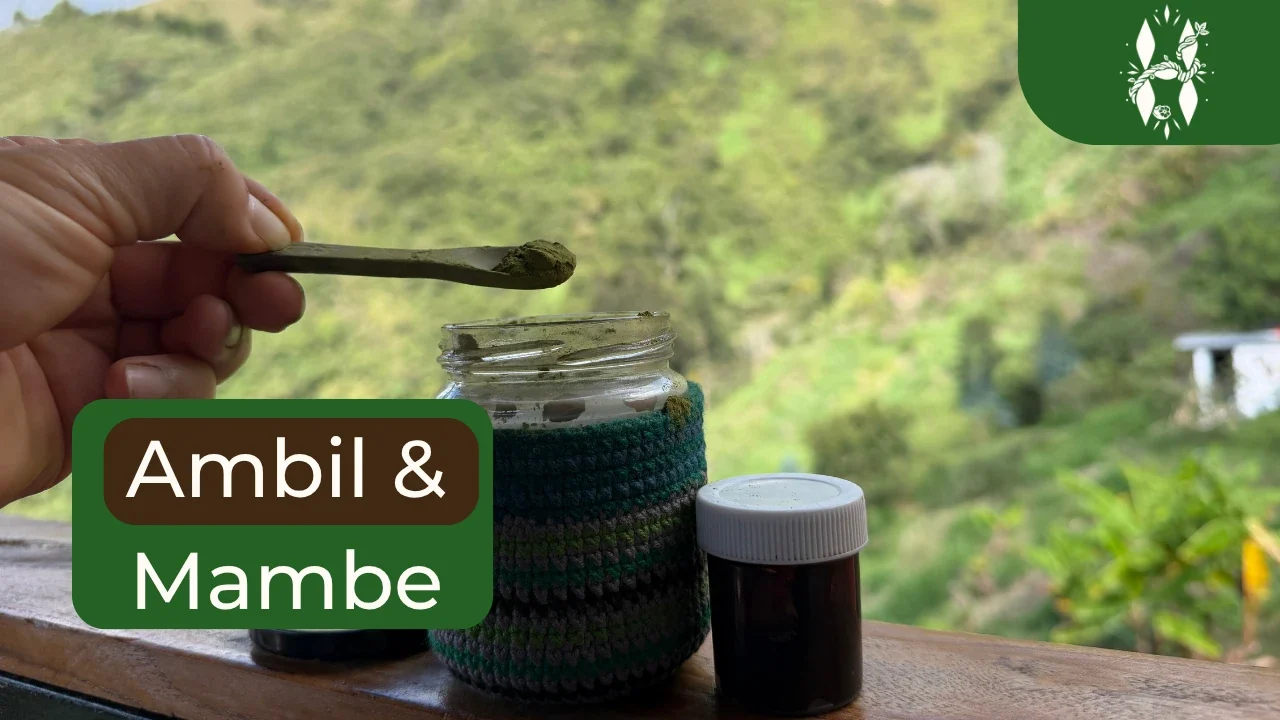
Mambe is a fine green powder of toasted coca leaves mixed with ash from the leaves of the yarumo plant. Nothing in it is refined or concentrated.
Traditionally, the coca leaves are toasted in an earthenware pot and crushed in a wooden mortar. The material is passed through a sieve to remove the fibre and then mixed with the ash. The yarumo ash helps maintain and activate the properties of the coca leaf.
The mambe powder has a sweet taste. We take around half a spoon to a spoonful and place it inside the mouth on the left side.
Mambe is connected with the words, especially the sweet words that allow something in your heart to be shared and received by the people around you. Its place is inside a conversation.
Why Mambe and Ambil Are Used Together
In the tradition the two go together, in sharing circles and also when important decisions for the community are made.
We like to say that spirituality in Latin America is very much connected to the spirituality of plants. In Asia, many spiritual practices are connected with breathwork, meditation and yoga. In Latin American traditions, eating, drinking or smoking a plant can also mean connecting with the essence and spirit of that plant.
The Oral Tradition and the Circle of the Word
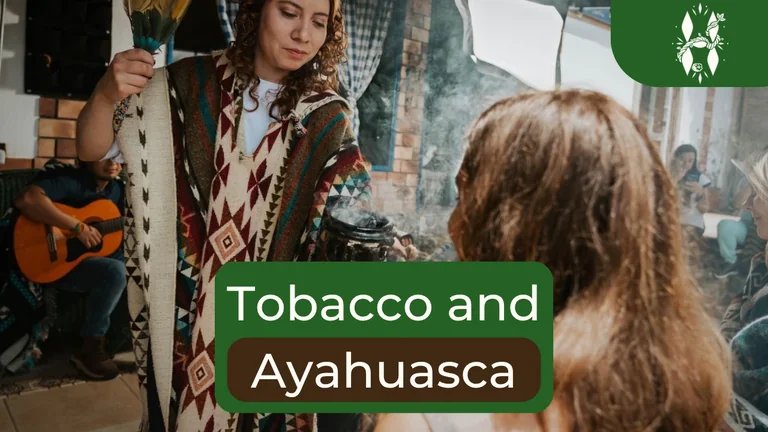
Ambil and mambe belong to an oral tradition in which knowledge passes through circles, conversations and time spent together by the fire. The maloca and the mambeadero give those conversations a shared place.
Ambil is associated with several peoples of the northwestern Amazon, including Uitoto and Bora communities. Tobacco as ambil and coca as mambe are used together in the mambeadero, where people exchange words and make community decisions.
I would say that Western civilizations have maintained much of their knowledge through books and libraries. In Latin American traditions, a lot of wisdom has also been maintained orally, through people sitting together and passing stories from one generation to another.
There is also the belief that the knowledge shared in those circles is held within the wisdom of the plants. In a way, taking ambil and mambe connects the person with that long oral relationship.
How We Use Them at Harmonica
We introduce ambil and mambe in the first opening sharing circle at Harmonica, before people share their personal intentions. I first came across these preparations through Sergio Henao, and now I introduce them when we sit down together at the beginning of a retreat.
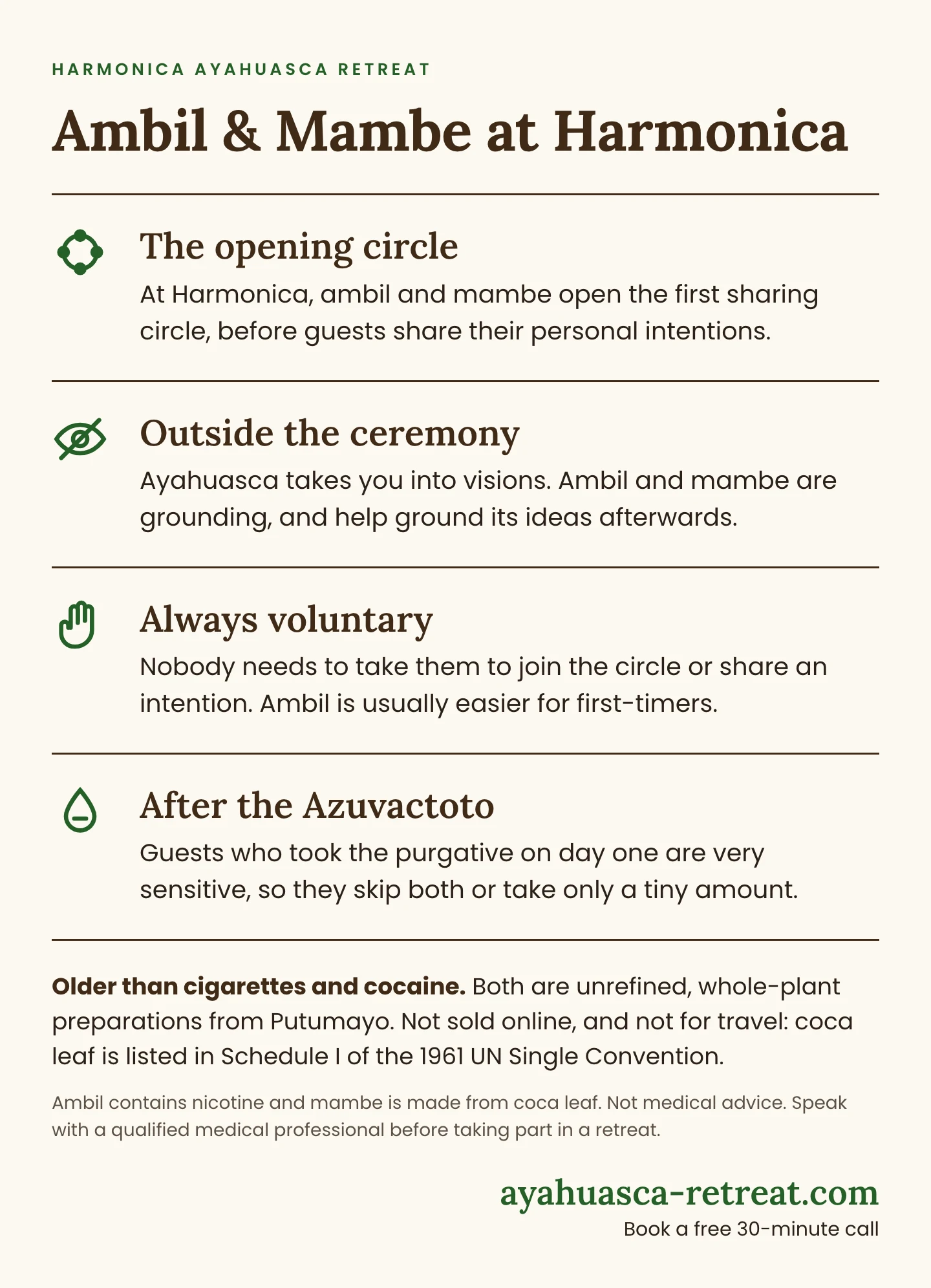
Obviously, everything we do here is voluntary. Nobody needs to take them to join the circle or share an intention.
What I notice is that ambil and mambe help with connection, openness and sensitivity. I feel like people open up a little bit more with these medicines supporting the circle than they would without them.
And also, there is the physical side. You put half a spoon or a spoonful of mambe into the left side of your mouth, and sometimes some of the green powder lands on your T-shirt. The mouth can get very dry and a bit numb, and mambe can also suppress the appetite. Those are the mambe side effects I see, and they are small.
If you want to know how the wider night is held, you can read about what happens during an ayahuasca ceremony.
Why We Keep Them Outside the Ayahuasca Ceremony
We keep ambil and mambe outside the ayahuasca ceremony because, in those moments, it is better to be just with the ayahuasca. In a way, ayahuasca takes you into your visions and internal process. Ambil and mambe are more grounding medicines.
Afterward, they can help you ground the ideas that came from the ayahuasca. That is part of the ayahuasca integration process.
Our ayahuasca ceremonies themselves follow the Kamsá Biyá tradition of the Putumayo, where the medicine is called yagé. The Putumayo tradition of yagé gives more context for that relationship.
Coca Leaves, Cocaine, Tobacco and Cigarettes
Tobacco and coca have a very bad reputation in the Western viewpoint. Tobacco is linked with cancer and addiction, while coca is linked with cocaine and everything around it.
“It is not the plants that are bad, but the misuse of the plants that is creating addictions and suffering.”
 Sergio HenaoYagecero at Harmonica Retreat, with 16+ years of experience
In the Indigenous viewpoint, misuse and addiction began when people removed the ceremonial aspect and the intention from these plants.
Again, ambil and mambe existed long before cigarettes and cocaine. Mambe is toasted coca leaf, while cocaine is a concentrated product extracted from the coca leaf. And ambil is cooked tobacco, taken a little at a time in a circle.
It is said in the Indigenous tradition that coca appeared during a time of difficulty. The plant gave people strength to work in the fields and helped suppress hunger. The same story carries a warning that if the white man corrupted coca, it would bring craziness into his mind and life, which in a way happened through cocaine.
If somebody believes ambil and mambe are simply nicotine and cocaine with a spiritual label, they are probably not the right fit for Harmonica. We explain our relationship with these plants in the first long voice message we send before the retreat.
The way I see it, for someone with a nicotine habit, ambil can also create a new association with tobacco as a plant used in ritual and with intention. I would not say the same about coca, because that relationship may be different.
Who Should Skip Them or Take Very Little
People who completed the Azuvactoto purgative on the first day should skip ambil and mambe or take only a very small amount. They are very sensitive after the purgative.
You can read about the Azuvactoto and other purgatives for more context.
We screen guests for their health before the retreat, including severe heart conditions that would prevent someone from drinking ayahuasca. A physician is also on our team. If you have a medical concern about taking part, bring the details to the screening process and speak with your doctor.
Putumayo Sourcing and Taking Them Home
Our ambil and mambe come from Putumayo, the region we work with for ayahuasca. Guests can buy both at the retreat and use them in their day-to-day life while they are in Colombia.
We do not sell ambil or mambe online. We also tell guests not to travel with either preparation because mambe is coca leaf, which the 1961 United Nations Single Convention lists in Schedule I.
Ask Us Before Joining the Circle
You can ask us anything about ambil and mambe, the Azuvactoto, the opening circle or the ayahuasca ceremony before you decide whether the retreat fits where you are.
The next step is to bring your questions to our free 30-minute consultation call.