
At their core, ayahuasca and yagé are the same medicine. They share the same vine, the same fundamental purpose, and the same essential invitation: to look honestly at yourself, at the mirror of your own soul, and see what is really there.
What differs is the cultural container. The way the brew is prepared, the ceremony format, the songs, the tradition behind the taita guiding the night, these vary significantly between Colombia, Peru, and Brazil. In this guide, we break down what yagé is, what makes the Colombian tradition distinct, and what you can genuinely expect.
What Is Yagé? Understanding Colombia’s Sacred Plant Medicine
Yagé (pronounced yah-HEY) is a psychoactive plant brew made from two plants native to the Amazon basin. The vine, Banisteriopsis caapi: contains harmala alkaloids that act as MAO inhibitors. The leaf, chagropanga or chacruna depending on the tradition, contains DMT, the compound responsible for the visionary experience. Neither plant works fully alone. The vine’s alkaloids block the gut enzyme that would otherwise destroy the DMT before it reaches the bloodstream. Together they produce an experience lasting five to eight hours.
Indigenous communities across Colombia, Ecuador, Peru and Brazil have worked with this medicine for thousands of years, as a tool for healing, self-reflection, and accessing deeper layers of knowledge. In the Colombian tradition it is considered a planta maestra: a master plant teacher. The visions it produces are understood as teachings.
Ceremonies are held at night under the guidance of a Taita. Purging, nausea and vomiting, is an expected part of the process, understood as physical and emotional cleansing.
Yagé vs Ayahuasca: Are They the Same Thing?
Yagé and ayahuasca are not the same thing, but the overlap is significant enough that drawing a hard line between them misses the point. The short version, for anyone who arrived here searching for ayahuasca in Colombia: yagé is what Colombians call it. Same vine, same leaf, same brew, a different name and a different ceremonial style.
Different Vocabulary, Same Medicine
Part of the confusion comes down to language:
Colombian vocabulary: Yagé (finished brew) = The vine (called ayahuasca) + The leaf (called chagro or chagropanga)
Worldwide vocabulary: Ayahuasca (finished brew) = The vine (called caapi) + The leaf (called chacruna)
In Colombian tradition, ayahuasca refers to the vine, one ingredient inside the yagé. Worldwide, ayahuasca refers to the finished brew. The same word, two different meanings depending on where you are.
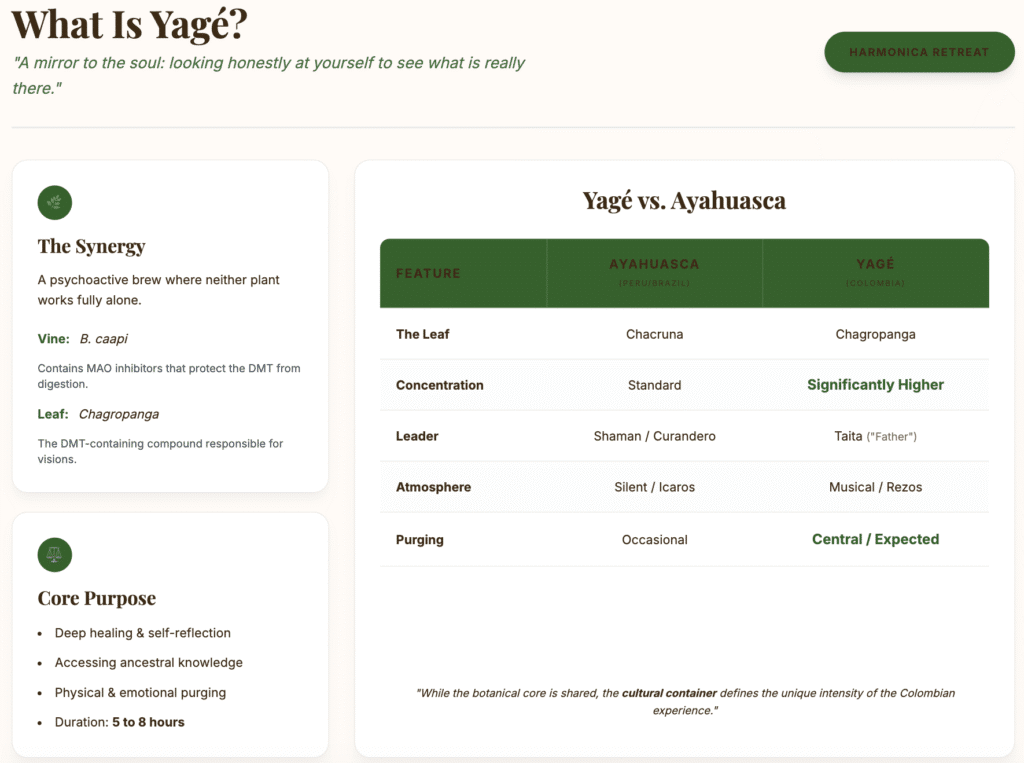
Ayahuasca | Yagé | |
Origin | Amazon basin | Amazon basin |
Number of plants | Two | Two |
Context | Ceremonial | Ceremonial |
Purpose | Healing, self-reflection, spiritual insight | Healing, self-reflection, spiritual insight |
The vine | Banisteriopsis caapi (called caapi) | Banisteriopsis caapi (called ayahuasca) |
The leaf | Chacruna (Psychotria viridis) | Chagro / Chagropanga (Diplopterys cabrerana) |
Ceremony style | Dark, silent, icaros | Music, guitar, rezos, periods of silence |
Brew concentration | Generally less concentrated | Generally more concentrated |
Purging | Present | Expected part of the process |
Guiding figure | Shaman / curandero | Taita |
Primary tradition | Peru, Brazil | Colombia, Ecuador |
Looking to attend a Ceremony? Book a free 30-minute phone call.
The Differences Between Yagé and Ayahuasca
Botanical Differences: Chaliponga vs Chacruna
Both brews use the same vine, Banisteriopsis caapi. The difference, according to online consensus, lies in the leaf. Ayahuasca traditionally uses chacruna (Psychotria viridis), while Colombian yagé uses chagropanga (Diplopterys cabrerana).
In practice this distinction is harder to verify than most articles suggest. Elders don’t use scientific names, they work from lineage knowledge and regional plant names. Different regions use different names for the same plant. The botanical difference is likely real, but not as clearly defined as the internet implies.
Preparation and Ceremony Style
Peruvian ceremonies take place in darkness, with long stretches of silence broken by the icaros of the shaman, sacred healing songs central to how the medicine is guided through the night.
Colombian ceremonies have a different energy. Medicine Music plays a larger role, including guitar, with alternating periods of sound and silence. Colombian taitas sing rezos: related in purpose to icaros but carrying their own distinct lineage and form. In Brazil the format shifts again. Yet across all three traditions, the essence of what is being worked with remains the same.
There is a preparation element for Yage, especially the mental aspect (the willingness to look within) and arriving with humility and respect is important. The physical preparation isn’t as tedious as in Peru.
Colombian Yagé vs Peruvian Ayahuasca
Colombian yagé is generally described as more concentrated and more purgative than what most people encounter in Peru. We regularly hear from participants who needed three ceremonies to connect with the medicine in Peru, who then connect deeply on their first or second night in Colombia. The reasons are debated, overharvesting in Peru, differences in brew concentration, and some accounts suggesting higher DMT content in Diplopterys cabrerana. Likely a combination of all three.
How Environmental Differences Might Affect the Properties of the Plant
I had a conversation with a researcher who attended our Ayahuasca retreat and she mentioned an interesting observation about cacao: its properties can vary depending on which side of a hill it grows on. This concept, while not directly proven for Ayahuasca, opens up an intriguing line of thought. If the environment, such as soil composition, altitude, climate, and other ecological factors, can influence the properties of one plant, it’s possible that Ayahuasca vines growing in different regions, like Peru and Colombia, might also exhibit slight variations in their properties.
Yagé in Colombia: Tradition, Culture and Ceremony
Indigenous Origins: Siona, Cofán, Kamsá Biyá and the Putumayo
Yagé has been at the heart of indigenous life in the Colombian Amazon for centuries. Among the peoples of the Putumayo, the Siona, Cofán, Coreguaje and Kamsá Biyá: it is a medicine of knowledge, inseparable from how these communities understand healing and community. We work directly with the Kamsá Biyá tradition at Harmonica Retreat.
The Role of the Taita
Taita means father, and that is precisely what the role embodies. The taita holds the community, carries the lineage knowledge of how to prepare and work with the medicine safely, and his authority comes from years of apprenticeship under elder taitas, drinking the medicine, learning the rezos, being shaped by the process itself.
Abuelo Yagé: Masculine, Feminine, or Neither?
Online you will frequently read that ayahuasca carries a feminine spirit, Madre Ayahuasca: while yagé carries a masculine one: Abuelo Yagé. There is truth in this. But the Kamsá Biyá tradition holds a more nuanced view. Yagé is understood as a neutral spirit: a planta maestra that arrives in whatever form the person needs.
In our ceremonies we see this regularly. Some participants encounter a profoundly feminine, nurturing presence. Others connect with the grandfather energy the tradition describes. The medicine reads what is needed and responds accordingly.
It is also worth acknowledging the broader cultural context. Colombia’s indigenous territories carry a strong masculine cultural tradition, and that backdrop is woven into the tradition itself. When people describe Colombian yagé as more masculine in energy, they are sensing not just the plant, but the world the tradition grew up inside.
Yagé vs Ayahuasca at a Glance
Yagé and ayahuasca are the same core medicine, and the differences come down to the leaf, the strength, the region and the ceremony around it.
| Feature | Yagé (Colombia) | Ayahuasca (Peru) |
|---|---|---|
| Vine | Banisteriopsis caapi | Banisteriopsis caapi |
| DMT leaf | Chagropanga or chaliponga (Diplopterys cabrerana) | Chacruna (Psychotria viridis) |
| Region | Colombian Amazon, mainly Putumayo | Peruvian Amazon |
| Brew | Often more concentrated and strongly purgative | Often lighter, varies by maestro |
| Ceremony led by | Taita | Curandero or ayahuasquero |
| Legal status | Legal, protected as indigenous heritage | Legal for ceremonial use |
So yagé vs ayahuasca is less about two different plants and more about two traditions around the one plant. The Colombian brew tends to be more concentrated and more purgative, and the ceremony is led by a taita rather than a Peruvian curandero. If you already know ayahuasca from Peru, Colombian yagé will feel like the same friend speaking with a stronger, more direct voice.
The Effects of Yagé: What a Ceremony Actually Feels Like
Ask ten people who have drunk yagé what their experience was like and you will get ten completely different answers. That is not a contradiction, it is the nature of the medicine. Yagé works differently for each person, in each ceremony, at each moment in their life.
What we can share is what consistently happens in ceremony and what to expect, and what consistently surprises people.
Timeline of Effects
At the start of the ceremony the Taita (Yagecero) blesses the medicine, copal smoke is blown over each participant, and everyone drinks, including the taita and his helpers. Effects begin within 45 minutes (or sooner). The ceremony moves between silence and music, guitar, traditional instruments, rezos: guiding the rhythm of the night. A second cup is offered after two to three hours for those who feel called to go deeper. The full experience lasts five to eight hours.
What Happens Inside
Yagé is fundamentally introspective. Less about what you see with your eyes (open or closed) and more about what you feel, the emotions that surface, the realizations that arrive, the parts of yourself you finally meet. Some people experience vivid visions. Others feel almost nothing visually but go through profound emotional shifts. Both are the medicine working.
The purge: nausea and vomiting, is an expected part of the process, understood in the tradition as physical, emotional and energetic cleansing. Most people feel significantly lighter after it.
What It Is Really About
Yagé is a mirror. It shows you what is actually there underneath, unresolved grief, buried emotions, patterns you have been carrying without realizing. It is a far more compassionate medicine than most people expect. It tends to work on what you are ready to heal, at the pace you need.
In the days following ceremony, people often describe a sense of openness: a lighter emotional load, a clearer sense of direction, a renewed connection to themselves and the people around them.
What is Yagé: Macho Culture in Colombia
The idea of Ayahuasca or Yagé being considered masculine might also be influenced by the “macho” culture present in Colombia. While this isn’t something that’s openly discussed, it’s a cultural undercurrent that can shape perceptions. For example, not too long ago, women in indigenous tribes were legally obligated to give their income to their men, highlighting the presence of this “macho” culture in ways that might not be immediately apparent to someone from the West.
Yagé in Putumayo and Mocoa: Where the Tradition Comes From
Putumayo is the Colombian region where the yagé tradition runs deepest, and Mocoa, its capital, is the town most people mean when they search for yagé in Colombia. It sits in the Amazon foothills of the southwest, near the borders with Ecuador and Peru. This is the land of the Inga, Kamsá, Siona and Cofán peoples, and the taitas who carry the medicine here learned it from the elders before them, not from a weekend course.
So when people look up yage in Mocoa or yage in Putumayo, what they are really feeling is the pull toward the source. And that pull makes sense. The medicine grew up in these valleys, in the Sibundoy Valley and the jungle around it, long before it had a page on the internet. If you want to follow the origins of the medicine, this is where the thread leads back to.
The geography matters less than people think. You do not need to reach a remote Amazon camp to drink real yagé. It can be that you are the type who needs to travel to the source to feel it is real, and that is okay. It can also be that you are romanticising the distance, when what you actually need is a safe container and a trained taita, which you can also find closer to a city. Drinking in the West is a different experience than drinking deep in the Putumayo, and we wrote about that difference on its own.
Wherever you drink it, the same care applies. A responsible taita or centre asks about your medications and your history before they let you sit, because yagé does not mix with SSRIs, MAOIs, lithium or a weak heart. Travelling far into the jungle for an unscreened ceremony is not braver. It is just riskier. Give yourself that level of clarity before you book.
“The name Yagé is used in Colombia not because of a particular method of making the brew, but because it’s the term that’s culturally rooted in that region.”
What Can Yagé Heal? Benefits, Research and Real Experiences
Research into ayahuasca has grown significantly over the past decade, showing promising results for treatment-resistant depression, PTSD and addiction. For the addiction side specifically, iboga and ibogaine act on physical dependency in a way ayahuasca does not, which we compare in ayahuasca vs iboga. A randomized controlled trial found 64% of patients with treatment-resistant depression showed significant symptom reduction within seven days of a single dose, compared to 27% in the placebo group. Harmonica Retreat works in partnership with Imperial College London, one of the leading research institutions in this field.
Beyond the clinical findings, the most consistent themes we witness in our ceremonies:
- Healing relationships with parents and family
- Overcoming addiction and breaking long-standing patterns
- Lifting depression and rediscovering optimism
- Finding clarity and a renewed sense of purpose
- Making peace with the past
- A deeper relationship with oneself
Every experience is different. Integration, making sense of what arose in ceremony and bringing it into daily life, is where much of the lasting change happens.
Safety and Contraindications
Yagé is a safe medicine with thousands of years of traditional use and is not physically addictive. There are however contraindications that must be taken seriously:
- Antidepressants (SSRIs, MAOIs, tricyclics): risk of serotonin syndrome. Supervised tapering required before ceremony.
- Heart conditions and high blood pressure: yagé temporarily raises heart rate and blood pressure.
- Schizophrenia and psychosis: contraindicated for personal or family history.
- Pregnancy: not recommended.
- Recreational drugs and alcohol: avoid in the period around ceremony.
Always consult a qualified medical professional if you are on medication or have an existing condition.
Legal Status of Yagé in Colombia and Beyond
In Colombia, yagé is legal and its ceremonial use is protected as part of indigenous cultural heritage, one of the few countries where you can participate in a ceremony in a fully legal context.
Outside South America, DMT is a controlled substance in most Western countries, Schedule I in the United States (certain religious exemptions apply)and similarly restricted across Europe. Brazil and Peru are exceptions, permitting traditional and ceremonial use.
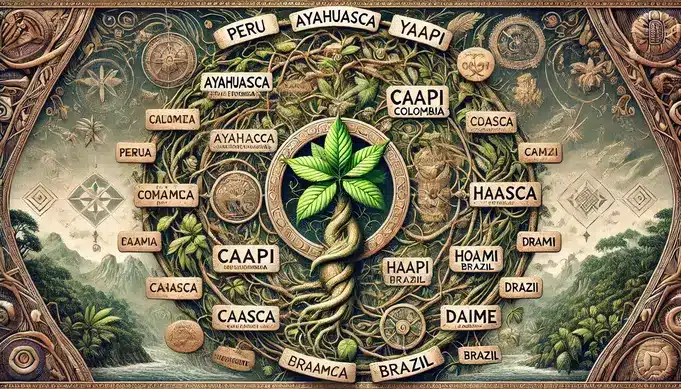
What are the different names for yagé and ayahuasca?
One of the most remarkable things about this medicine is how it was discovered and used independently by countless indigenous tribes across thousands of miles of Amazon rainforest, spanning Colombia, Brazil, Ecuador, Venezuela, Bolivia and Peru, with no obvious means of communication between them. Each culture developed its own name, its own preparation, its own ceremonial tradition. All pointing to the same medicine.
Some of the most common names across the region:
- Yagé: Colombia and Ecuador
- Hoasca: Brazil, particularly in religious ceremonial contexts
- Daime: associated with the Santo Daime religious tradition in Brazil
- Natema: used by the Shuar people of Ecuador and Peru
- Nixi pae: used by the Huni Kuin (Kaxinawá) tribe in Brazil
- Ambiwaska: used by the Inga tribe in Colombia
- Shori: used by the Asháninka people in Peru
- La Purga: used across various regions, referencing the purgative nature of the medicine
- Mariri: also commonly used in Brazil
The diversity of names reflects the diversity of traditions. The essence of what is being worked with remains the same.
Conclusion
Yagé and ayahuasca are more similar than they are different. The same vine, the same fundamental medicine, the same essential invitation, to look honestly at yourself and see what is really there. What differs is the cultural container, the tradition behind it, and the concentration of the brew.
If you feel called to experience the yagé tradition of Colombia, rooted in the indigenous lineages of the Putumayo and held in a ceremonial context that has existed for centuries, we invite you to explore Harmonica Retreat.
Frequently Asked Questions around Yagé
Where to Experience Yagé in Colombia and in Medellín
Yagé is the same medicine as ayahuasca, and we hold ceremonies with it in Medellín, Colombia. So if you have been looking for ayahuasca in Colombia, this is it. Known in Spanish simply as el yagé, it draws people from across the country and abroad. You do not need to reach a remote Amazon camp to drink it. Guests fly into Medellín, and we collect them straight from the airport. For most people who want yagé in Colombia, Medellín is the destination itself.
Medellín makes this easy for two plain reasons. Its airport connects to most of the Americas and Europe, and the weather around the city stays mild the whole year. Harmonica Retreat is set in the green hills of the city, a short drive from the airport. We drive that route ourselves through our retreat shuttle, so no one sorts out unfamiliar roads alone after a long flight.
How to Choose a Yagé Ceremony in Colombia
Before you book yagé anywhere in Colombia, check four things. Skipping any one of them raises the risk.
- Medical screening. A responsible center asks about your medications and health before it accepts you, because yagé does not mix with several common drugs. A place that skips this is telling you it will take anyone.
- Lineage. Ask who prepares and serves the medicine. We work within the Kamsá Biyá tradition of the Putumayo, and the taita who leads is trained under elder taitas rather than self-appointed.
- Group size. Small groups let facilitators watch each person through the night. Large ceremonies spread that attention thin, which matters most in the hours when someone needs support.
- Integration. The days after ceremony decide how much of the work lasts. Confirm there is real support afterward rather than a handshake at the gate. Our ayahuasca integration guide covers how we handle it.
Who Should Not Drink Yagé in Colombia
Yagé is not the right choice for everyone. If you take an SSRI, lithium, or an MAOI, the brew can be dangerous. The same warning applies to anyone with a heart condition. A careful center will turn you away rather than gamble with it. Talk to your own doctor first. Tell any facilitator your full medical history well before you travel.
If you are weighing a yagé ceremony in Medellín, the clearest next step is to see when we hold them. Our upcoming ceremonies page lists current dates, and a 30-minute consultation answers the medical and travel questions before you commit to yagé in Colombia.
FAQs
What is yagé?
Yagé is a sacred plant medicine brew from the Colombian Amazon, made from the Banisteriopsis caapi vine and a DMT-containing leaf. Used by indigenous communities for thousands of years for healing, self-reflection and spiritual insight. Essentially the same medicine known worldwide as ayahuasca.
What is the definition of yagé?
In Colombian indigenous tradition, yagé refers to the finished ceremonial brew, a planta maestra, master plant teacher, central to the healing traditions of the Putumayo region.
What is the difference between yagé and ayahuasca?
The core medicine is the same. Differences lie in regional vocabulary, the leaf used, brew concentration, and ceremony format. Colombian yagé is generally more concentrated and purgative.
Is yagé stronger than ayahuasca?
Most people who have drunk in both Peru and Colombia describe the Colombian brew as stronger. Likely due to brew concentration, the leaf used, and differences in preparation traditions.
Is yagé safe?
Yes, with thousands of years of traditional use. Important contraindications exist, particularly for people on antidepressants, with cardiovascular conditions, or history of psychosis. Proper screening before ceremony is essential.
What does yagé mean?
The name used by indigenous communities of the Colombian Amazon for the ceremonial brew. In Colombian vocabulary, yagé is the finished brew, the vine is called ayahuasca, and the leaf is called chagro or chagropanga .
What kind of drug is yage?
Yage is a psychedelic plant brew, essentially the Colombian tradition of ayahuasca, whose main active compound is DMT combined with MAO inhibitors from the yage vine. It is classed as a serotonergic psychedelic and is taken in guided ceremonial settings.
Which tea contains DMT?
Ayahuasca, also called yage, is the tea that contains DMT, drawn from plants like chacruna or chagropanga and brewed with the vine that carries MAO inhibitors. Those inhibitors are what allow the DMT to become active when the brew is drunk.
What drug is ayahuasca similar to?
Ayahuasca is most similar to other DMT-based and serotonergic psychedelics, and its visionary effects are often compared to a long, intense version of what people experience with psilocybin mushrooms. Unlike smoked DMT, its effects come on gradually and last several hours.
Where can you drink yagé in Colombia?
You can drink yagé across Colombia, most traditionally in the Putumayo region and, increasingly, at screened retreats near Medellín. Medellín is the easiest to reach for most travellers, with an international airport and a mild climate year round, while Putumayo and its capital Mocoa are the historic heartland of the tradition. Choose a centre that screens you medically and works within a real lineage.
Is yagé the same as yahe or yaje?
Yes. Yahe and yaje are just different spellings of yagé, the Colombian name for ayahuasca. The word is spoken far more than it is written, so the spelling shifts from region to region, but it points to the same medicine, made from the same Banisteriopsis caapi vine.
Do you need to go to the Amazon to drink yagé?
No. You do not need to reach a remote Amazon camp to drink yagé. The medicine and the taitas who serve it travel, so ceremonies are held in cities like Medellín as well as in the Putumayo. What matters more than the location is proper medical screening, a trained taita, and real integration support afterwards.


![29 Best Ayahuasca Documentaries: Free & Paid [2026 Guide]](https://www.ayahuasca-retreat.com/wp-content/uploads/2026/02/ayahuasca-documentary-768x512.png)