What is the ego?
There is no single definition of ego, but here I mean the identity we construct around ourselves.
Dr. David Hawkins describes the ego as our lower self, focused on survival and self-preservation. In his book Transcending the Levels of Consciousness, he explains that when consciousness is lower, the ego has a tighter grip on our thoughts and behaviour.
Eckhart Tolle describes the ego as the part of the mind that comments, doubts, and speculates. He says it is afraid of being nothing, so it identifies with possessions, thoughts, and emotions, and from this creates the "self" we usually know. He explores this in his book A New Earth.
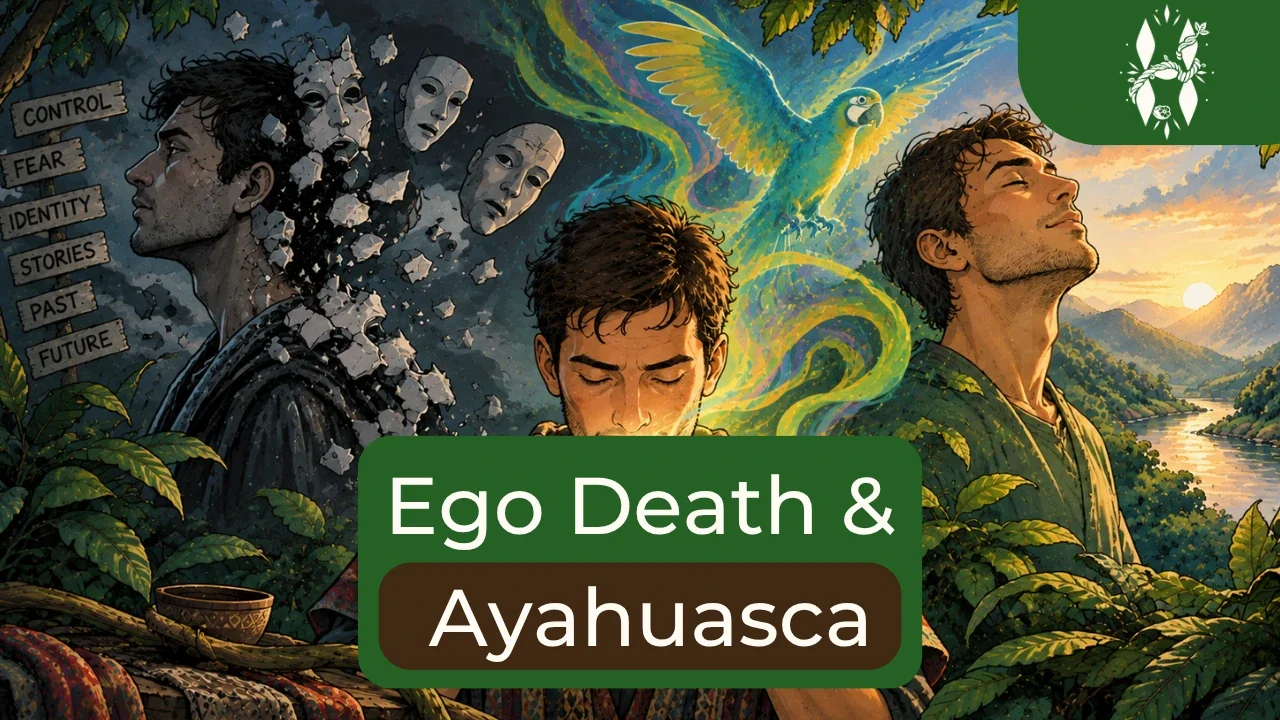
Together, these views describe the ego as our constructed identity: our name, work, achievements, beliefs, pride, shame, and guilt. Some parts can motivate us and also protect us. Other parts can limit us, repeat negative patterns, and harm our relationships. In a way, this self-image shapes how we see ourselves and where we believe we belong in the world.
What is ego death?
Ego death is when the identity you have built falls away: your ideas, values, roles, and the sense of who you are.
You can approach the idea by asking, "Who am I without my name, occupation, history, strengths, or weaknesses?" Stay with it, and the labels may feel separate from the person observing them. In ego death, that distance becomes a lived experience.
Researchers call this "ego dissolution." A 2016 paper by Nour, Evans, Nutt and Carhart-Harris describes a compromised sense of self. The boundary around you can disappear, with a feeling of union with your surroundings. The researchers created the 8-item Ego-Dissolution Inventory to measure this experience. Ego death is the common name for its strongest form.
People tend to pull in opposite directions around ego death. One person fears losing control because the familiar identity feels safe. Another seeks the experience because the same identity has created suffering, disconnection, or a constant state of fight or flight. One holds tightly to the familiar. The other hopes the structure falls away. Both reactions come from your relationship with the person you believe yourself to be.
“An ego death on Ayahuasca can be both a liberating and terrifying process. It can serve as a powerful reset, yet the change will happen in the everyday experiences of life and not in the peak moments in ceremony.”
 Oliver GlozikFounder of Harmonica Retreat
Why people seek ego death: escaping self-made traps
We create many of our own problems and also much of our suffering. Often, we stand in our own way.
You want progress in a relationship, career, or personal growth, and then the familiar self-sabotage comes back. You know where it leads, but still you return to the same coping mechanisms. Just when you are about to reach the next stage, the old pattern takes the driver’s seat again.
The ego also shows itself in our closest relationships. Anger, a hurtful comment, or some impulsive action can create real pain. And seeing that pain leaves us carrying guilt and regret.
After repeating this enough, it starts feeling like carrying a heavy backpack that you cannot put down. You try to let go, you try to move forward, and somehow the burden returns.
This is why many people feel drawn to ayahuasca ego death. The idea of briefly dissolving these self-made barriers can feel like a chance to reset and begin again. Ayahuasca has this reputation for breaking down the usual identity, and people hope they can return with less of the old baggage.
If you are wondering whether this kind of reset can heal those patterns, you can read about healing vs improvement and the long-term effects of ayahuasca, or see how our Ayahuasca Retreat Colombia works.
What does ego death on ayahuasca feel like?
Ego death on ayahuasca can feel scary, liberating, confusing, or completely peaceful and at home. And also, more than one feeling can come in the same ceremony. Words rarely do it justice. It is like trying to explain a colour to a blind person.
From the outside, someone may look super calm or lie on the floor shaking. At Harmonica, we support each person according to what they need.
If you are in the middle of it, stay grounded and be grateful that the things you thought were important are being stripped away, because that allows you to rediscover yourself.
Liberating and at peace: becoming one with the universe
Ego death can feel liberating and deeply peaceful, almost like coming home and becoming one with everything. On my second ayahuasca retreat, during the fourth ceremony, I was surrendering and surrendering. Then it felt as if I became one with the universe. The idea of me as a separate person disappeared, and I entered an all-encompassing state of universal consciousness. I did not think I would come back. I was not thinking at all. It was more like: okay, now this is done.
The ego focuses on separation and creates an us-versus-them world. Oneness feels like merging with everything as the boundary between you and the universe falls away. Some seekers also turn to Bufo Alvarius, which leads straight to this experience.
Frightening: when everything you built is taken away
Ego death can feel frightening when everything you identify with suddenly disappears. One participant was an entrepreneur. The system he had built and all his worldly attachments were swirling around him. Then, poof, they were taken away and taken away. Everything he identified with was gone. The more attachments you have, the scarier their removal can feel.
Confusing: “that is not you either”
Ego death can feel confusing when one identity disappears and another begins to form. Before I started facilitating, I went through a long retreat where much of my identity changed. At the end, the ayahuasca told me: yes, you changed much of your identity, but this new identity is another part of this ever-evolving mess, and that is not you either. I found that confusing.
Signs of ego death
The signs of ego death involve losing your usual sense of identity and separation.
- Your sense of being a separate self falls away.
- Boundaries dissolve, bringing the union described by Nour, Evans, Nutt and Carhart-Harris.
- Things you considered important stop feeling important.
- Thinking may stop completely.
- Your name, job, or achievements feel as if they are disappearing.
- Afterwards, you may question your identity and values.
These signs can appear within the wider flow of what happens in an ayahuasca ceremony.
How long an ego death lasts
From my experience, ego death itself usually lasts around a couple of minutes. Time feels different in that state, so those minutes can seem much longer. The duration varies from person to person. The after-effects may remain for days or weeks as you integrate the experience.
Ayahuasca, the default mode network and ego death
During ayahuasca, activity drops in the default mode network, the brain network most linked to our sense of self. The network is most active when your mind wanders or thinks about you. Scans showed lower activity in the posterior cingulate cortex and precuneus, and the medial prefrontal cortex.
Researchers connect this quieter self-network with ego dissolution, the feeling that your usual boundary has loosened or disappeared. The scans show an association, but do not prove that reduced activity causes the experience. The science is young, and a brain scan cannot explain the whole experience.
For me, knowing a possible mechanism does not make ego death less real. You can understand the words and the scan, but feeling it is different. Read more about how ayahuasca affects the brain.
Ego death on Bufo vs. Ayahuasca
Bufo, often called the "5-MeO-DMT experience," can bring ego dissolution almost immediately, while ayahuasca usually unfolds through a longer inward process. Within moments of inhalation, people can feel thrust into an overwhelming sense of unity as the ego's chatter falls silent. The experience lasts around 15 to 30 minutes, though it can feel much longer.
Bufo leaves little room for gradual introspection. Its speed can be both its strength and its challenge. Some people find the abrupt shift disorienting. Others experience it as a direct route into oneness.
Ayahuasca tends to work through layers of consciousness, emotions, memories, and beliefs. Ego death with ayahuasca may come after confronting fears, personal trauma, or deep emotions. In a way, it is more like a marathon than a sprint.
For me, and for many others, ayahuasca does not always lead straight into cosmic oneness. It asks for surrender, patience, and courage while personal material comes up. Ego dissolution and unity can happen, but they are not promised in every ceremony. They may arrive after a long period of looking inward.
What happens after ego death
Ego death is not a permanent state because the ego comes back, either in its old form or a new costume, sometimes as a spiritual ego. It can feel like a system reboot for your psyche. Once the system is running again, familiar patterns can reinstall because the ego reads familiar as safe, even when they caused suffering.
The new costume can have the same mechanism underneath. You let go of one identity and make another because, in a way, you still need one. I think you are the observing consciousness behind it, but maybe you need to experience this before you can feel it. A spiritual ego after ayahuasca can rebuild the same search for validation around different symbols. Before, maybe it was the car you drive. Afterwards, maybe it is the number of ceremonies you have done, or how little you care about a car.
In my view, the moments after an ego death probably give you a rare openness to redefine your identity more deeply. In a Cell Reports study, DMT, one of the active compounds in ayahuasca, promoted new branches, spines and synapses in rat brain cells grown in a dish, and a single dose increased spine density in living rats. This is animal and cell research, so it does not prove that such a window exists in humans.
That openness can also feel destabilising. If you identified strongly with parts of your personality and then saw you were more than those parts, bigger questions can come up: who am I, what matters to me, and which values do I want to live by? For one person, the answers feel clear. Another person struggles to piece together who they are becoming.
Integration does not happen by itself. You need to observe the thoughts, emotions and behaviours taking shape, and then you decide which ones belong in the identity you are rebuilding. Our Ayahuasca Integration article can help you work with that period. The work is less about holding onto the ego death and more about choosing your values, letting go of old habits, and carrying those choices into daily life.
Why an ego death won't save you (and what will)
An ego death can be a powerful reset, but by itself it will not change your life. Real change does not come from one huge moment. I speak about this in a short video on our channel.