Ayahuasca is not tied to one religion. It lives in Indigenous Amazonian traditions and also inside Brazilian churches such as Santo Daime and the União do Vegetal. Many Christians drink ayahuasca, and some leave ceremony feeling closer to God, which is one reason I do not believe the fear that it is demonic. Some Christian-influenced tribes even tell that the ayahuasca vine grew after the beard of Jesus fell to the earth.
This is a big topic, one that could stir up a bit of controversy. When you stop and think about it, so many wars have been fought in the name of God, with people insisting their way is the “right” way while condemning others’ beliefs and practices.
Personally, I find it sad that something meant to bring peace and hope into people’s lives often ends up causing so much division.
Key takeaways
- Ayahuasca can offer a deeply personal connection to divinity, it’s not tied to any specific religion or belief system and allows people to explore their own spiritual truths.
- After the Spanish Inquisition, some indigenous groups adopted Christianity, finding parallels between their own beliefs and the new faith, for example similarities between the Virgin Mary and Pachamama.
- At Harmonica Retreat, the focus is on creating a safe space for personal exploration, free from dogma or religious preaching.
- Many Christians drink ayahuasca, and some reconnect with Christianity or feel closer to God through ceremony.
- The fear that ayahuasca is demonic often comes from the unknown and from seeing your life without filters, while many people, me included, have come closer to God through ceremony.
Looking to attend a Ceremony? Book a free 30-minute phone call.
“For us, all beliefs are welcome. Whether you come from a religious background, follow a spiritual path, or don’t believe in anything at all, that’s completely fine.”
Find out if Ayahuasca is right for you
- Will you be safe physically and emotionally?
- How will you be supported in the ceremony?
- How do the facilitators handle difficult situations?
- How will you be able to process the experience?
- You want change, but will your life be unrecognizable after Ayahuasca?
Ayahuasca and Christianity: Is It Against the Faith?
Ayahuasca is not a Christian practice, and most mainstream churches do not endorse it, and still many Christians drink it and read their own faith into what they feel. So whether it goes against Christianity depends on who you ask, and on the person asking it. There is no single ruling that covers everybody.
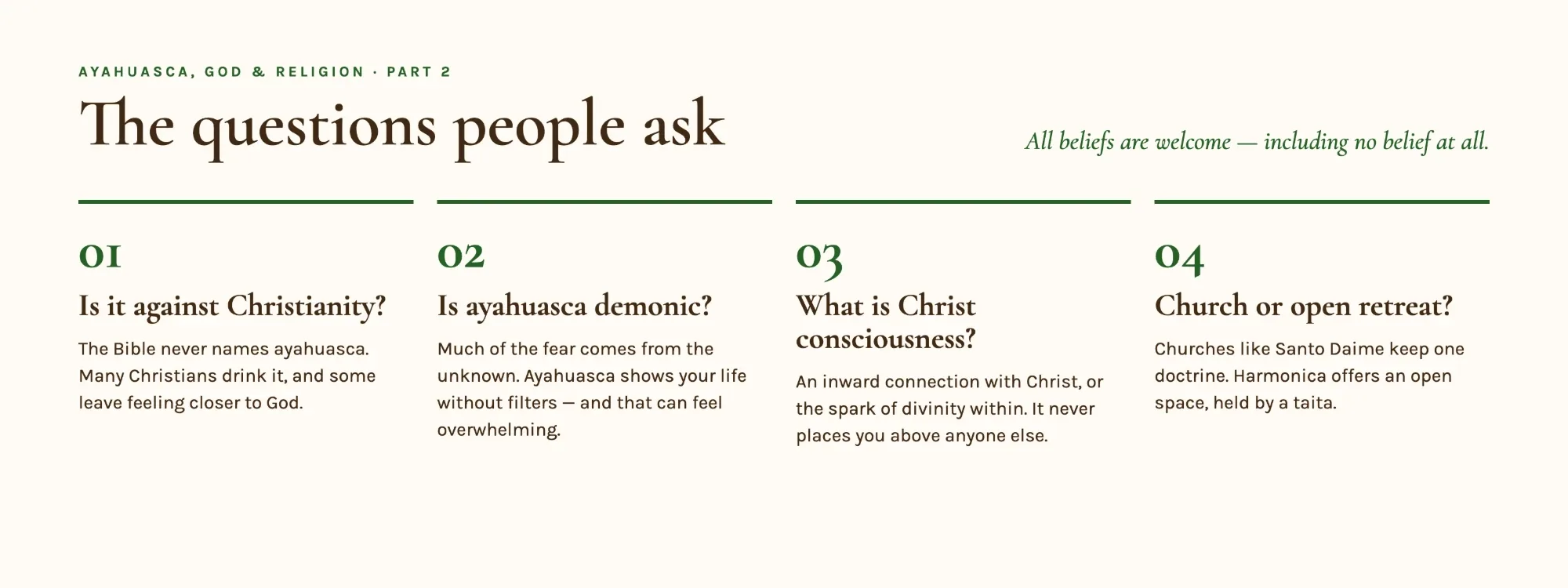
The Bible never names Ayahuasca. It is a plant brew from the Amazon, and if you want the plain version of what Ayahuasca actually is, the texts of the Bible were written long before Europe knew the Amazon was there. So there is no verse that says yes, and there is no verse that says no.
I like to say Ayahuasca is a conversation you are having with yourself in an extraordinary state. And by having that conversation, the images and feelings arrive in the language you already carry, so a devout person often meets God, and a person raised without religion often meets something they don’t have a name for. Less about the plant handing you a religion, more about the plant showing you what is already living inside you. What you do with that afterward, in your own church or your own kitchen, that part is your responsibility.
Christ Consciousness and Ayahuasca
Christ consciousness in ayahuasca usually means experiencing a connection with Christ, or with that spark of divinity within yourself. For some people, the connection is visual. For others, it is more a feeling within oneself.
Within spiritual communities, somebody may say they connected with Christ consciousness instead of saying they connected with Christ.
Sometimes this experience gets mixed with grandeur. The person may believe they are Jesus, the second coming of Christ, or the Messiah. This is called a Messiah complex, and it can also become a form of spiritual ego.
When we see this, we have a conversation with the person about what they experienced. Connecting with divinity can be beautiful, obviously, but it does not mean your divinity stands above anybody else's. And in the end, it is also for each person to understand it for themselves.
Is Ayahuasca Demonic?
I do not believe ayahuasca is demonic. I have seen it bring many people closer to God and divinity, myself included. There is a lot of fear-mongering around ayahuasca because for many people the topic is unknown, and obviously, unknown experiences can feel scary, especially when somebody speaks with complete certainty about bad spirits.
A quote I once read says, "People swear they are fighting a demon, but in reality, they are suffering the consequences of their own actions." Ayahuasca can show you your life without the filters you normally use to protect yourself. This can become overwhelming, and sometimes we shut down, project the fear outward, and call the experience demonic.
One guest comes to mind who grew up religious and then moved away from religion because of a lot of suppressed shame. Through ceremony, he was able to reconnect with his faith, which in his case was Christianity.
But also, if your church teaches that ayahuasca is forbidden, this is a real conversation to have with your own religious community. Some Christians also worry that ayahuasca is a shortcut to God without faith or grace, but in my experience the ceremony did not replace daily practice.
And also, difficult ceremonies are real, and they need to be handled with calm support during the experience and also afterwards. Medications, especially antidepressants, and any mental-health history need to be discussed with a doctor and a screened facilitator before anything else.
Psychedelics vs Entheogens
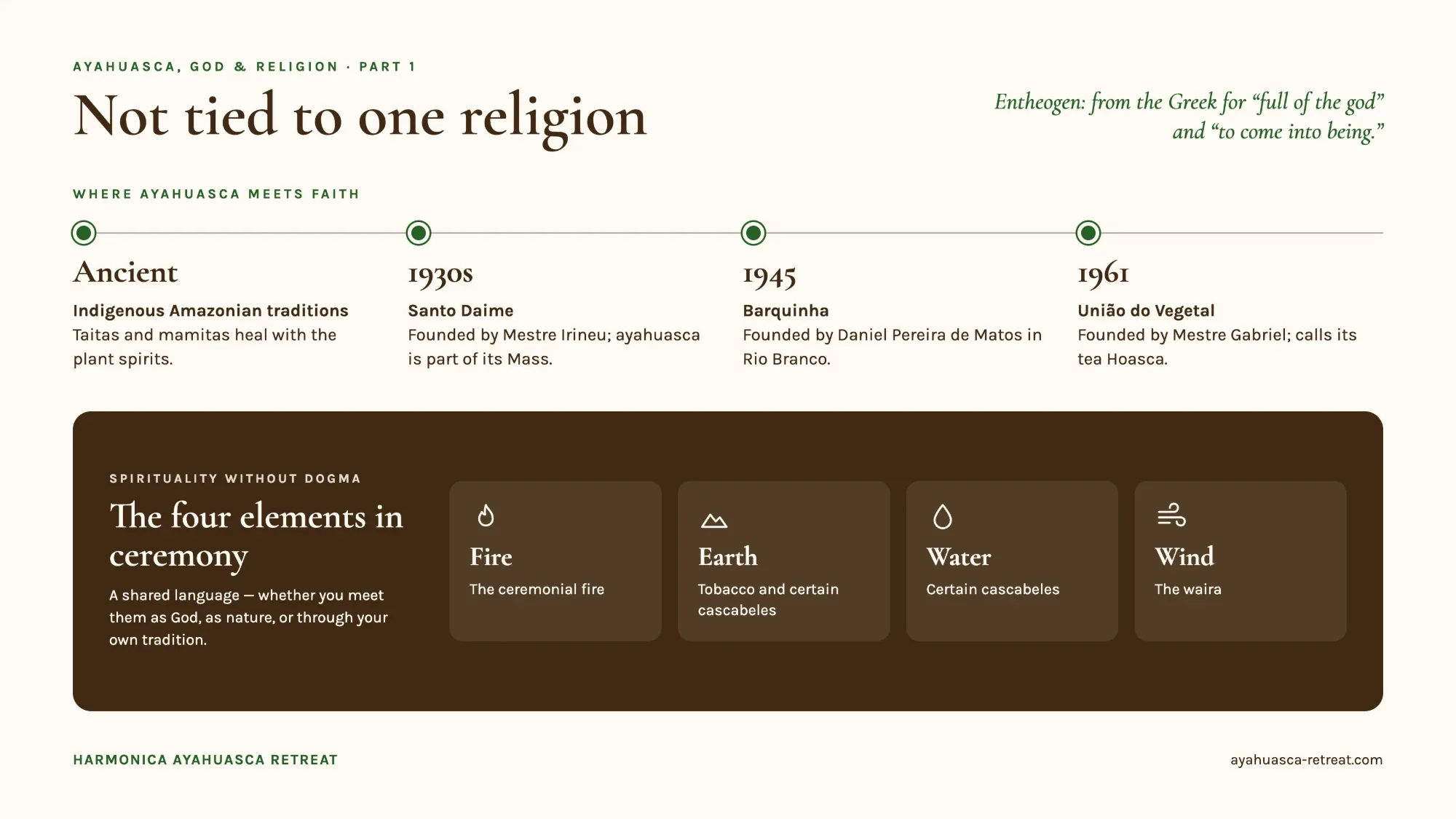
When discussing substances like Ayahuasca, the term “psychedelics” often comes up. However, a term that’s been gaining more traction in certain circles is “entheogen.” The word “entheogen” actually has roots in Ancient Greek. It comes from “entheos,” meaning “full of the god, inspired, possessed,” and “genesthai,” which translates to “to come into being.” So, in essence, an entheogen is something that causes a person to become full of divine inspiration or to feel connected to the divine.
In my opinion, it’s not a stretch to imagine that “psychedelic” experiences like an Ayahuasca ceremony could have played a role in the formation of early religions.
In a separate Blog we talk about the teachings of Mother Ayahuasca.
The Origin of Ayahuasca
The origins of Ayahuasca are deeply rooted in the spiritual traditions of indigenous peoples, particularly in the Amazon basin. The shamans, often called Taitas or Mamitas, were the traditional healers or “doctors” of their tribes.
Must read blog: Origin of Ayahuasca
“Ayahuasca connects us with our heart, where our own sacredness lies, and through that we can connect with the divinity which is all around us.”
– Sergio Henao
From “The Old Bearded Man in the Sky” to the Energy of the Universe: Shifting Perspectives on God
For those who grew up in strictly religious households, resentment towards God and religion often builds up. If you’ve been raised to believe that every move you make is being judged, that you’re inherently a sinner, and that missteps could send you straight to hell, it’s no wonder many end up feeling disconnected.
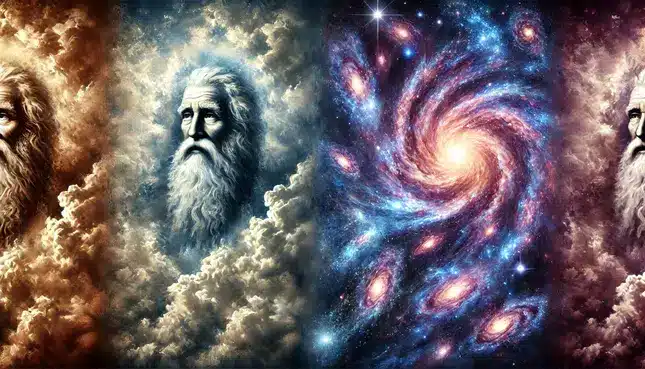
The image of God as an old bearded man in the sky, keeping tabs on our every action, feels distant and alien to many people today. However, in conversations with others, there seems to be a growing shift toward ideas like “the universe” or a “guiding energy.”
At Harmonica Ayahuasca Retreat, we like to say that Ayahuasca isn’t about dogma. We’re not here to push you in any particular direction or impose any belief system.
My Personal Journey with Ayahuasca, God and Religion
Growing up, my parents took an interesting approach when it came to religion. They told me I could choose a religion whenever I was ready, without pushing anything on me.
For most of my life, I would’ve described myself as agnostic. I figured maybe God exists, but I don’t know… I’ve never met Him. I believed there was something, maybe the universe or some higher power, at play, but I wouldn’t say I had a real connection to “it.”
It was through my journey with Ayahuasca that I connected with what I would call the divine spark. Interestingly, this wasn’t something I was actively seeking. I went into the ceremonies looking for healing, guidance, strength, and wisdom. And somewhere along that path, I encountered this divine energy. There’s a quote by Rumi that perfectly sums up this experience for me: “I searched for God and found only myself. I searched for myself and found only God.”
At first, I was just happy to have had that connection during the ceremony. But I wasn’t really integrating it into my daily life. It wasn’t until about a year later, during a particularly difficult time, that I got a clear message to surrender more and to start taking time each day to connect with that divinity, whicever word you want to use for it, God, Spirit, the universe. Since then, I’ve been doing better in terms of cultivating a practice with it.
Honestly, it’s been a huge help. It’s like having a big ally with me. It’s taken a lot of pressure off because I don’t have to be in charge of everything all the time. My job is to plant the seed and water it, but it’s the Holy Spirit, or whatever you want to call it, that makes the tree grow.
This is just my personal experience and I’m not here to preach.
People’s Experiences at Harmonica Retreat with Divinity
At Harmonica Retreat, we’ve had multiple participants share stories about how they connected with that divine spark, or what they might call God, through their Ayahuasca ceremonies. For some, the encounter with divinity wasn’t something they expected at all.
Some have linked their experience with divinity to Jesus, while others simply refer to it as “God.” And this connection isn’t exclusive to the Christian faith.
Religion Does Not Equal God
Personally, I think one of the biggest issues is that some religions, or at least certain interpretations of them, make us believe that the only way to connect with God is through organized religion. The problem with that is, once you introduce human structures, you also bring along human flaws: mistakes, greed, power struggles, and all the imperfections that come with being human.
But the thing is you don’t need organized religion to connect with divinity. You are the vessel for that connection. It’s within you, and anyone has the ability to tap into it directly, without a middleman.
That being said, religion can also be a valid path to God.
“In the end, we see this as an expression of personal freedom, the freedom for each person to live out their spiritual truth in the way that feels right to them.”
Indigenous Viewpoints on God and Divinity
There are many indigenous tribes, and I can’t claim to know or accurately represent all of their views, but I’d like to share a couple of powerful conversations I’ve had with shamans and healers that shed some light on their understanding of God and the divine.
Ayahuasca, God and Religion Viewpoint 1:
One shaman I spoke with shared that, in his eyes, the divine spark exists in every living being. He sees it in nature, in the birds, the wind, the trees, essentially, in all of creation. To him, divinity is what breathes life into this miraculous world.
Ayahuasca, God and Religion Viewpoint 2:
Another conversation that really stood out to me was with the grandson of Mama Concha, a sharp and insightful young man from a lineage of 12+ generations of Ayahuasca healers. He was only 16 years old at the time, but we had a long and profound discussion about the healing work his family has been doing for generations.
What struck me most was his explanation of how the healing happens. He made it clear that it’s not the Taita (shaman) who performs the healing. The shaman calls in the spirits of various plants, angels, and ultimately asks the great spirit, what we might call God, for healing on behalf of the person. The actual healing is in the hands of the divine.
He went on to say something that really stuck with me: “You won’t believe it, but there are people out there who don’t believe in God.” For him and his family, God is not just a belief, it’s a lived experience, something so deeply integrated into their daily lives and healing work that the idea of someone not believing in God was almost incomprehensible.
Religious Elements in Colombian Ceremonies
Colombia is a deeply Christian country, a legacy that traces back to the time of the Spanish Inquisition.
At some point, many indigenous groups adopted Christianity, finding parallels between their own beliefs and the new faith being introduced. When the Spanish spoke of the Virgin Mary, the indigenous responded by saying, “We know her, she’s Pachamama,” the spirit of Mother Earth who nurtures and sustains all life. Similarly, when the Spanish spoke of Jesus, the indigenous saw connections to the spirit they honored through the use of tobacco, which, in their worldview, represents light, healing, and the energy of the sun.
I once heard a story told by some tribes influenced by Christianity. They say the beard of Jesus fell to the earth and the ayahuasca vine grew from it. Whether you believe that story is for you to decide.
Interestingly, when foreigners come to ceremonies in Colombia, some feel a sense of sadness when they see that the indigenous people are practicing Christianity. But over the years, I’ve come to see that this is just a different expression of their beliefs, not necessarily a rejection of their heritage.
Sergio has noted that a few hundred years ago, the Spanish were troubled because the indigenous didn’t believe in Christ. Now, it seems, some visitors are troubled because they do believe in Christ. It’s almost ironic, really, it seems impossible to make everyone happy.
In our ceremonies at Harmonica Retreat, there are very few Christian elements. However, Juan Fernando occasionally includes some Christian prayers, either before the ceremony or sometimes during it.
The Four Elements as Spirituality Without Dogma
The four elements give people a way to connect with spirituality without asking them to accept one religious doctrine. Sergio likes to say that nature is something all of us can recognize, regardless of our beliefs. We live within nature, and water, fire, earth, and wind give us a shared language inside the ceremony.
In our ceremonies, fire appears through the ceremonial fire. Earth appears through tobacco and certain cascabeles. Water is represented by certain cascabeles, while wind is represented by the wayra.
Different prayers and songs also speak about the four elements. A Christian may connect the elements with God, and another person may understand them through nature or through their own tradition.
For me, this makes the ceremony more open.
Faith-Based and God-Centered Ayahuasca Retreats
A faith-based or God-centered Ayahuasca retreat is one that builds the ceremony around a specific idea of God, usually with prayer, and sometimes inside a church such as Santo Daime.
At Harmonica Retreat we don’t run a God-centered container in that strict sense. We keep the space open, so a Christian can pray, a Buddhist can sit, and a person with no religion can just meet themselves without anyone handing them a God. In Colombia the one holding the ceremony is often a taita, an indigenous elder whose lineage carries its own relationship to the spirit of the plant.
If you are looking for a retreat that keeps you inside one religion the whole way through, a church like Santo Daime will serve you better. If you mostly want to meet God in your own words, an open container like ours fits well.
A faith label on the website tells you nothing about safety on its own, so screen the people running it with our checklist for choosing a safe Ayahuasca retreat. If you take medication or carry a mental-health history, talk to a doctor and a screened facilitator first.
Ayahuasca Religions and Churches: Santo Daime, UDV and Barquinha
One example of a religious organization that incorporates Ayahuasca into its practice is Santo Daime. In their ceremonies, Ayahuasca is used as part of their Mass and serves as a way to connect with God.
Santo Daime was founded relatively recently, in the 1930s, which is quite new when you consider how long Ayahuasca has been used by indigenous peoples. What’s important to understand is that Santo Daime is just one interpretation of how Ayahuasca can be used.
If you’re interested, you can learn more about Santo Daime at santodaime.org.
It’s also worth mentioning that in the United States, there is a legal loophole that allows Ayahuasca ceremonies to take place legally if they are conducted within a religious context.
Mestre Irineu founded Santo Daime, and it is one of the Brazilian ayahuasca religions, together with the União do Vegetal and the Barquinha. Created on July 22, 1961, by José Gabriel da Costa, known as Mestre Gabriel, the União do Vegetal describes itself as a religion with Christian and reincarnationist foundations and calls its tea Hoasca. The Barquinha was founded by Daniel Pereira de Matos in 1945 in Rio Branco.
A religious ayahuasca organization like these gives you a fixed doctrine and hymns, while a retreat like Harmonica gives you an open container with a taita.
Key Points and Conclusion
Once again, I want to emphasize that Ayahuasca isn’t about dogma. You don’t need to subscribe to any particular belief system to experience its profound effects. At Harmonica Retreat, no one is preaching which path you should follow or what you should or shouldn’t believe.
Whenever you’re ready, Ayahuasca is simply there to hold space for whatever unfolds.
FAQs
What religion is associated with ayahuasca?
Ayahuasca is not tied to a single organized religion, but it is central to indigenous Amazonian spiritual traditions and to syncretic churches such as Santo Daime and Uniao do Vegetal that blend it with Christianity. People of many faiths and none use it.
Do I need to believe in God or follow a specific religion to experience Ayahuasca?
No, you don’t need to adhere to any particular belief system to participate in an Ayahuasca ceremony. Ayahuasca is not about dogma, and at Harmonica Retreat, we don’t push any religious or spiritual beliefs. Whether you have a religious background, consider yourself spiritual, or have no beliefs at all, Ayahuasca is about connecting with yourself and whatever unfolds in the process.
Is ayahuasca against Christianity?
Ayahuasca is not a Christian practice, and most mainstream churches do not endorse it, though many individual Christians drink it and describe feeling closer to God. Whether it fits your faith is a question for you and your own community, not a rule we can hand you.
What does the Bible say about ayahuasca?
The Bible says nothing about ayahuasca directly, because it is an Amazonian plant brew and the biblical texts were written long before Europe knew the Amazon existed. People who raise the question usually point to broader passages about sober-mindedness or about the body as a temple, and they read those both for and against it.
Are there faith-based or God-centered ayahuasca retreats?
Yes, faith-based and God-centered ayahuasca retreats exist, ranging from formal churches like Santo Daime that build the ceremony around Christian prayer to looser gatherings that simply invite you to pray in your own words. At Harmonica Retreat we keep the container open rather than tied to one religion, so if you want a strictly doctrinal frame a church like Santo Daime will fit you better. Whichever you choose, screen the facilitators for safety before anything else.
Is ayahuasca demonic?
No, the Harmonica view is that ayahuasca is not demonic. Ceremony can bring difficult personal truths into view, while many people also report becoming closer to God or reconnecting with their faith.
What is Christ consciousness in an ayahuasca ceremony?
Christ consciousness usually means an inward connection with Christ or with the divinity a person associates with Christ. Some people experience it visually, while others feel it within themselves.