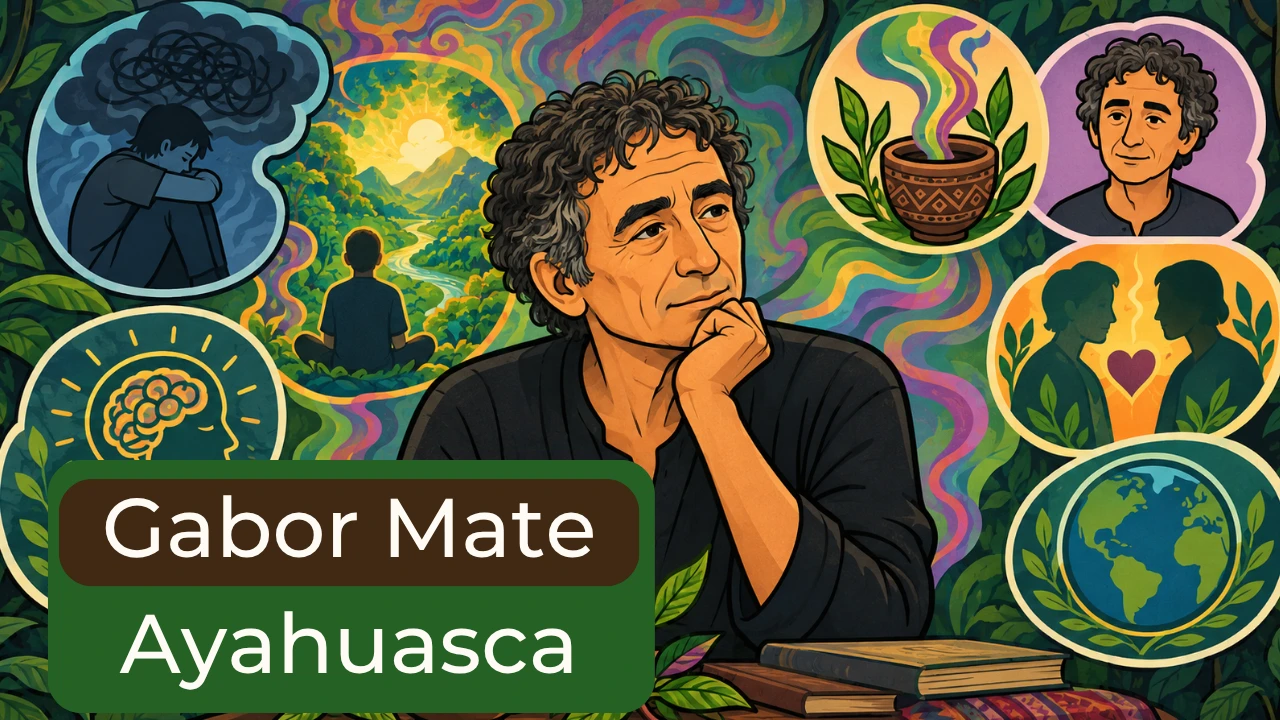
Gabor Maté has worked directly with ayahuasca for more than ten years. He is a retired Canadian physician who specialised in addiction medicine and spent twelve years working with people with severe addiction in Vancouver. He asked what pain sat underneath the substance or behaviour, and what the person was trying to escape.
Around 2009, he began organising multi-day ayahuasca retreats in British Columbia. At 75, he went to Peru to co-lead a retreat for healthcare professionals. Within moments, the Shipibo healers saw how much he needed to clear. They assigned a maestro to him.
I came to Maté through his books and talks, but I have never met him and Harmonica has no connection to him.
Key takeaways
- He ran his own retreats. From around 2009, Maté organised occasional multi-day retreats for people dealing with addiction and stress.
- He is a physician. Maté worked in family practice and addiction medicine. He is not a psychiatrist, psychologist, or licensed psychotherapist.
- A small study followed the retreats. It involved twelve participants, had no control group, and relied on self-reported substance use.
- His own ceremony corrected him. Maté went to Peru believing one deep trauma needed clearing. He left focused on the daily work of caring for who he was being.
- He recommends no retreat named here. That includes Harmonica. Maté has also warned about financial exploitation and sexual abuse in retreat settings.
Looking to attend a Ceremony? Book a free 30-minute phone call.
The Credentials Behind His Work
Gabor Maté is a retired Canadian physician who specialised in addiction medicine. He is not a psychiatrist, psychologist, or licensed psychotherapist.
He earned his medical degree from the University of British Columbia in 1977 and worked in general family practice. He later spent twelve years as a staff physician for the Portland Hotel Society in Vancouver’s Downtown Eastside, working with people experiencing severe addiction.
Maté also spent seven years as medical coordinator of the palliative care unit at Vancouver Hospital. He was made a Member of the Order of Canada in 2018.
He was born in Budapest in January 1944 and emigrated to Canada in 1956. His books include *In the Realm of Hungry Ghosts*, *Scattered Minds*, *When the Body Says No*, and *The Myth of Normal*.
His wider work asks how what happened early in life can shape the coping mechanisms a person carries into adulthood. *Scattered Minds* deals with attention deficit hyperactivity disorder (ADHD), while our separate guide looks at ayahuasca and ADHD.
His titles also appear among our books worth reading before a ceremony. Maté’s ayahuasca story differs from those of many other public figures who have spoken about ayahuasca because he did more than describe a personal ceremony. He organised retreats himself and brought healthcare professionals into the work.
Gabor Maté’s Ayahuasca Retreats in British Columbia
From around 2009, Maté began running occasional multi-day retreats called *Working with Addiction and Stress*. The retreats took place in a Coast Salish First Nations community in British Columbia.
The ceremonies were held in the band’s longhouse, a traditional ceremonial space blessed by band elders. A Shipibo master ayahuasquero led the ceremonies together with three non-Indigenous Canadian apprentice ayahuasqueros.
Maté did not pour the medicine. He organised the retreats and worked with participants, while the ayahuasqueros held the ayahuasca ceremonies.
Over roughly two years, he worked with somewhere in the region of 150 to 200 people. Most came from the Vancouver area and were dealing with addiction.
This fits his central argument. The work was less about removing a substance from somebody’s life, more about understanding the pain and escape underneath its use.
In November 2011, Health Canada told Maté to stop. Health Canada warned that continuing could bring legal action under the Controlled Drugs and Substances Act, and the matter was referred to the Royal Canadian Mounted Police (RCMP).
Maté complied. He told CBC News that stopping was not a big personal loss for him, but he felt it was a loss for people who could benefit from the work.
He also said at the time that he had no intention of breaking the law. His hope was to receive permission to use ayahuasca in a therapeutic context.
The retreats ended, but researchers had already observed some of the work. Their later paper gave a small and limited picture of what participants reported.
What the Twelve-Person Ayahuasca Study Found
Researchers from the University of Victoria and the University of British Columbia observed Maté’s retreats and published a paper in 2013. Gabor Maté was not an author or co-author of that study.
The researchers thanked Maté and his retreat team in the acknowledgements. The named authors were Gerald Thomas, Philippe Lucas, Neill Capler, Kenneth Tupper, and Gina Martin.
The study followed twelve participants. It reported improvements in hopefulness, empowerment, mindfulness, and quality of life, along with a statistically significant reduction in problematic cocaine use.
Those findings came with serious limits. The study was observational, had no control group, and relied on self-reported substance use without laboratory verification.
Twelve self-reporting participants cannot establish that ayahuasca treats addiction. The study describes what happened within one small group and gives later researchers a question to examine.
One person can read the reported changes and decide that ayahuasca has proven itself as a treatment. Another can see the study limits and decide the participants’ experiences mean nothing.
Both reactions ask the paper to carry more than it can. The participants reported changes worth listening to, and the research design cannot prove what caused those changes.
That distinction is important when talking about ayahuasca and addiction. A ceremony may help someone see a coping mechanism from another angle. The responsibility for what happens afterwards remains with the person.
Peru Changed the Question He Was Asking
Dr. Gabor Maté on his June 2019 retreat at the Temple of the Way of Light.
Maté went to the Temple of the Way of Light in Peru in June 2019. It was his first experience drinking ayahuasca in the Amazon with the Shipibo, although he said he had already worked with ayahuasca for more than ten years in North America, Peru, and Colombia.
He Went to Help Lead the Group
Maté travelled to Peru to help co-lead a retreat for western healthcare professionals. He listed physicians, psychiatrists, specialists, psychologists, counsellors, and psychotherapists among the participants.
He arrived expecting to help hold the group. To his surprise, the Shipibo healers focused on him.
Maté said the healers found it striking that a group of people devoted to helping others arrived carrying more than many groups. In his account, healers absorb something from the suffering they work with, while western medical training does not teach them how to clear it.
That does not make every doctor secretly broken. It points toward a common dynamic: caring for other people can become another way to avoid attending to yourself.
The Healers Assigned Someone to Work With Him
Within a few moments of being with Maté, the Shipibo healers saw that he carried something requiring attention. They assigned a maestro to work with him individually.
Maté gave himself fully to the five days. He stayed away from email and the internet, stopped helping other people, and did not concern himself with anyone else’s process.
For him, withdrawing that attention from everybody else became an act of valuing himself. The container gave him permission to receive care instead of always being the person providing it.
The Ceremony Corrected His Assumption
Maté arrived believing that one deep trauma needed to be cleared. He thought this uncleared trauma was creating the blockages in his life.
He came away saying that assumption was wrong. He stopped asking which trauma needed one final clearing and started asking whether he was caring for who he was each day.
This is the part of his account I connect with most. It takes the ceremony out of the fantasy that one big experience will finish your inner work.
The work became less about one dramatic clearing, more about whether Maté did his homework every day. Was he caring for himself? Was he present with the person he was being? Was he returning to the same patterns once the retreat ended?
One person hears about his five days and decides the right ceremony will clear everything. Another person hears that daily work is required and decides the ceremony itself has no value.
Maté’s account gives room to both parts. The retreat affected him deeply, and also the experience handed responsibility back to him.
Ayahuasca did not take over the driver’s seat of his life. It helped him see the work, and the decision to do that work remained his.
The Addiction Is Often Covering Something
Maté’s central argument is that the substance or behaviour is not the root problem. The addiction often functions as a coping mechanism for pain the person does not know how to hold.
His Argument Goes Beneath the Behaviour
The useful question becomes less about why somebody uses cocaine, more about what the cocaine does for that person in the moment. Does it numb something, create energy, soften loneliness, or offer an escape?
The specific answer is different for every person. That is why Maté asks what pain sits underneath the addiction and what the person is trying to escape.
This applies beyond illegal drugs. It can apply to alcohol, food, shopping, work, or compulsive pornography use. A behaviour does not need to contain a chemical substance to become a coping mechanism.
One person sees this and uses the explanation as permission to continue. Another sees only the behaviour and tries to punish it out of themselves.
Understanding the pain does not remove responsibility. It gives you a more accurate place to begin your homework.
The Man Who Came to Stop Using Cocaine
I remember a man who came to our finca after his father had died and his cocaine use had become severe. He arrived wanting to get rid of the cocaine.
The death and the grief belong to the history of what had happened. I cannot tell you that grief was what he was escaping, because that would be my guess rather than his experience.
After conversations and ayahuasca ceremonies, he understood what he had been running from. That insight changed how he saw the cocaine.
The work was less about fighting cocaine as an isolated enemy, more about meeting what the cocaine had been covering. This is exactly the distinction Maté makes in his work.
The man returned to another retreat about a year later and said he had not used cocaine during that time. Beyond that year, I do not know what happened.
I think the limit belongs in the story. We saw him return after about a year without using, and I cannot turn that into a lifelong outcome.
What Sugar Was Covering for Me
My own example is smaller. I used to have an addictive pattern with sugar, but I would not describe it as a deep addiction.
Sugar has its own addictive pull. For me, there was also something I wanted to sweeten in my life.
When I felt stressed, alone, or touched by abandonment, sugar became my go-to coping mechanism. The pattern gave me something sweet at the exact moment I did not want to feel what was happening inside.
Seeing that did not make sugar responsible for my emotional life. It showed me the conversation I had been avoiding.
And by seeing the pattern, I had more choice around it. The choice still remained mine.
His Support Comes With Serious Warnings
Maté has spoken positively about ayahuasca while also warning people about the conditions around it. His enthusiasm and his caution appear in the same 2015 opinion piece.
He wrote in *The Globe and Mail* that ayahuasca may achieve in a few sittings what years of psychotherapy can only aspire to do. He described the medicine as putting people in contact with repressed pain and trauma.
At the same time, he called ayahuasca “not a panacea” and said nothing works for everyone. He also warned that unscrupulous practitioners can exploit ayahuasca for financial gain.
His warning went further. Maté wrote about healers preying sexually on vulnerable clients, most often young women.
A person considering a retreat has to examine the people, the boundaries, and the whole container around the ceremony. Maté himself says healing involves the context and the way the experience is made available.
One person hears his praise and stops asking questions about the retreat. Another hears his warnings and assumes every retreat is dangerous.
A name like Gabor Maté cannot make the decision for you. You need to look at who runs the ceremonies, how they speak about risk, how they handle vulnerability, and whether they promise outcomes nobody can guarantee.
The Responsibility After Ceremony
Maté’s story gives ayahuasca a serious place in conversations about trauma and addiction. It also refuses the idea that a ceremony removes the need for daily work.
That balance is close to how we approach trauma healing with ayahuasca at Harmonica. The ceremony can bring a person into an extraordinary conversation with themselves, but the actions after that conversation remain theirs.
We host more than 30 retreats a year at our finca near Medellín, about an hour from Laureles and Poblado. Ceremonies are held in English or Spanish, and I continue training under Sergio while drinking the medicine myself.
None of this creates an association with Maté. He has never endorsed Harmonica, and I have never met him.
We also do not present his experience as a reason that every person should drink ayahuasca. Knowing what people come to work on can help start a conversation, but the timing, medical situation, and readiness of one person can differ completely from those of another.
One person wants the ceremony to decide everything for them. Another spends years waiting until every uncertainty disappears.
The first person needs to slow down and take responsibility for the choice. The second may need to ask the questions directly instead of using uncertainty as another hiding place.
For me, Maté’s story is less about borrowing confidence from a famous physician, more about looking at your own situation without self-deception. You stay in the driver’s seat before the ceremony, during the integration, and in the life you build afterwards.
If you are deciding whether ayahuasca fits your life at this moment, Jenna Ram can discuss that question with you on a free 30-minute consultation call.
FAQs
Is Gabor Maté a psychiatrist?
No. Gabor Maté is a retired Canadian physician who worked in general family practice and specialised in addiction medicine. He is not a psychiatrist, psychologist, or licensed psychotherapist. His experience includes twelve years working with severe addiction in Vancouver’s Downtown Eastside and seven years coordinating palliative care at Vancouver Hospital.
Where did Gabor Maté do ayahuasca?
Maté said he worked with ayahuasca in North America, Peru, and Colombia over more than ten years. His documented retreats for people dealing with addiction took place in a Coast Salish First Nations community in British Columbia. In June 2019, he drank ayahuasca with the Shipibo in the Peruvian Amazon for the first time. He was 75 and had travelled there to help co-lead a retreat for western healthcare professionals.
Does Gabor Maté recommend an ayahuasca retreat?
Maté recommends no specific retreat that this page can name. He ran his own retreats in British Columbia, but stopped after Health Canada intervened in November 2011. He has also warned about retreats that exploit people financially and healers who prey sexually on vulnerable clients. Harmonica Ayahuasca Retreat has no relationship or association with Maté, and this page does not imply his endorsement.
What does Gabor Maté say about addiction?
Maté argues that addiction is often an attempt to escape or soothe pain. The substance or behaviour can become a coping mechanism, while the pain underneath remains unaddressed. Understanding that pain does not excuse harmful behaviour. It gives the person a clearer starting point for changing the pattern and taking responsibility for what happens next.
Can ayahuasca help with addiction?
Some people report that ayahuasca helped them see the pain or coping mechanism beneath an addiction. Ayahuasca is not an addiction treatment, and no ceremony can guarantee recovery. The 2013 observational study connected to Maté’s retreats reported several positive changes, including reduced problematic cocaine use. It involved only twelve participants, had no control group, and used self-reported substance use without laboratory verification.