
What Is Holotropic Breathwork in Its Classic Form?
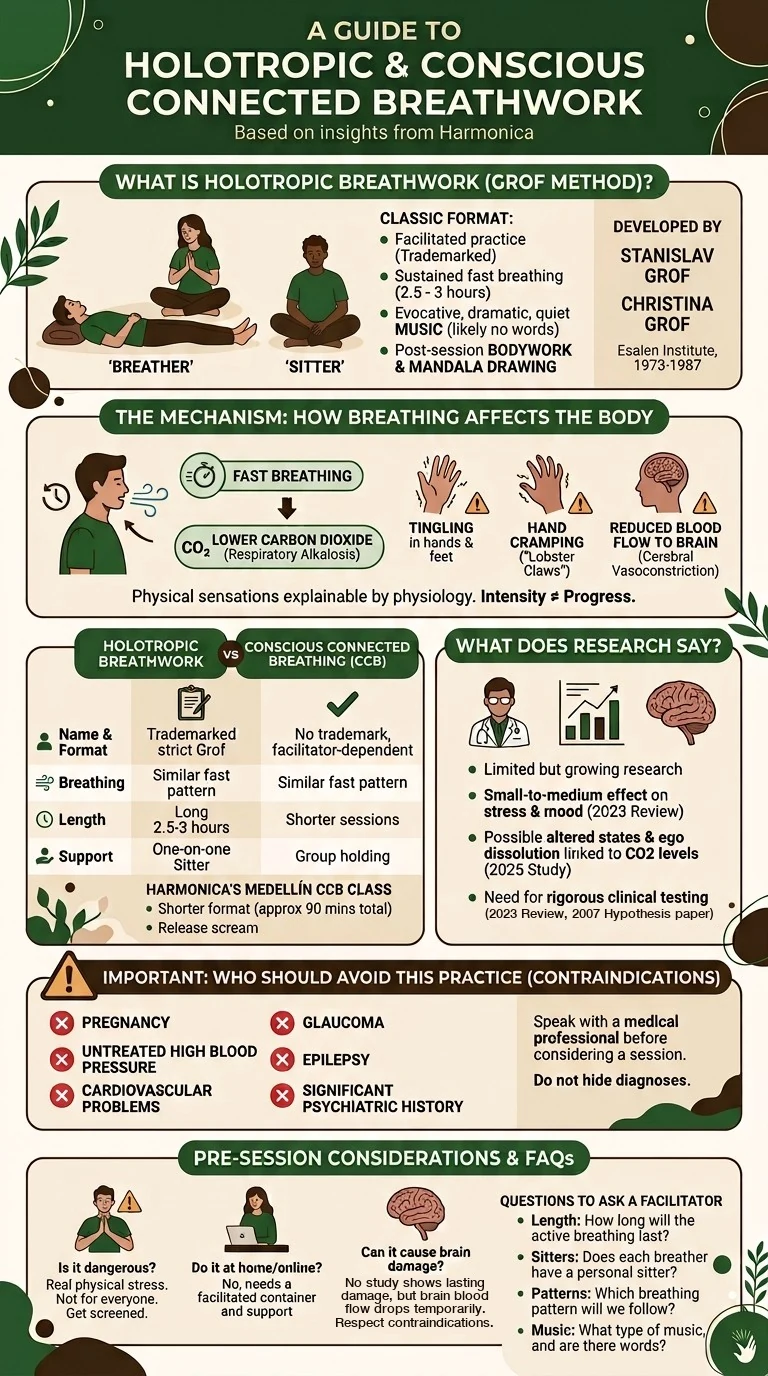
Classic holotropic breathwork lasts two and a half to three hours. Grof Transpersonal Training says shorter sessions should not be called Holotropic Breathwork.
Holotropic Breathwork® is a registered trademark taught by Grof Transpersonal Training through certified facilitators. I have heard reports of people, in a way, turning into a wolf during a long session. That intensity is why the personal sitter matters.
The Principles of Holotropic Breathwork describes a clear music arc: evocative and stimulating, then dramatic and dynamic, reaching a breakthrough before becoming quiet, peaceful and meditative. As I understand it, the music has no words. Words can direct the mind through associations, while rhythmic music leaves your subconscious more space to lead.
Holotropic comes from Greek: holos means whole and trepein means moving toward, describing a movement toward wholeness.
The spiritual name can create expectations before somebody starts breathing. They expect to become whole within three hours, then judge the session against what they imagined. The name describes the method’s intention, but it promises no specific result in one session.
In a classic session, one person breathes while a personal sitter stays beside them. Then they swap roles, with music continuing throughout. Bodywork and mandala drawing may follow.
If you are unsure whether holotropic breathwork fits you, discuss the intensity and format during our free consultation call.
Who Created Holotropic Breathwork?
Stanislav and Christina Grof created Holotropic Breathwork at the Esalen Institute from 1973 to 1987. According to Grof Transpersonal Training, Stanislav was Scholar-in-Residence at Esalen in Big Sur for those years.
Before Esalen, Stanislav researched LSD and other psychedelic substances at the Psychiatric Research Institute in Prague. The framework later drew on psychedelic research, anthropology, depth and transpersonal psychology, and spiritual traditions.
If you come to this through ayahuasca, I think this background makes the connection easier to understand. The interest in non-ordinary states remained, while facilitated breathing replaced the psychedelic substance inside a supported container.
What Happens in Your Body During Holotropic Breathing?
Sustained fast breathing lowers carbon dioxide in the blood, causing respiratory alkalosis and cerebral vasoconstriction. The StatPearls chapter on hypocarbia lists painful tingling in the hands and feet. The vasoconstriction also reduces blood flow to the brain.
Hands can cramp. Tingling and cramping usually ease within a few minutes after normal breathing resumes.
People can give these sensations a spiritual meaning when their hands tighten, or fear something has gone seriously wrong. The carbon dioxide change gives a concrete physical explanation. That explanation does not define the emotional experience, but it can help you stay grounded in your body.
Intensity can feel like progress, so you breathe faster and the sensations increase. Then you assume the session works better. A more intense session is not a better session. Intensity is not the measurement.
What Happens in a Full Holotropic Breathwork Session?
A full session gives the breather space to stop talking and following normal conversation, while music supports the process.
Having a sitter beside you creates trust for some people. For others, feeling watched brings uncertainty or exposes coping mechanisms, so the same setup can feel uncomfortable.
Music shapes the atmosphere, but you do not need to perform a reaction by crying, seeing images or remembering an old event.
One person may be loud while another lies quietly. From outside, you cannot know what either person is experiencing.
Bodywork and mandala drawing give the experience another form. The mandala is not an art test. It puts the experience on paper before you turn it into a story.
Is It Normal to Cry, Shake or Shout During Breathwork?
Yes, crying, shaking or shouting can happen during an intense breathwork session. These expressions may look alarming if you expected quiet meditation.
A strong expression alone does not reveal the experience. It may come from sadness, music or physical intensity, or the person may have no words yet.
I think we need humility when interpreting another person’s process. Crying does not automatically mean childhood trauma was released, and silence does not mean somebody was blocked.
Facilitators see these expressions often, but a strong process should not always be pushed further. The sitter and wider container matter because somebody is present when the process becomes strong.
“People are often surprised by how powerful of an exercise it is and how much can be released just with the medicine of one’s own breath.”
 — Oliver Glozik
Founder of Harmonica Retreat in Medellín, Colombia.
How Is Holotropic Breathwork Different From the Wim Hof Method?
The Wim Hof Method uses a distinct round-and-hold pattern: roughly 30 breaths, a breath hold and around 15 seconds of recovery breathing, repeated three to four times.
The method commonly pairs with cold exposure. Its instructions warn that the breathing can cause loss of consciousness and must never be practised in or near water.
If you do cold immersion, do the breathing out of the water. Never hold your breath during cold immersion.
Classic holotropic breathwork follows the longer Grof format described above. Conscious connected breathwork is another label you may encounter, and it is what we offer. The next section explains the differences. Ask the facilitator what will happen rather than assuming a familiar label guarantees a specific format.
Two fast-breathing classes can feel very different because each facilitator chooses the length, support and specific breathing instructions.
Holotropic Breathwork vs Conscious Connected Breathwork (CCB): What Is the Difference?
Conscious connected breathwork (CCB), also called conscious connected breathing, uses similar breathing in less formalised sessions. I believe the strict Holotropic Breathwork trademark partly makes CCB far more common.
I think there is a huge overlap between the two, but obviously the time period is a lot different: Holotropic Breathwork lasts two and a half to three hours, while CCB is much shorter.
The shorter format can be a good first connection with this breathing. You experience the rhythm, physical sensations and your response, while longer sessions can go deeper as you gain experience.
A 2025 study by Havenith found highly similar outcomes (see below).
I like CCB in a group. Hearing others breathe helps you enter the rhythm during the hard first part, and I find people sometimes go less deep alone.
Our breathwork class in Medellín is CCB, not Holotropic Breathwork. I am not certified by Grof Transpersonal Training, so we do not use the name for what we offer. The conscious overbreathing part runs about 30 minutes.
| Element | Classic Holotropic Breathwork | Conscious Connected Breathwork (CCB) |
|---|---|---|
Name and format | A registered trademark with a strict Grof format and certified facilitators | There is no trademarked format, so it depends on the facilitator |
Breathing | Faster and deeper than usual, sustained through the session | Similar connected, intense breathing; ask for the exact pattern |
Length | Two and a half to three hours of breathing | Usually much shorter; our Medellín class has about 30 minutes of conscious overbreathing |
Support | A personal sitter beside each breather, and the pair swaps roles | Depends on the facilitator; in our class I hold the whole group and come closer when somebody needs it |
Music | Moves from evocative to dramatic to quiet; as I understand it, without words | Depends on the facilitator and can include words |
Other elements | Bodywork and mandala drawing | In our class, a release scream at the end of the intense breathing |
Practical verdict | Choose this when you want the full Grof structure and have been screened for contraindications | A good first connection with this kind of breathing if none of the contraindications apply; with experience, longer sessions can go deeper. |
Does Holotropic Breathing Have Proven Benefits?
Breathwork research shows some benefits, but does not prove that classic holotropic breathwork treats a medical condition. A 2023 meta-analysis in Scientific Reports pooled 12 randomised controlled trials involving 785 adults. It found a small-to-medium effect on stress and mood, with a moderate risk of bias.
The meta-analysis covered breathwork practices more broadly. It did not show that a full Grof session produces the same outcome for everyone or justify replacing medical or psychiatric care.
People misuse these findings in two directions. One person dismisses a small-to-medium effect because it was not huge. Another presents any effect as treatment for every emotional struggle. Both go beyond the evidence, which still carries uncertainty because of the moderate risk of bias.
Your experience remains your own. Feeling calmer does not predict everybody’s response, while a difficult session does not prove the method harms everybody.
Havenith and colleagues' 2025 study tracked physiology and experience during Holotropic and Conscious-Connected breathwork. During deliberate hyperventilation, lower exhaled carbon dioxide correlated with altered states resembling psychedelic experiences, including ego dissolution. Deeper states predicted follow-on effects such as improved well-being and reduced depressive symptoms. Both breathwork approaches produced highly similar outcomes. The paper also declares that several authors are trained breathwork facilitators, a conflict of interest to keep in mind.
A separate 2023 review led by Fincham, in Neuroscience & Biobehavioral Reviews, reported strong changes in subjective experience and effects on the central and autonomic nervous systems. It also said possible benefits for trauma-related, mood and somatic conditions need further research and rigorous clinical testing. The review did not run its own trial. The 2007 Rhinewine and Williams paper was a hypothesis paper proposing Holotropic Breathwork alongside ongoing psychotherapy and calling for research to confirm or refute the idea.
Who Should Not Do Holotropic Breathwork?
Some medical or psychiatric histories require individual medical guidance before joining holotropic breathwork. Grof-lineage contraindications include:
- Pregnancy
- Untreated high blood pressure
- Cardiovascular problems
- Glaucoma
- Epilepsy
- A significant psychiatric history
A general description like this one cannot decide whether a session suits your history. If any contraindication applies, speak with a qualified medical professional first.
Two types of people ask. One has a listed condition and wants to hear, “It will probably be fine.” The other has no known condition but feels unsure about the intensity or screening.
They need different answers. The first person needs medical guidance and may need to avoid the session. The second needs clear details about the format, physical effects and support.
Do not hide a diagnosis or accept pressure from anyone claiming breathwork is safe for everybody. A responsible no can protect you from an unsuitable session.
Is Holotropic Breathwork Dangerous?
Holotropic breathwork puts real physical stress on the body and is unsafe for some people.
Fast breathing temporarily reduces blood flow to the brain, as the StatPearls chapter explains. Strong sensations can feel meaningful or frightening, but intensity does not show suitability. Give accurate information during screening.
Can Holotropic Breathwork Cause Brain Damage?
No cited study reports lasting brain damage from holotropic breathwork, from Rhinewine and Williams in 2007 to Havenith in 2025. None was designed to rule it out.
Sustained fast breathing causes a documented temporary reduction in brain blood flow. This proves neither lasting brain damage nor safety for everybody.
Take the contraindications seriously because the long-term picture remains unknown. If a listed condition applies, ask a doctor before joining.
What Breathwork Do We Offer in Medellín?
Harmonica runs a shorter weekly CCB class alongside our ayahuasca work, and you can read the practical details for our weekly breathwork class in Medellín.
Before anyone joins, we screen for heart disease and other cardiovascular conditions, psychiatric conditions, pregnancy, and the same contraindications that apply to holotropic breathwork. CCB is not suitable for everybody.
We also use breathwork for ayahuasca preparation, helping people meet strong sensations and notice their response as control loosens.
During integration, breathwork gives space for emotions and ceremony insights. The homework remains yours, and no breathing session can take responsibility for it.