A psilocybin retreat at Harmonica is a screened mushroom ceremony near Medellín, available as a public group ceremony or a private booking. We host more than 30 ayahuasca retreats a year, and we also hold mushroom ceremonies in English or Spanish.
People often come with two opposite expectations. One person expects mushrooms to fix their life in one evening. Another person is so nervous that they prepare for something terrible. Both expectations can take you away from the experience in front of you.
A mushroom ceremony can bring insights, emotions, memories, confusion, resistance, or a level of calmness. It can also be that the experience develops slowly. Whatever comes up, the ceremony does not remove you from the driver’s seat of your life.
Looking to attend a Ceremony? Book a free 30-minute phone call.
What We Mean by a Psilocybin Retreat
A mushroom ceremony is a structured period in which you take mushrooms and stay within a held container for the experience. In the traditional Mazatec framing, mushrooms are called Niños Santos, meaning the Holy Children.
Mushroom ceremonies tend to have a looser structure than ayahuasca ceremonies. The music can be more varied, and conversation is sometimes possible. A mushroom ceremony commonly lasts four to six hours.
Looser does not mean casual. You are entering an extraordinary state, and that asks for a level of seriousness before, during, and after the ceremony. The structure leaves some room for your process without treating the evening like a social gathering.
We like to describe a psychedelic ceremony as a conversation you are having with yourself through the medicine. It can be a loving conversation. It can also be difficult or confusing. It can also be that you understand something during the ceremony and only see its relevance several days later.
You do not need to force the experience into a story while it is happening. Chasing a specific vision can be a little bit like chasing a butterfly. The more aggressively you run after it, the further away it can move.
How Mushrooms Differ from Ayahuasca
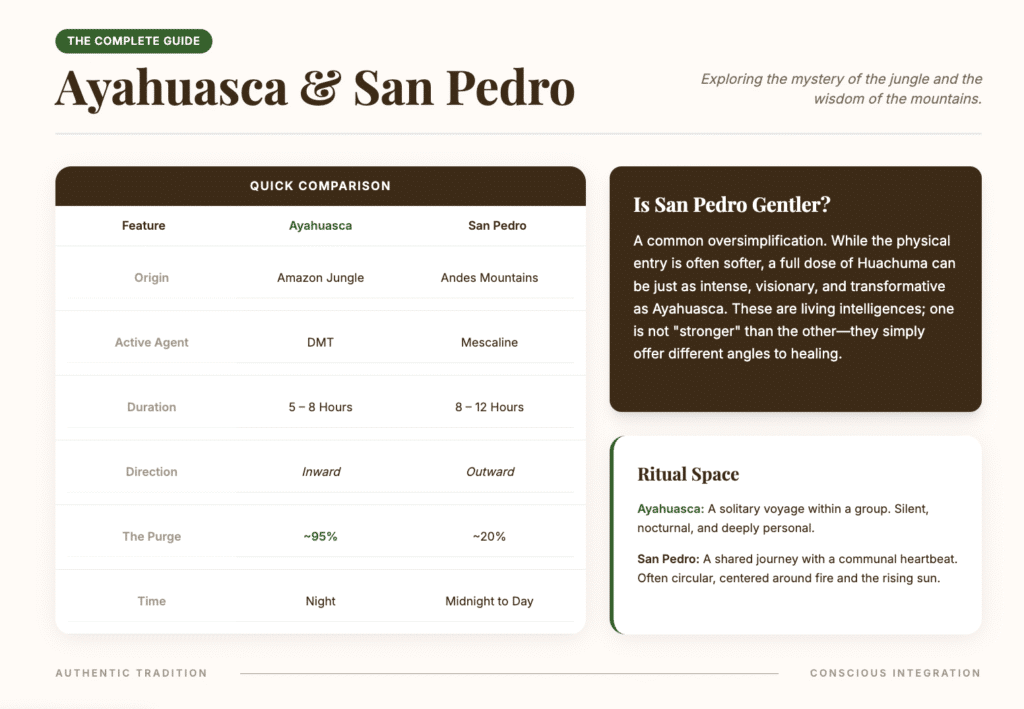
Mushroom ceremonies generally allow a looser flow than ayahuasca ceremonies. Ayahuasca tends to have a more defined ceremonial structure, while mushroom music and interaction can vary more.
Somebody can hear this and conclude mushrooms must be the easier choice. That conclusion does not follow. A looser structure tells you something about the container. It does not predict the level of intensity you will experience.
There are also different types of people. One person feels grounded when the evening follows a defined structure. Another person becomes tense when every part of the ceremony feels fixed and prefers some room for conversation. The same recommendation does not apply to both people.
Your relationship to the medicine also plays a role. It can be that mushrooms feel familiar to you. It can also be that you feel more called toward ayahuasca. It can also be that neither ceremony fits where you are at this moment.
Ayahuasca and mushrooms belong in separate ceremonies. Reputable operators keep the medicines separate rather than stacking them together. Combining them does not prove courage, experience, or spiritual maturity.
If you are weighing both paths, read how ayahuasca and mushrooms compare. Use the differences to ask better questions about your needs instead of deciding which medicine sounds more impressive.
Public Group Ceremonies and Private Bookings
Harmonica offers every ceremony as a public group ceremony and as a private booking. Both formats are available with English or Spanish support.
A public mushroom ceremony means your process happens in the presence of other participants. You remain responsible for your own experience, and there is also a shared container around the evening.
A private ceremony removes the presence of other participants. Some people prefer this because they notice themselves monitoring everybody around them. Other people isolate whenever life becomes uncomfortable, and a group setting may ask them to keep staying present around others.
So again, private does not automatically mean better. Group does not automatically mean better either. Look at the kind of person you are and the pattern you tend to repeat.
Ask yourself a few direct questions. Do you become distracted by other people’s emotions? Do you use privacy to avoid being seen? Would a group bring support, or would you spend the ceremony trying to understand what everybody else is doing?
A private booking follows the same screening process. Paying for privacy does not bypass a conversation about whether you should take part.
Screening Comes Before Booking
Screening comes before every booking because some people should not participate in a mushroom ceremony. A careless operator can hurry past this conversation because the person is ready to book, but readiness to pay says nothing about suitability.
One of the four subjects covered on Harmonica’s consultation call is whether a ceremony is right for you at this moment in your life. Timing matters because a person can feel drawn toward an experience while also being in a situation that needs another kind of support.
Anyone with a personal or close family history of psychosis, schizophrenia, or bipolar disorder should not take part. This is a firm boundary. Somebody in an acute crisis needs a doctor or therapist this week rather than a ceremony several months from now.
Screening also depends on you giving complete information. If you hide part of your history because you want a yes, the conversation cannot do its job. And by treating screening as an obstacle, you remove the part that is meant to identify whether you belong in the ceremony.
It can be disappointing when the answer is no. Give yourself a level of grace around that disappointment, but also listen to the answer. Another therapy, another kind of support, or more time may fit your situation better.
If you are unsure about your psychiatric or medical history, speak with a doctor who knows your situation before considering a ceremony.
Preparation Starts with Fewer Expectations
Preparation begins by approaching the ceremony without demanding a specific vision, answer, or emotional release. You can bring an intention, but five or ten demands can turn the ceremony into a test that the mushrooms are expected to pass.
People often create this expectation after reading dramatic reports online. Then the inner voice starts saying like, “Hey, if I do not see these images or resolve this relationship tonight, the ceremony did not work.”
That level of expectation makes it harder to stay with the experience you are having. And by reducing the demand for a certain result, you create more space to observe what is present.
Preparation also includes taking the screening seriously and asking about the instructions that apply to your situation. Do not replace direct guidance with advice collected from random videos, friends, or somebody who attended a different retreat.
There are two common preparation patterns. One person tries to control every detail and arrives exhausted from preparing. Another person does almost nothing and expects the ceremony to carry the full responsibility.
A more grounded preparation sits between these patterns. Learn enough to understand the container, answer the screening questions fully, and leave some room for the unknown. The ceremony is less about creating a perfect experience and more about meeting the experience without fighting it.
Integration Carries the Ceremony into Daily Life
Integration gives you a chance to examine the ceremony and decide which actions belong in daily life. Without that homework, a strong evening can remain another experience that you talk about for two weeks and then place on a shelf.
A insight about a relationship stays an idea until you change how you speak with that person. A realization about a coping mechanism stays an idea until you notice the next moment you reach for it. The ceremony can begin the conversation, and your actions continue it.
There are again two types of people. One person wants to change their job, relationship, city, and identity immediately. The other person thinks about the same insight from ten angles and never takes one concrete step.
The impulsive person may need more patience. The overthinker may need to use some of the momentum before it disappears. The same advice does not apply to everybody.
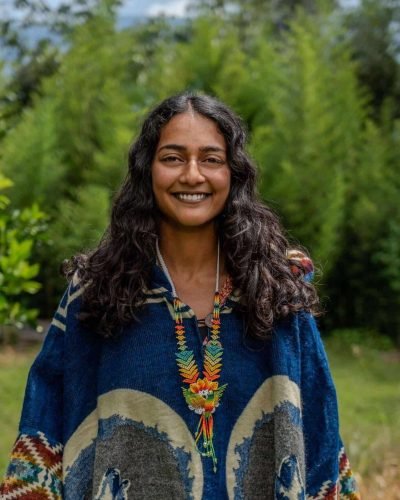
Jenna Ram leads Harmonica’s integration calls. Integration support gives you a place to discuss what came up without handing your responsibility to another person.
You can also use our guide to integration after a ceremony to think through the days and weeks that follow. Regardless of whether the experience felt soft, difficult, clear, or confusing, integration asks how you will relate to it now.
Give yourself a level of compassion if change takes time. Different seeds need different time to grow. Also do not turn compassion into an excuse to keep repeating the same self-sabotage and waiting for another ceremony to do the homework.
Some People Should Not Take Part
A mushroom retreat is unsuitable for anyone with a personal or close family history of psychosis, schizophrenia, or bipolar disorder. A person experiencing an acute crisis also needs immediate professional support instead of a future ceremony.
A psilocybin ceremony is also the wrong choice for somebody unwilling to complete screening or disclose relevant history. The same applies if the goal is to stack mushrooms with ayahuasca in one ceremony.
A retreat cannot promise a health outcome, a new identity, or a permanent answer about your life. If you need such a guarantee before attending, step back from the booking. Speak with a doctor or therapist about the support you need.
Some people also arrive with a spiritual ego around how much they can handle. They assume that because they have done many ceremonies, screening is not necessary for them. Experience does not remove risk or personal responsibility.
Inner maturity includes being able to receive a no. It also includes recognizing when your situation has changed and fresh screening is needed. A decision from another period of your life does not replace a current conversation.
Psilocybin Retreat Cost Comes on the Call
Harmonica provides the current mushroom ceremony cost during the consultation call. Harmonica does not publish a set price for the mushroom ceremony.
A public group ceremony and a private booking are different arrangements, so tell Jenna which format you are considering. The call also gives you room to discuss whether a psilocybin retreat fits this moment in your life.
When comparing mushroom retreats, ask each operator about the parts that affect the full experience:
- Screening before booking: Ask whether the operator examines suitability before accepting the booking.
- Public or private format: Confirm which ceremony format the quote covers.
- Ceremony support: Ask how support works across the common four-to-six-hour ceremony period.
- Preparation: Find out which instructions you receive before arriving.
- Integration: Ask what support is available after the ceremony.
- Language: Confirm that you can communicate comfortably during screening and ceremony support.
A lower quote can include fewer of these parts, so compare the complete arrangement. Screening and integration require time, and leaving them out changes the experience you are comparing.
Do not choose a mushroom retreat only because the ceremony description sounds mystical. Look at the screening boundary, the way medicines are kept separate, and the support surrounding the ceremony.
FAQs
How much does a psilocybin retreat typically cost?
There is no single typical cost that applies to every psilocybin retreat. Public and private ceremonies are different arrangements, and operators can include different preparation or integration support. Harmonica gives the current mushroom ceremony cost during the consultation call. Ask what the quote includes so you can compare the full arrangement rather than comparing two numbers with different services behind them.
Is a mushroom ceremony the same as an ayahuasca ceremony?
No, a mushroom ceremony and an ayahuasca ceremony use different medicines and tend to follow different structures. Mushroom ceremonies are generally looser, may use more varied music, and sometimes allow conversation. Ayahuasca and mushrooms should remain in separate ceremonies. The choice depends on your situation, relationship to each medicine, and whether either option fits you at this time.
How long does a ceremony last?
A mushroom ceremony commonly lasts four to six hours. The time can feel different from person to person because you are in an altered state and moving through your own internal process. Do not use the duration as a measure of how valuable the experience was. A soft ceremony can leave useful homework, and an intense ceremony can still require patience before any insight becomes clear.
What happens after the ceremony?
Integration follows the ceremony. You reflect on the experience, identify the insights that remain relevant, and decide which actions belong in your daily life. It can be that one clear action appears quickly. It can also be that you need time before you understand the experience. Jenna Ram leads Harmonica’s integration calls, but the decisions and actions after the call remain your responsibility.
Can I do a private ceremony instead of a group one?
Yes, every Harmonica offering is available as a private booking as well as a public group ceremony. A private ceremony can suit someone who would spend the evening monitoring other participants. Private ceremonies still require screening. Privacy changes the social setting, but it does not remove the need to decide whether participation is suitable.
Who should not take part?
Anyone with a personal or close family history of psychosis, schizophrenia, or bipolar disorder should not take part. Somebody in an acute crisis needs immediate support from a doctor or therapist. People unwilling to complete screening or disclose their history should also step away. If none of these situations applies and you want to discuss whether a psilocybin retreat fits this moment, book the consultation call.

Oliver