Ayahuasca remains illegal in Texas, and possessing it is a felony. DMT is listed in Penalty Group 2 under Texas Health and Safety Code §481.103 and is classified federally as a Schedule I substance under the Controlled Substances Act. Texas has no state exemption, no decriminalisation measure, and no licensed programme.
At the same time, Texas has become one of the more serious states in the country when it comes to psychedelic research, largely because of efforts led by veterans’ groups. That research is real—but it has not changed the criminal law. Those two facts are often blurred together.
We speak with many Texans, including a disproportionate number of veterans. So this is where the law actually stands, rather than where the headlines might suggest it does.
The wider picture is on ayahuasca and US law and the church exemption. Other states: California, Florida, New York.
Looking to attend a Ceremony? Book a free 30-minute phone call.
What Texas Law Says
DMT is a Penalty Group 2 substance under Texas Health and Safety Code §481.103, and possession of any amount is a state jail felony at minimum, rising with quantity. Texas has passed no decriminalisation measure, no Texas city is known to have passed a deprioritisation resolution, and there is no religious exemption at state level.
On the criminal law, Texas is among the stricter states in the country, and that is worth stating plainly because the research headlines create an impression of movement the statute book does not support. The federal picture is on is ayahuasca legal in the US.
What the Research Changed
In 2021 Texas passed HB 1802, directing a state-funded study of psilocybin for post-traumatic stress in veterans, in partnership with Baylor College of Medicine and the VA. At the time it was among the most notable psychedelic measures passed in any conservative state, and it happened because veterans’ organisations asked for it rather than because of the usual advocacy channels.
Texas has since gone further, committing state funding to ibogaine trials in 2025 through a consortium model, the largest state commitment to ibogaine research to date. What that changed: the political conversation, and the prospect of regulated access at some future point. What it did not change: whether you can legally drink ayahuasca in Texas today.
The reporting tends to blur research authorisation into access, a study into a treatment programme, and psilocybin or ibogaine into ayahuasca. A person can read a year of Texas psychedelic headlines and come away believing something untrue about the brew specifically.
Veterans and the Border Route
A large share of the Texans who contact us are veterans, and many have already looked at ibogaine clinics in Mexico. Those clinics sit a short drive from the border and market heavily to exactly this group, and the route is real and well travelled.
It is also a different medicine with a different risk profile, and the risk is cardiac. Ibogaine prolongs the QT interval and has caused fatalities, and it requires ECG screening before and cardiac monitoring throughout. The most dangerous context of all is the one that brings most people to it, which is opioid dependence: ibogaine interacts with opioids and the detox setting is where deaths have clustered. If you are considering it, the screening standard of the clinic matters more than anything else you will read about it, and a clinic that does not require an ECG before accepting you has told you what its standard is.
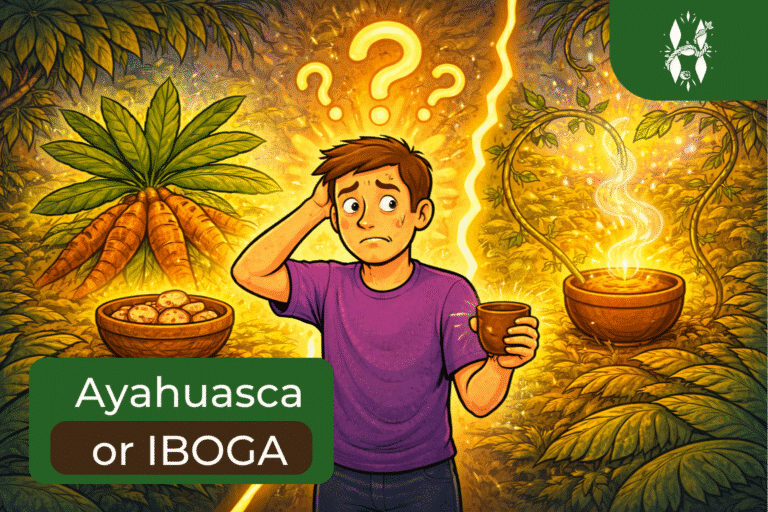
If it is ayahuasca specifically you are weighing, the choice is the same one everybody faces: a domestic circle with no licensing, no insurance and no medical standard, or a legal retreat abroad. Houston has a direct flight into Medellín. We have written for this group on ayahuasca for veterans and ayahuasca and PTSD, and the comparison with iboga is on ayahuasca vs iboga.
What Texans Ask Us
The question that comes up most from Texas is whether VA benefits or a security clearance are at risk. We are not the right people to answer that and neither is a retreat facilitator. It is a question for a veterans’ service organisation or an attorney, and anybody who answers it breezily is telling you they have not thought about it.
The second is about medication, and it is the one that matters most here. A large proportion of the veterans we speak to arrive on an SSRI or an SNRI, often alongside something for sleep, and sometimes a stimulant. Every one of those interacts with the MAO-inhibiting alkaloids in the vine, and the taper is a medical decision made with a prescriber over weeks. It can be that your prescriber has never been asked this before, and it can also be that they say no, and that answer deserves weight rather than a workaround.
The third is whether a group of veterans can go together. Often yes, and often it works well, because the container already exists between them. It is worth saying to the retreat in advance so the group can be held as a group.
Where Texans Go
Most Texans who get serious about this travel, and the reason is a structural one. In a state where possession is a felony, a domestic circle carries no licence, no insurance and no medical standard, and it has a strong reason to hesitate before calling for help. Recognition in law elsewhere removes every one of those problems at once.
Houston has a direct flight into Medellín of under five hours. We run our retreats about fifty-five minutes outside the city, and formats and costs are on ayahuasca retreats, with a comparison of centres at best ayahuasca retreats.
For veterans specifically, the medication conversation with your prescriber is the one to start first, because it takes weeks and it cannot be rushed at the end. That and the rest of the disqualifying conditions are on who should not do ayahuasca. All the strength on your path.
FAQs
Is ayahuasca legal in Texas?
No. DMT is Schedule I federally and sits in Penalty Group 2 under Texas Health and Safety Code §481.103, where possession is a felony. Texas has no decriminalisation measure, no city-level deprioritisation resolution and no state religious exemption.
Did Texas legalise psychedelics?
No. Texas passed HB 1802 in 2021, funding a study of psilocybin for post-traumatic stress in veterans, and committed state funding to ibogaine trials in 2025, the largest such state commitment to date. Research authorisation is not legal access, a study is not a treatment programme, and neither psilocybin nor ibogaine is ayahuasca.
What about ibogaine clinics in Mexico?
Ibogaine is a different medicine with a cardiac risk profile: it prolongs the QT interval, has caused fatalities, and requires ECG screening and cardiac monitoring throughout. Its most dangerous context is opioid dependence, which is what brings many people to it. Clinics near the Texas border market heavily to veterans, and the clinic’s screening standard matters more than anything else. See ayahuasca vs iboga.
Are there ayahuasca ceremonies in Texas?
Yes, mostly private circles around Austin, Houston and Dallas, and all of them operate outside the law in a state where possession is a felony. There is no licensing standard and therefore no external check on training, medical cover or medicine sourcing.
How far is Colombia from Texas?
Medellín is roughly a four-and-a-half to five hour direct flight from Houston, with no visa required for US passport holders. Dallas connects readily through Houston or a Florida hub.
What does a retreat cost from Texas?
Roughly 450 to 3,000 US dollars for the retreat, based on what we see across the centres we track as of 2026, plus a direct flight from Houston. Colombia and Peru sit at the bottom of that range on local costs. Veterans ask us about this often, and it is worth knowing that a Mexican ibogaine clinic will typically cost several times more than an ayahuasca retreat in Colombia, for a medicine with a cardiac risk profile. See ayahuasca retreat cost.

Oliver