Ayahuasca and Anger Inside the Ceremony
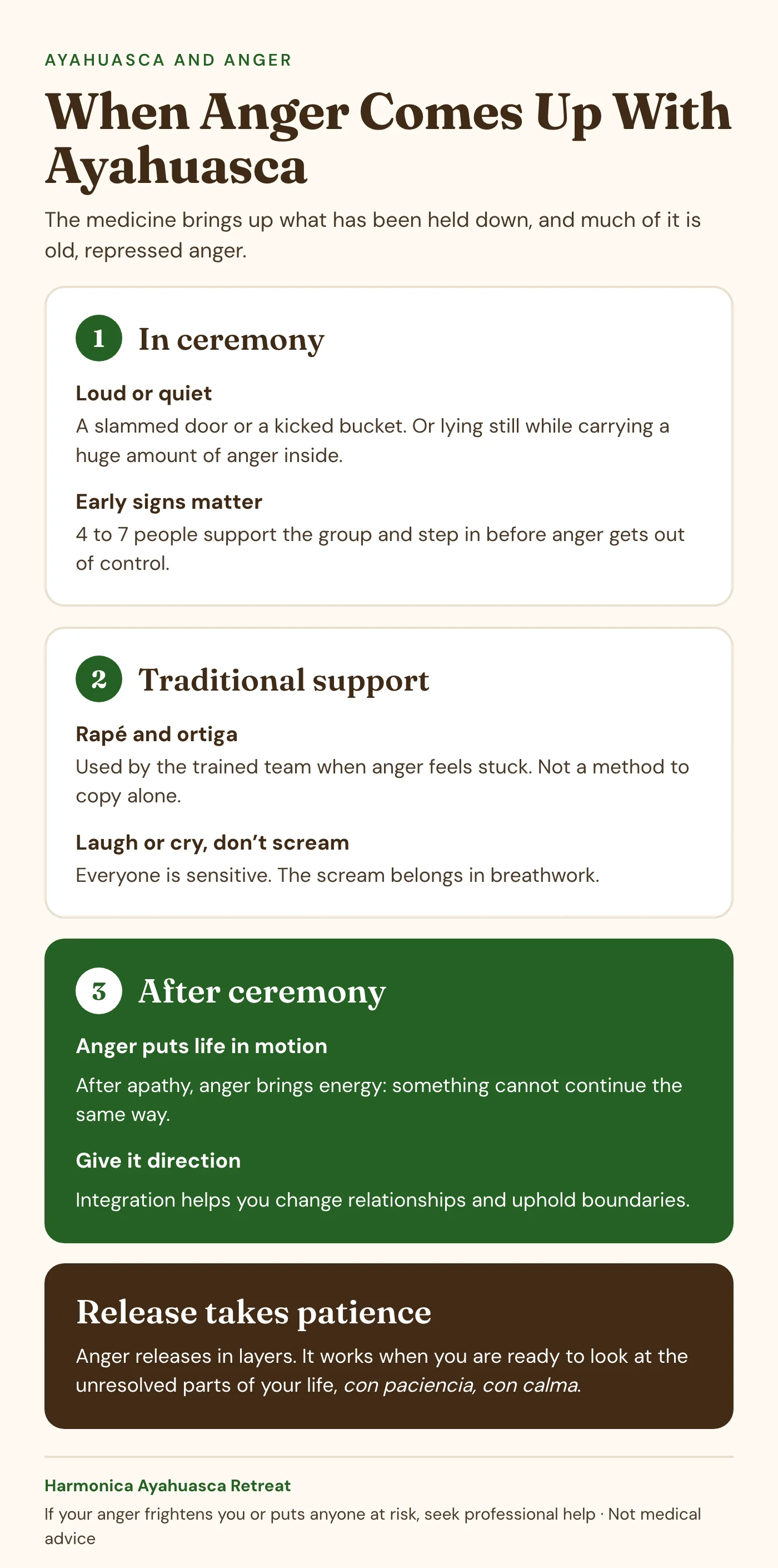
I remember one participant who went to the bathroom and shut the door very loudly. I went over, asked how he was doing, and he said he was sitting with all this anger.
Another time, somebody kicked his bucket in frustration. A slammed door or a kicked bucket can look small from the outside. For us as facilitators, these early signs tell us to pay close attention because the anger may become stronger.
Ayahuasca can be a very strong medicine, and obviously explosive too. We approach the person, see how present they are, and support them before the situation gets out of control. At our retreats near Medellín, 4 to 7 people support the group in ceremony, depending on the group size.
Not everybody becomes loud. Some people lie quietly while carrying a huge amount of anger inside.
A difficult emotion can also become part of a difficult ceremony. The person may be meeting something they have avoided for years, and obviously that conversation is not always comfortable.
When Anger Takes Over in Ceremony
We respond to overwhelming anger according to the person and what is happening in the room. In some situations, we may use a strong application of rapé. In my experience, the application often brings vomiting, followed by a calmer state and a release of physical tension.
A strong rapé application is also hard on the body. It is something the trained ceremony team decides in the moment, rather than a method for somebody to copy alone. You can read more about what rapé is and why people purge in ceremony.
Another support used in our tradition is ortiga, or stinging nettle. In my experience, ortiga helps the circulation of blood. The tradition also understands it as a way of cleaning heaviness from the energetic body.
Sometimes a person needs strong support because the anger feels stuck and has become too much to hold. The response depends on the person, their body, and the intensity of the process.
The main responsibility of the team is to remain attentive. We do not wait until somebody completely loses their centre. We watch for the early signs, like the door being slammed or the bucket being kicked.
The Breathwork Scream and the Pressure Valve
Conscious connected breathwork gives anger a specific moment to move through the voice and body. At our retreats, the active part ends with an invitation to let the breath out through a scream.
Some groups produce a long, strong scream. In other groups, hardly anything comes out. It depends on the day, the group, and how much each person feels ready to release.
What I notice is that crying often follows. The anger finds a pressure valve, and the sadness underneath starts coming through.
The guidance during an ayahuasca ceremony is different. We say that if you need to laugh, laugh. If you need to cry, cry, but please do not scream, because everybody else is also in a sensitive state.
Breathwork creates a specific container for the scream. Ceremony requires awareness of the whole group. And also, you remain responsible for how you express your anger around other people.
Anger After Ayahuasca Can Put Life in Motion
Anger after ayahuasca can bring energy to a person who previously felt apathetic or unable to act. Anger has an impulse in it. It says that something cannot continue in the same way.
I find one part of Dr. David R. Hawkins’ map of consciousness useful here. In his book Power vs. Force, Hawkins places anger above apathy, grief, and fear because anger contains more energy for change. This is his model, and I use it as one way of understanding why anger can feel like movement after numbness.
That movement still needs direction. Anger may show you that some relationships need to change, or that you need to uphold a boundary.
Some people have built a large part of their success from anger. They fear that letting go will remove their competitive edge and make them passive. I understand that fear because anger may have helped them work, protect themselves, and push through difficult periods.
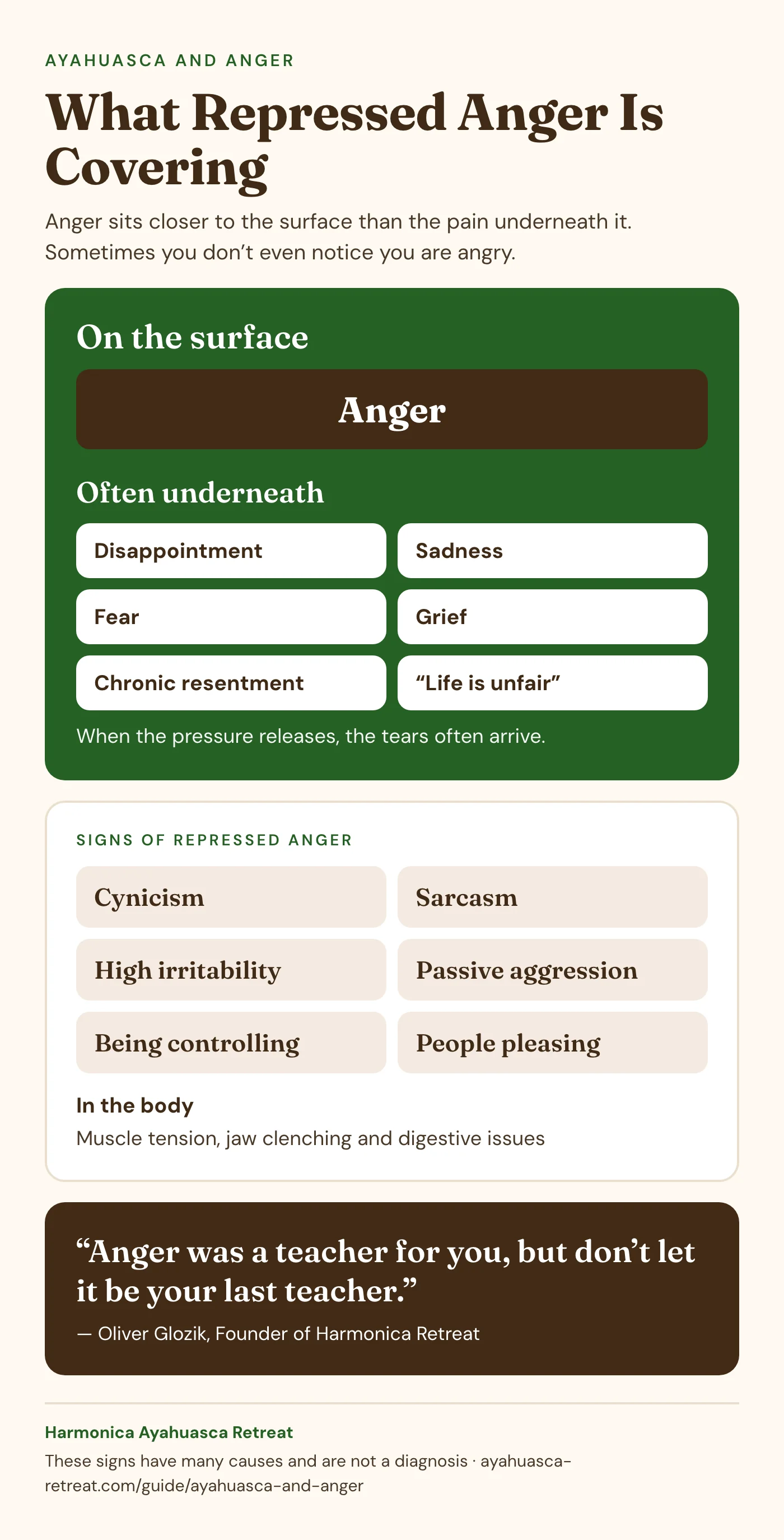
“Anger was a teacher for you, but don’t let it be your last teacher.”
You can create from other states of consciousness as well. Anger may start the movement, and later calmness, care, discipline, or curiosity may continue it. This is part of personal growth after ayahuasca.
Good integration after a ceremony gives you space to examine those choices before acting on every impulse. We include preparation and integration around the ceremony, an online course, and free monthly integration calls for past participants.
My Own Anger in Ceremony
My own anger in ceremony has involved disappointment, unmet agreements, and the feeling that I was left alone. Of course it has come up. I’m human, and you know, one feels a lot of things with ayahuasca.
At this point in my relationship with ayahuasca, I can keep my centre while still feeling what comes through. I can stay present enough to listen to it.
Sometimes it shows me where somebody crossed my boundaries. At other times, it shows me that I did not uphold the boundary myself.
In the end, every emotion is valid and every emotion has its teaching.
For somebody with a people-pleasing pattern, even recognising anger may be progress. The work then involves feeling the anger and setting clearer boundaries.
What Anger May Be Covering
Anger often sits closer to the surface than the pain underneath it. People say anger is a secondary emotion because disappointment, sadness, fear, or grief can be hiding below the heat. I feel like this description fits many processes I have seen, although each person has their own history.
You might be angry with your father, for example, while also carrying disappointment about what you did not receive from him. There may be disappointment in yourself, disappointment about how your life has gone, or the feeling that life has been unfair.
The connection between anger and grief becomes clear when somebody finally releases some pressure. The anger moves, and then the tears arrive.
So it is also about coming to terms and accepting life the way it is, and from there forgiveness through ayahuasca may become possible.
What Are the Signs of Repressed Anger?
Repressed anger can be difficult to spot because sometimes you do not even notice that you are angry.
What I notice is that anger does not always come through as a clear feeling. It can show up in the way you react to people and situations, sometimes long before you can name it as anger. Some common signs are:
- Cynicism
- Sarcasm
- High irritability
- Passive-aggressive behaviour
- Being controlling
- People pleasing
The body can also carry some of this. Muscle tension, jaw clenching, and digestive issues can show up when anger is hard to feel. I feel like a lot of emotions are connected with the stomach, which is obviously also where ayahuasca works.
I used to be a people pleaser, and I would definitely put myself in the category of people who have a hard time feeling their emotions. I am improving, but in a way it is still hard for me sometimes. This can also come up through shadow work with ayahuasca, because anger may sit beside the moments when you did not uphold your boundaries in the way you wanted to.
If you have a hard time feeling your emotions, I think they often start showing up through the circumstances in your life. Life nudges you towards the anger through irritation, tension, people pleasing, or the feeling that your boundaries have been crossed. In a way, these circumstances give you another chance to feel what you could not feel directly before. Your part is to notice the feeling and stop pushing it down automatically.
These signs can have many causes, and they are not a diagnosis. If they worry you, a therapist or doctor can help. You also do not need to decide immediately that every tight jaw or difficult interaction means hidden anger. Give yourself some patience, and ask whether anger has become difficult for you to feel directly.
How Do You Release Anger?
Releasing anger takes patience and calmness, especially when the anger has been building for decades. One participant told me that he wanted to let out all of the anger from his childhood. My thought was, con paciencia, con calma. So what we always say is: with patience, with calmness.
A ceremony can open the pressure valve. Breathwork, therapy, and other somatic practices can open it again. Some pressure leaves, the body settles, and the next layer may become visible later.
Putting more pressure on the release often makes it less likely to happen. If you enter with the demand that every childhood wound must leave tonight, you create another inner fight.
Ask yourself: “Am I suppressing it, am I expressing it, or am I feeling it?” Suppressing anger means pushing it away. Expressing it without awareness may mean throwing your anger at everybody around you, and that is obviously not going to create harmonious and nurturing relationships in your life.
Feeling anger means allowing the emotion to be present while staying responsible for your actions. You can notice the tension, receive the information, and give the body time to move through it. You do not need to direct the force of the emotion at another person.
After some anger releases, obviously people feel a lot better. They feel lighter, without all the tension they were carrying, and sadness or disappointment may become easier to face. There is usually more work afterwards.
When Ayahuasca Fits and When Other Support Fits
Ayahuasca fits this work when you are ready to look at unresolved experiences and take responsibility for what comes afterwards. The medicine may bring inner conflicts into awareness, but it cannot do the integration homework for you.
If you are just drinking ayahuasca because you are looking for a magic pill, obviously it is not going to work. Therapy may be the better place to begin because it offers continued support and time to understand the anger safely. And I feel like, especially for anger, somatic practices are very, very powerful.
Anyone whose anger feels frightening or puts another person at risk should seek professional help. Ayahuasca should also be avoided in some medical and psychiatric situations, which we explain in our guide to who should not drink ayahuasca.
The question is whether you are ready to face what has been held down without expecting one ceremony to remove it all. If you want to talk through ayahuasca and anger and whether this is the right moment for you, book a free consultation call.