Why Does Ayahuasca Bring Up Sadness?
Ayahuasca can bring up sadness as part of purging and letting go. The medicine can help us release emotions, thought patterns and trauma that have been stored inside us, both energetically and physically.
Crying is one form of purging. Vomiting, diarrhoea and yawning can be part of the same process. There is more on the physical side in our guide to vomiting and purging during ayahuasca.
The sadness that comes up is often connected to our past selves. You may feel grief for what you went through, or for how long you carried an emotion without being able to release it.
If you are grieving someone who has died, that is a different thing, and we have a separate guide to ayahuasca and grief.
My Story With Sadness
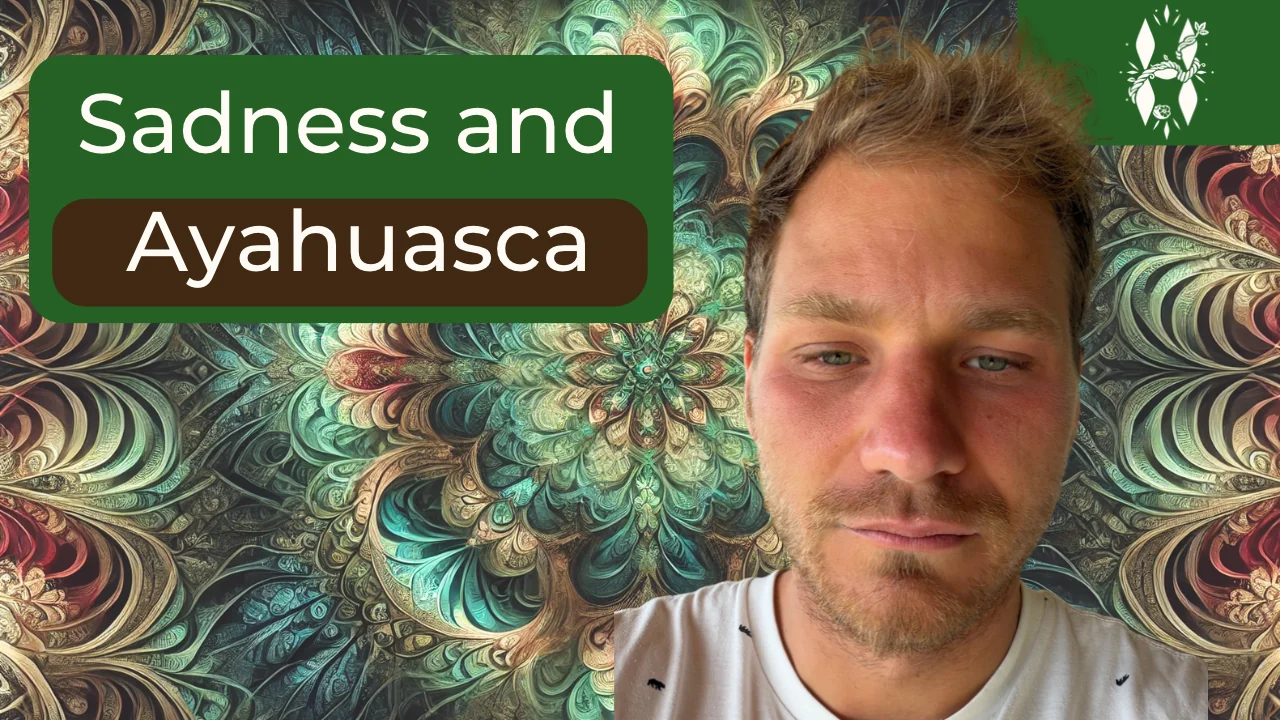
My story with sadness began long before I drank ayahuasca. Even before ayahuasca, I would be inundated by this emotion, incapacitated and trying to get on with my normal life.
Then out of nowhere it would rear its head, and I would just have to stay home while it lasted. I would just cry and cry, and feel sad and heavy and low in my room. I originally came to drink ayahuasca to look at where this sadness came from, face it and hopefully let it go.
“We often overintellectualize healing. Actually feeling the sadness within you (through Ayahuasca) can liberate so much heaviness in the body.”
During my first retreat, I encountered sadness again. In one ceremony I was crying a lot, and at a certain moment I felt a level of strength. I asked the medicine to show me what was hiding in the shadows. What happened to me that made me cry this much?
Instead of a potentially scary memory surfacing, the medicine showed me that beyond my sadness and everything heavy and dark was unconditional love.
It was something I knew and could feel to be true. I felt it for every living thing, and soon felt that at the core of the universe was unconditional love. This changed how I saw myself.
Before, sadness was at the core of my being. But now if I go deeper, there is always love.
Learning that once did not mean the problem was solved and I would never feel sadness again. Like any lesson that helps you become aware of something true about yourself, it had to be integrated. To be human is to feel the whole spectrum of emotions, so sadness will come up again and again.
On my path with ayahuasca, I have learnt to be okay with that. It is no longer an emotion I am trying to get rid of. Since then, I have been focussed on cultivating the connection to love that I know is inside me, and inside everyone and everything.
Why Do You Cry So Much During Ayahuasca?
Some people cry a lot more than others in ceremony, and for a long time that person was me. After I started working with ayahuasca, I seemed to be the only team member who cried, haha. It became a bit of a joke in the team: "Oh yeah, Jenna is crying again."
This was especially true during my first two years or so. I used to think, "God, what's wrong with me?" When it is so visible and nobody else seems to be crying as much, it is tempting to feel defective or broken in some way.
Sometimes I would cry for a couple of hours and feel such a cathartic release afterwards. Then I would drink again the next day and do it all over again. I remember thinking, "How is there anything left to cry out?"
With hindsight, I feel grateful for releasing all of that trapped emotion. Now that I do not cry so much, I can see the benefit of having released it.
Oliver, who founded Harmonica, has seen the opposite pattern too. He describes people, usually men, who have built a strong emotional shell and have not cried for ten years or more. When ayahuasca helps them cry, releasing that tension can feel renewing.
When Sadness and Anger Mask Each Other
Sadness and anger can mask each other in both directions. Looking back, I can see that my patterns were set up so that I would cry in lots of different situations, when I probably needed to feel another emotion.
When I projected other people's judgement or criticism onto me, I would feel sad and cry instead of feeling shame. When I felt like a victim, I would cry. When I needed to feel anger, I would cry.
As my journey has evolved, through the medicine and my integration work, I can see how automatically I go to sadness and avoid emotions such as shame and anger. I am only now starting to learn how to express them.
When I get the signal to cry, I try to ask myself: is it really sadness or is it masking something else?
Oliver points out that the pattern can run the other way. Anger can cover sadness because it puts us in a more forceful state and can make us feel more in control. It may feel safer to express anger towards someone than to admit feeling sad or hurt.
Do You Need to Know Why You Feel Sad?
You do not always need to know why you feel sad before you can let yourself feel it. It was a big takeaway for me because it was quite the opposite of my original intention with the medicine.
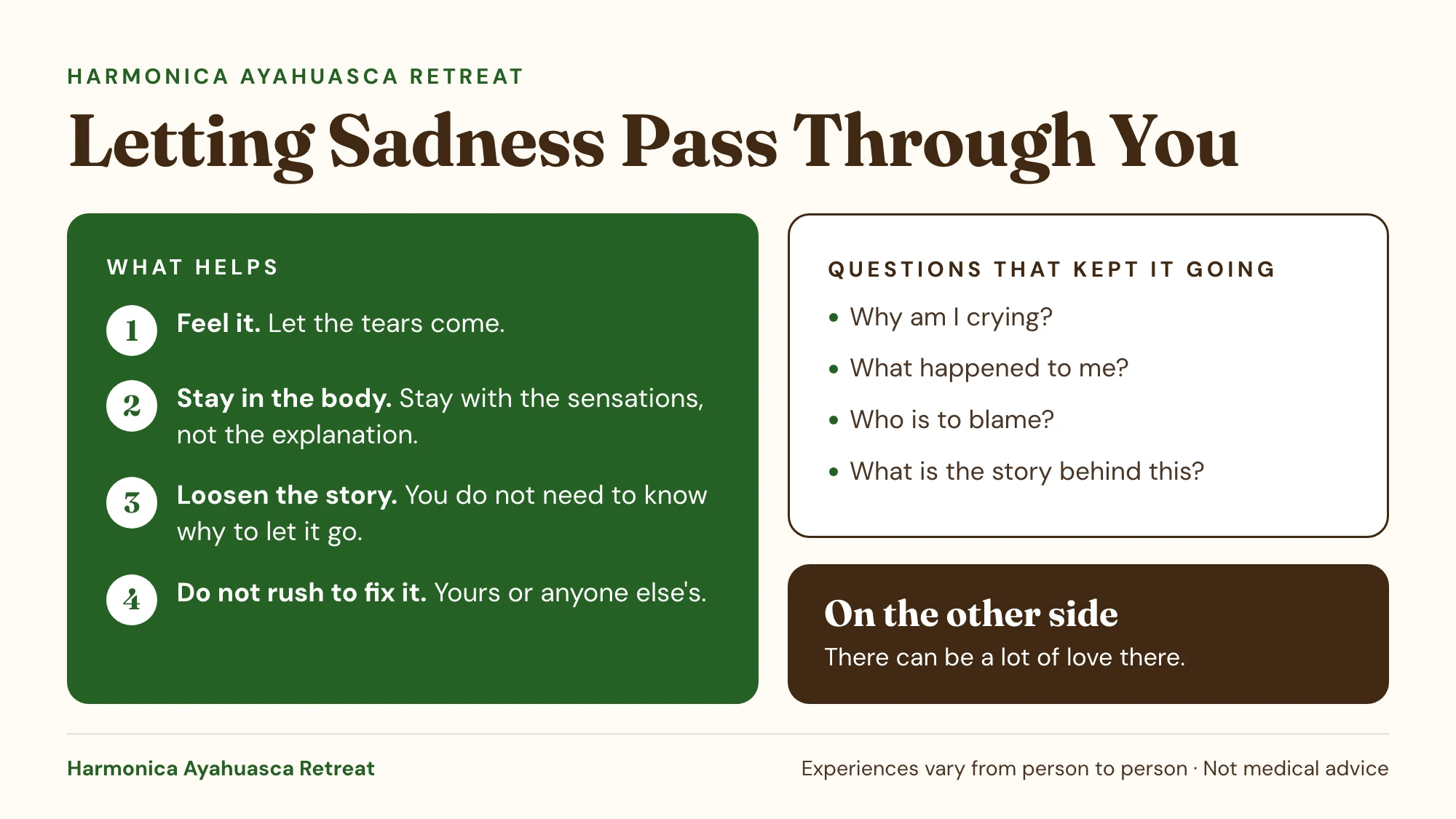
I was always trying to get to the bottom of why. Why am I crying? What happened to me exactly to make me this way? Who is to blame? What is the story behind this?
Those questions and my attempts to answer them kept the emotion persisting for longer than it needed to. They prevented me from feeling it, letting it go and moving on.
Sometimes an insight does come, and it can change how you understand your past. Yet an explanation is not always required. The body may be ready to release something before the mind can give it a clear name or story.
Oliver's advice is to stay with the sensations in the body and loosen your grip on the story. When you have the courage to feel sadness and let it pass through you, there can be a strong sense of liberation afterwards.
I want to emphasise how much love there is on the other side of feeling sad, if you can actually feel it without a whole narrative or story around it.
How Ayahuasca Can Change Your View of Old Regrets
Ayahuasca may help you release the emotion around an old regret and see the event from another perspective. Oliver describes regret as something many people carry when life did not go the way they wanted.
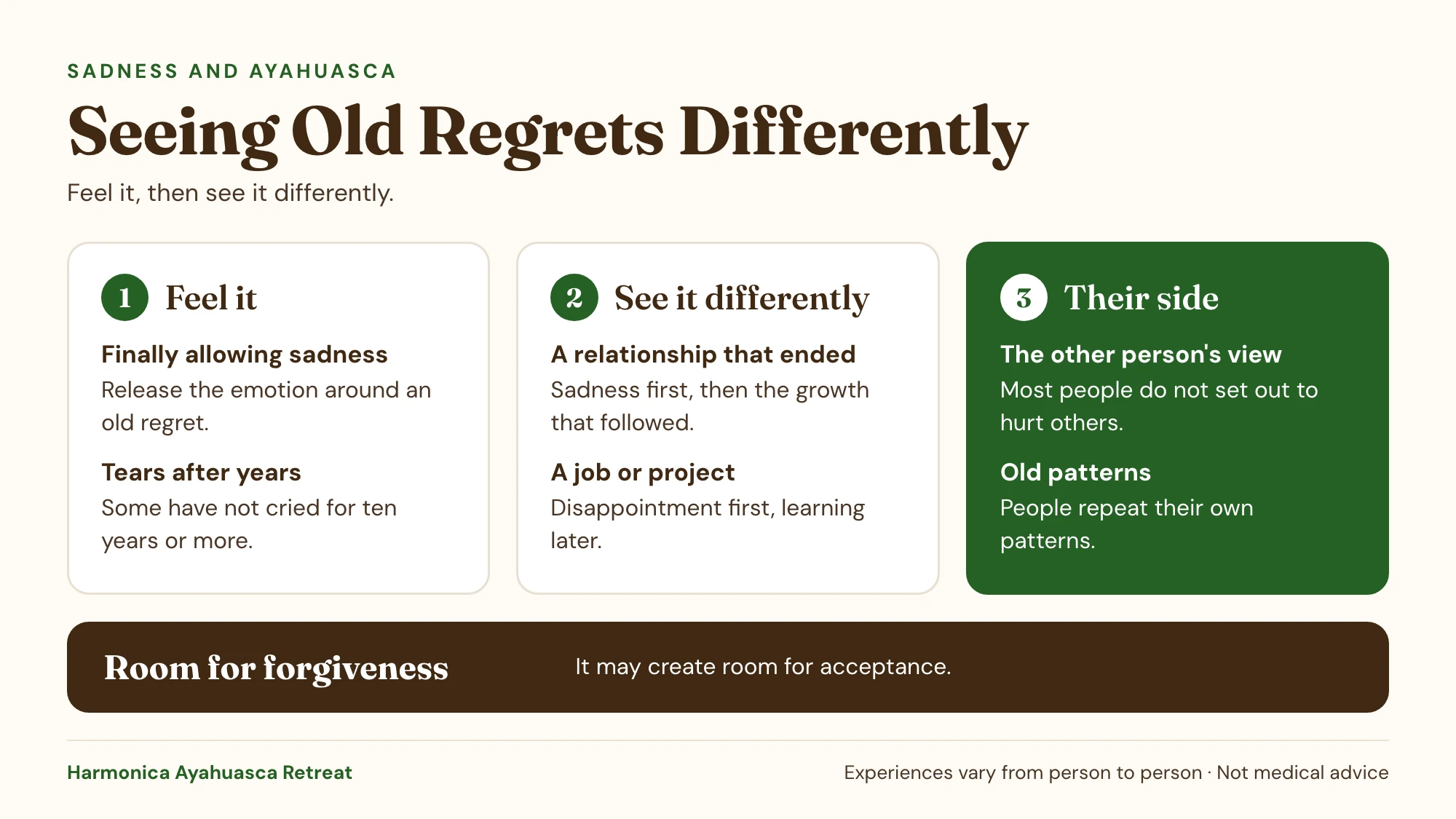
A relationship may have ended, leaving sadness that takes time to process. Oliver has spoken about a relationship of his own that failed and the growth that followed. The new perspective did not erase the sadness, but it helped him recognise what he learned after the relationship ended.
The same process can apply to a job or project that did not work out. The first response may be disappointment. Later, you may see changes or learning that only became possible because the original plan fell apart.
Family and friendship conflicts can shift when you begin to understand the other person's point of view. Oliver believes that most people do not set out to hurt others with malicious intent. People repeat their own patterns, and those patterns can still cause pain.
Seeing this does not erase what happened. It may create room for acceptance and forgiveness after ayahuasca. It can also change how you approach ayahuasca and relationships when old hurt comes back into view.
Why a Good Facilitator Does Not Try to Fix Your Sadness
A good facilitator lets you feel your sadness and go through it, instead of trying to fix it. Oliver, who founded Harmonica, is very clear about this: it is very easy for a facilitator to fall into wanting to fix somebody's emotion, in ceremony and also after it.
From the outside it can look caring: wanting to give someone a hug, or checking again and again whether they are doing okay. But many times, as Oliver puts it, that urge comes from the facilitator's own inability to sit with their emotions, or from needing to fix the environment so that everyone feels good in the moment.
His view is that the key is to allow people to feel their emotions, to let them feel it and go through it, without trying to fix it.
The same is true if someone near you cries: the tears do not automatically mean that the emotion needs to be stopped. And when you are the one crying, you do not have to make yourself feel better for the comfort of the people around you. The tears can be allowed to come, move through your body and pass in their own way.
Sadness and Ayahuasca vs Depression: How They Feel Different
Sadness tends to be a fleeting emotion, while depression feels more like a state of apathy or hopelessness that is harder to move out of. Sadness can appear before a retreat, during a ceremony, after a ceremony or after leaving.
Deep inner work and the readjustment that follows can bring sadness into awareness. You may cry and then feel lighter, or the emotion may return later. Its presence alone does not mean you are depressed.
Depression can feel more fixed. Apathy and hopelessness may affect far more than a single emotional moment, so if you think you might be depressed, we need to talk it through with you individually before a retreat, and so does your doctor.
If you take antidepressants, speak with your prescribing doctor before considering ayahuasca. Never stop or change medication on your own. You can read more in our ayahuasca and antidepressant safety guide and our guide to who should not take ayahuasca.
Ayahuasca should not be treated as a promised cure for depression. If low mood appears after a retreat, have a look at our guide to depression after ayahuasca.
Sadness After the Retreat
Sadness after ayahuasca can come up in the days after you return home as the inner work begins to settle. Leaving the retreat does not mean every emotion has finished moving.
Integration can help you notice the difference between feeling an emotion and becoming caught in its story. Our ayahuasca integration guide is a good start. Harmonica also provides an online preparation and integration course, along with free monthly integration calls for past participants.
Sadness may feel heavier when you are back in your normal environment without the people who shared the retreat. There is more on that in our guide to feeling lonely after ayahuasca.