My Experience of Regret in Ceremony
My own regret came up strongly in an ayahuasca ceremony. I carried a lot of guilt about mistakes from my past and decisions that were not in line with the person I wanted to be. At the same time, I was engaging in numbing activities and addictions, and through those coping mechanisms, I was hurting myself and people around me.
I remember the shift as an almost passive moment. There was a lot of internal work happening while the regret came up, including moments of self-hate. Then, at one point, there was just that moment of consciousness: we’re all doing the best we can, I’m doing the best that I can, and this is how my best looked at the time.
I became tired of fighting with something from the past that I could no longer change. In a way, the self-forgiveness came very naturally after that.
I understood that in my mid-20s, I did not know how to handle the emotional overwhelm I was under. That self-acceptance brought a lot of love and inner peace. Before that, there had been so much tension, regret, and thinking about what could have been. Obviously the people around me at the retreat noticed the change.
Afterwards, I felt a deep peace, and a lot more doors started opening. That was when I decided to stay in Colombia and start this journey. A lot more energy was freed up too. When I was very concerned about regret of the past, my energy was in the past.
At that time, I joined the retreat as a participant. I had not started facilitating ceremonies. My story also involved the kind of numbing patterns discussed in our guide to ayahuasca for addiction. This was my experience, and another person may go through a very different process.
The Regret We All Carry
The guilt people bring into ceremony is often connected to a parent, an ex-partner, their children, a habit, or something they did years ago. I think we all carry regret about parts of life that did not work out the way we hoped.
Maybe a relationship fell apart, or love was not reciprocated. Maybe a job or project failed, or a friendship broke as two people went in different directions.
I remember one guest who was a father. He had been very strict with his child, and he felt guilty about the way he had behaved. After the retreat, he started being more loving, understanding, and supportive, and he was not as harsh with his child anymore.
I think healing usually starts with regret from the past, fear of the future, or physical pain.
The difference between guilt and shame is quite simple. Shame says, “There is something wrong with me,” while guilt says, “Something I did was wrong.” Shame can take over your whole identity, so we discuss it separately in our guide to ayahuasca and shame.
Before drinking ayahuasca, I think you need to ask yourself: are you ready to look at the unresolved topics in your life? That question can also become part of setting an intention.
Why Pushing It Down Keeps It Going
A 2022 survey asked 579 adults, aged 18 to 84, how they dealt with guilt and sorted their responses into 34 strategies.
The two most common strategies were self-reflection and suppression. Suppression included ignoring the guilt, trying to forget it, bottling it up, and avoiding thoughts about it.
“By pushing guilt further down, it has a weird way of perpetuating itself.”
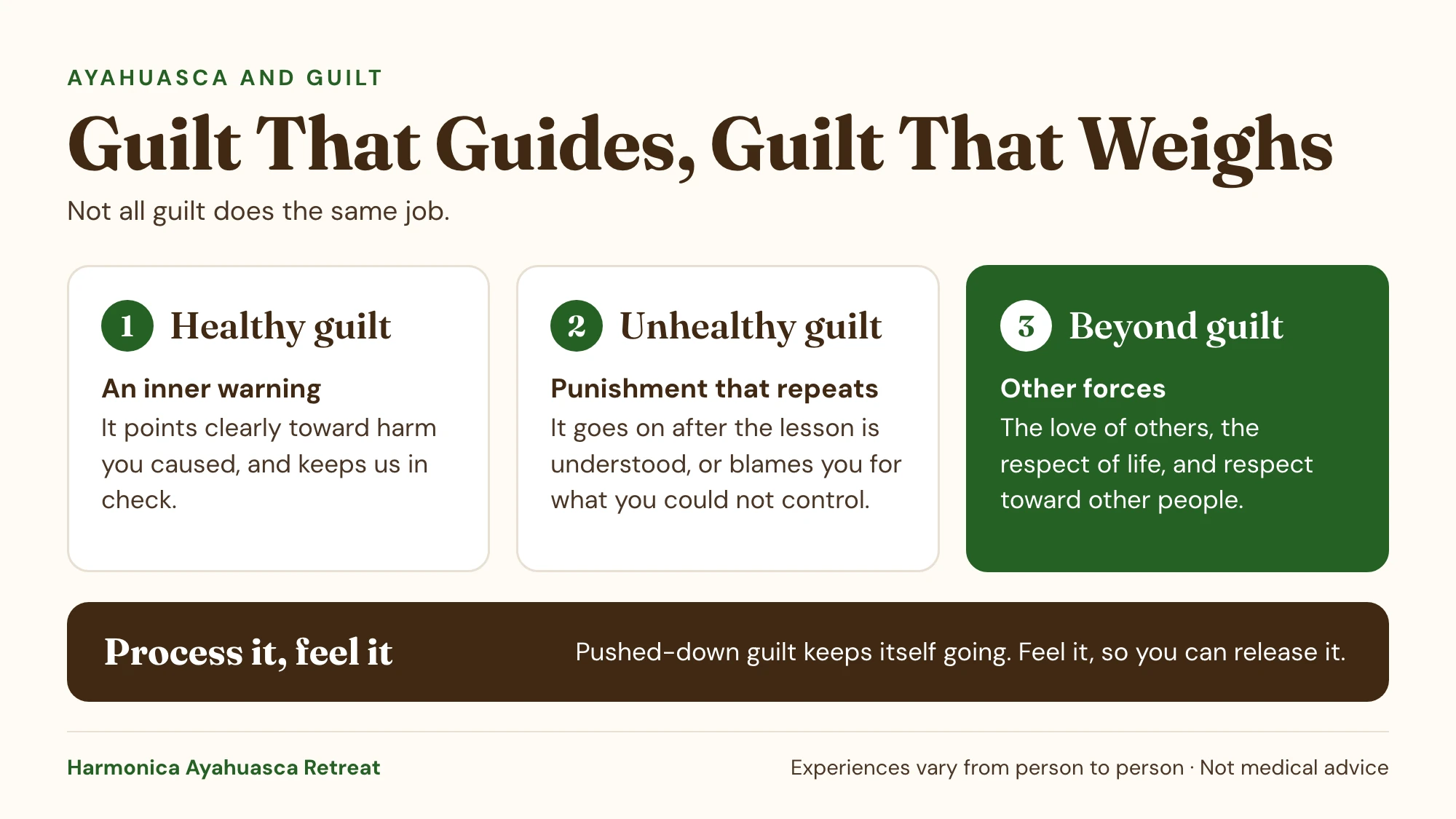
So when someone asks me how to get rid of guilt, I think it's important to start to process it, to feel it, to be able to release it.
Ayahuasca can bring the buried memory and its emotions closer. What I have seen is that people respond differently when this happens. Some go through the inner turmoil quietly, while others become more expressive and need more individual support.
A small 2022 exploratory study followed 45 volunteers before and within 24 hours after an ayahuasca ceremony. Their questionnaire scores showed increased self-compassion and reduced self-criticism. The study had no control group, so its authors called for larger controlled studies.
For me, letting go of guilt and regret, and learning how to forgive yourself for past mistakes, came through understanding that I just didn't know better at the time. I write more about this in our guide to forgiveness through ayahuasca.
How Do You Make Amends with Someone You Hurt?
Making amends begins with taking responsibility for your part in what happened. How to make amends depends on the relationship, the harm, and whether the other person is ready to speak.
I think these conversations can be good because we walk through life unconsciously. Through our unconscious ways, we hurt others without being aware of how our actions impact them.
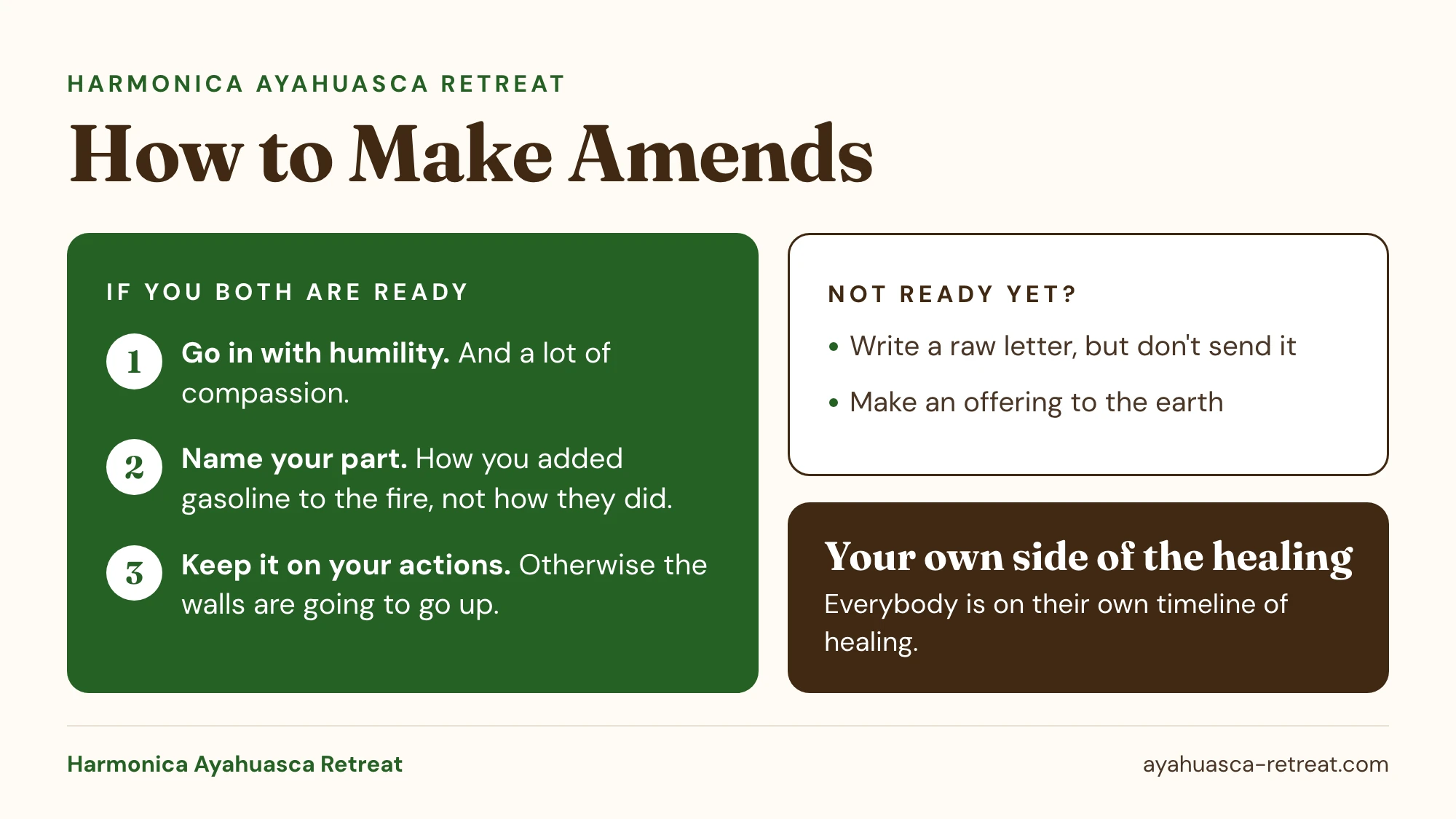
Go into the conversation with a lot of humility and a lot of compassion. In a conflict, there are usually two people who added gasoline to the fire. Have the courage to talk about how you added gasoline to the fire.
If you begin explaining what the other person did wrong, obviously the walls are going to go up. So keep your attention on your own actions and their impact. Don't make it about the faults of the other person, what they did wrong, or what made you do this and that.
In many ways, these situations come up inside families. A conversation can lead to crying, hugging, and a breakthrough between people who have carried the conflict for a long time.
There is also the example of an ex-partner you have not contacted for 15 years. If that person is already over the topic, it can be a nice gesture to help clean it up. But you can also make an offering to the earth to free up the energy without needing to talk to them. If you feel it, it's good to reach out.
When One of You Is Not Ready
You can work on your side when you or the other person is not ready for a conversation. Everybody is on their own timeline of healing.
Write a letter and express everything there. If it is a very raw letter, it is important not to send it.
An unsent letter is basically one’s own side of the healing and expression. Once you process your emotions around the topic, I feel like something begins to free up. And then the outer world can start changing around that too. The letter can still have a positive impact.
Is Guilt Useful, or Is It Something to Let Go Of?
Guilt can work as an inner warning when it points clearly toward harm you caused. Our own conscience is our inner guidance system, and one could argue it helps keep us in check, so we don't do harmful actions towards others.
People sometimes call this healthy guilt. Unhealthy guilt repeats the punishment after the lesson is already understood, or makes you responsible for events you could not control.
I think about this carefully in relation to the ayahuasca retreats for veterans that we also run. Guilt and shame connected to the brutality of war are very delicate topics. We are talking about extreme situations here. One might say it is good that a person feels guilty about that brutality. But obviously that guilt is going to create more and more suffering in that person as well.
Moral injury is the term used for lasting guilt and shame after taking part in, or witnessing, acts that went against your moral code.
For many people, there was already a chain of events before military service. There may have been a challenging upbringing, followed by military training that broke down different personalities to rebuild them the way the military needs, so they can function in that organization. Then the person was sent into war-torn countries, where other laws apply, like survival of the strongest. A lot of what happens there is something a civilian may not understand.
That chain can have devastating effects on mental health, and I think it is also why there is so much PTSD among veterans (see ayahuasca and PTSD). I like to say it is never good to see oneself as a victim. But in a way, you can recognise the chain of events and have compassion for the person who went through it.
Most likely any person who had gone through those similar chains of events would have handled it in a similar way. Through that, I hope compassion and forgiveness can come through as well.
In these extreme situations, the victim, but in a way even the perpetrator, is suffering. Holding on to more guilt or pushing it further down can continue that suffering.
Someone might say, “Hey, guilt is the thing stopping me from doing something harmful again.” Well, okay, that's one step. And also, guilt does not need to remain the only force guiding you.
You can make different choices for the love of others, for the respect of life, and for respect toward other people.
Support After the Ceremony
When the old guilt comes back after you return home, I would tell you to feel it as much as possible. It is normal for the emotion to return. For me, guilt that comes back is an emotion that still wants to be felt.
By feeling it, you start to release some of what you have been carrying. And also, if the guilt is still present, there may be a lesson that needs your attention.
At Harmonica, we hold sharing circles the morning after the ceremony. Past participants also receive an online preparation-and-integration course and access to free monthly integration calls. Our guide to integration after the retreat explains how the ceremony and the following weeks can work together.
During the ceremony, 4 to 7 people support the group depending on its size, and a physician is on the team.
Ayahuasca does not replace therapy. Therapy and ceremonial work can go together. If guilt is tied to depression or thoughts of harming yourself, speak with a doctor or therapist first.
Ayahuasca is also unsuitable for some people because of medications and certain physical or psychiatric conditions. You can read more in who should not drink ayahuasca.
If you want to discuss ayahuasca and guilt and whether a retreat fits your situation right now, book a free consultation call.