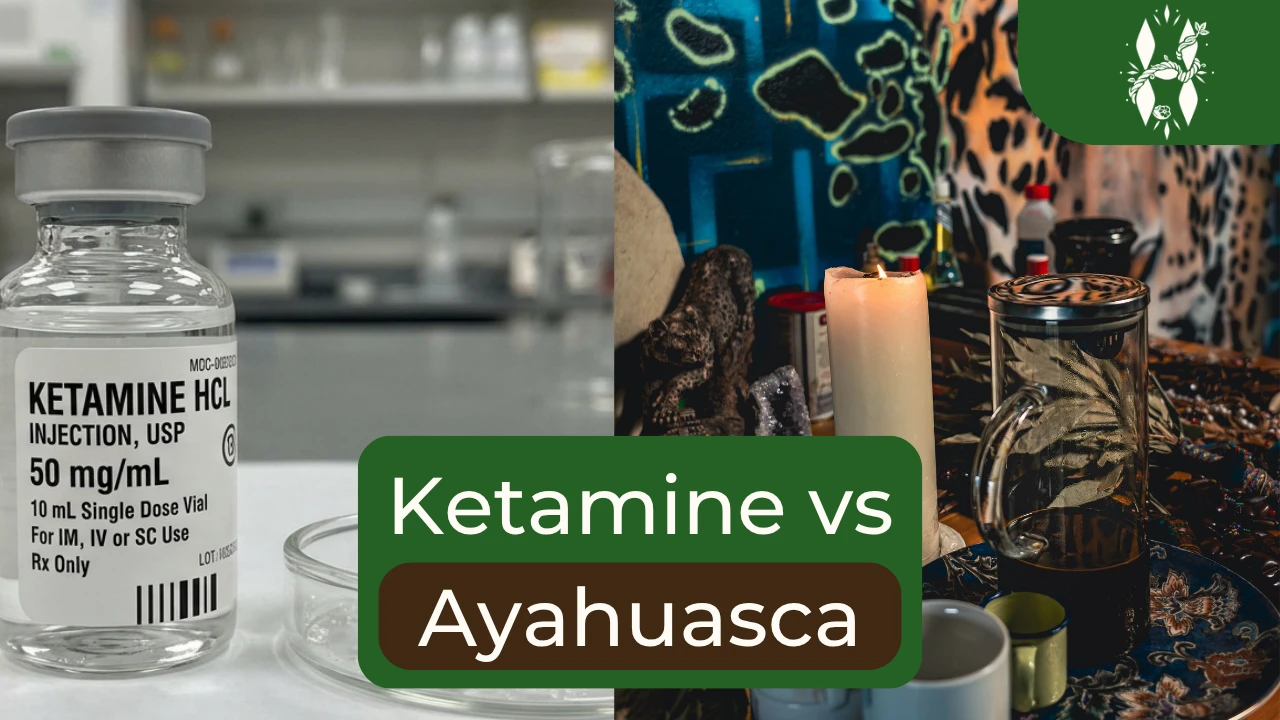
Ayahuasca vs Ketamine at a Glance
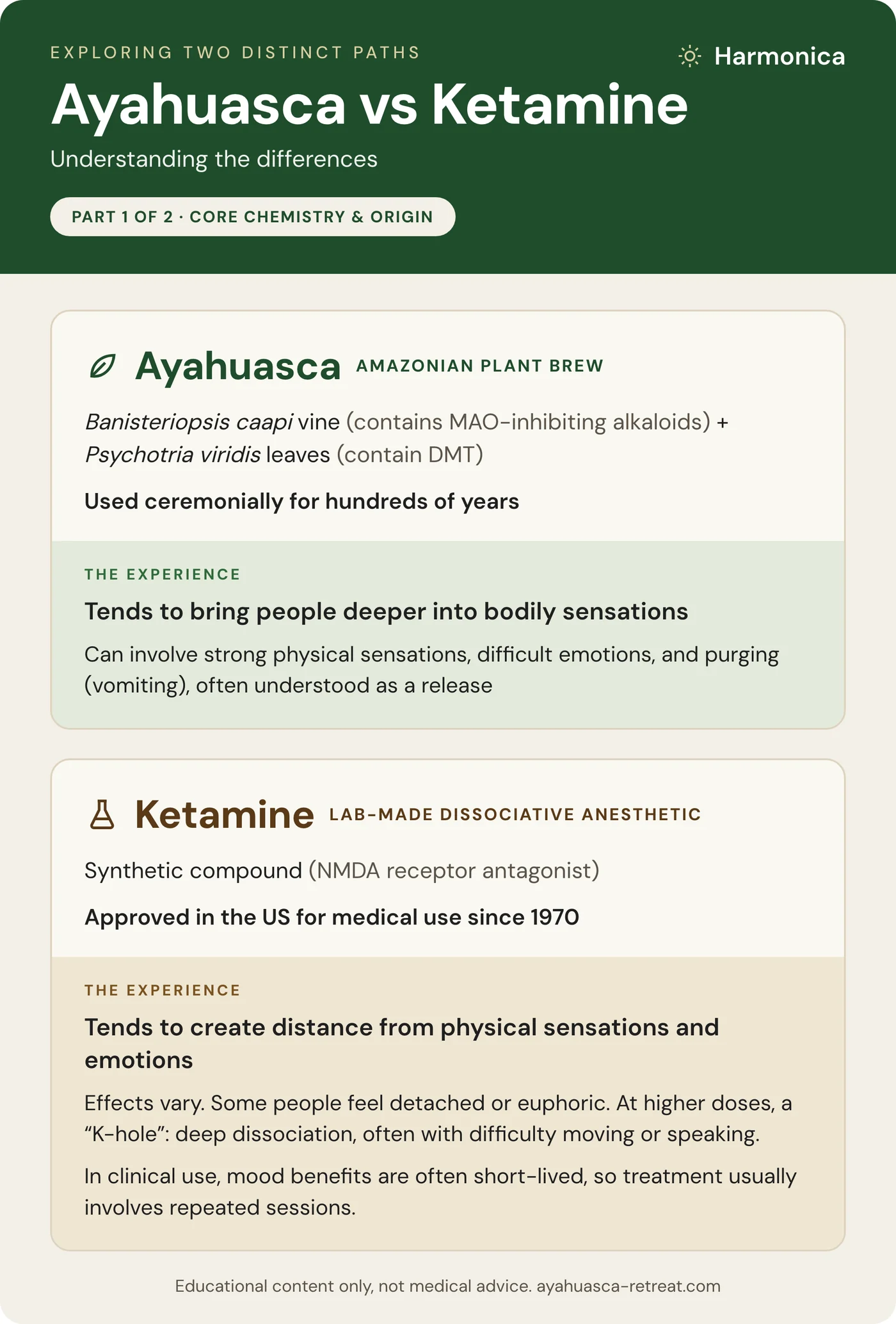
Ketamine vs ayahuasca becomes clearer when you separate the substance from the container around it. A review in Neuropsychopharmacology describes ketamine as a selective N-methyl-D-aspartate (NMDA) receptor antagonist and ayahuasca as a brew combining N,N-dimethyltryptamine (DMT) with monoamine oxidase inhibitors (MAOIs).
| Ayahuasca | Ketamine | |
|---|---|---|
What it is | Ceremonial psychoactive brew | Dissociative anesthetic |
Where it comes from | Amazonian plant tradition | Lab-made substance |
How it is taken | Brew taken by mouth | Infusion, nasal spray, or recreationally through the nose |
Setting | Ceremony | Clinic, party, club, or another setting |
Who guides it | Shaman and ceremony team | Clinical team during treatment; often nobody during recreational use |
How long it lasts | Ceremony takes about 6 to 8 hours | Varies by route; Spravato sessions include at least two hours of monitoring |
What it does in the body | DMT combined with MAO-inhibiting beta-carbolines | Blocks NMDA receptors and can produce dissociation |
Afterwards | Preparation and integration surround the ceremony | Clinical effects may fade; our volunteer always returned to baseline |
Main risks | Medication, medical, and psychiatric contraindications | Dissociation, sedation, nausea, dizziness, and urinary damage with regular use |
I like to say ayahuasca is like being blindfolded and touching an elephant. Ten people touch the same elephant and come away with ten different experiences. When somebody says, “This is how ayahuasca is,” I would say that is one way ayahuasca can be.
“What is important to remember in this comparison is that ayahuasca is an ancestral medicine that has been here for hundreds of years, with a living tradition behind it, while ketamine is a lab-made substance.”
 Oliver GlozikFounder of Harmonica Retreat
Is Ketamine a Psychedelic?
Ketamine is best described as an atypical psychedelic, or a drug with psychedelic-like effects. Its dissociative action differs from classic psychedelics.
Ketamine is a dissociative anesthetic that has been used in human and veterinary medicine for decades. Ketamine itself has had United States approval since 1970 and has also been used as an animal tranquilizer.
Ketamine therapy can take several forms. A ketamine infusion delivers the drug intravenously, while Spravato uses esketamine as a nasal spray. Ketamine assisted therapy places psychotherapy around the ketamine sessions.
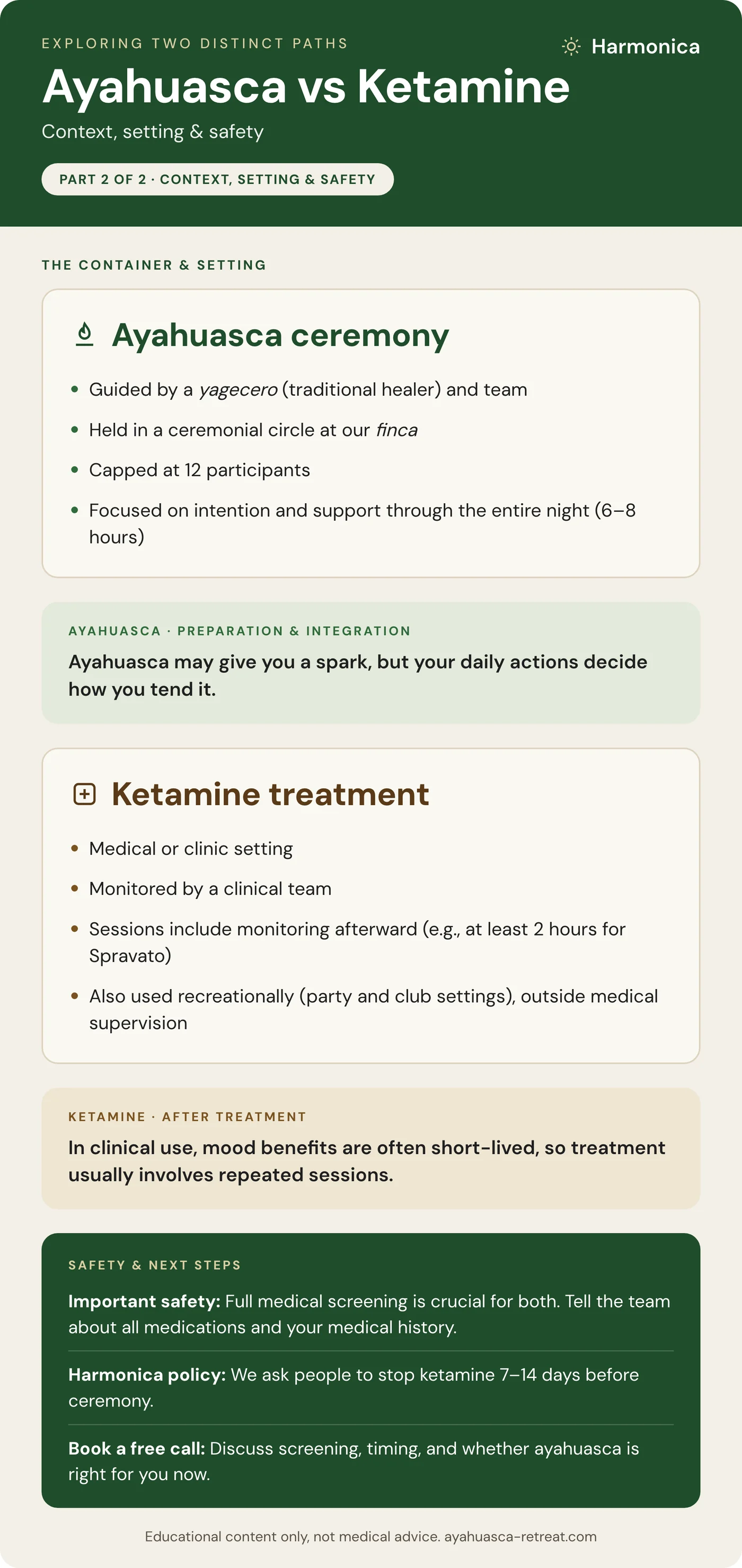
Spravato prescribing information from the U.S. Food and Drug Administration says Spravato is approved with an oral antidepressant for treatment-resistant depression in adults. It is available through a restricted program, and patients must be monitored for at least two hours because sedation and dissociation can occur.
When somebody applies to our retreat and mentions ketamine, I first ask whether the use was therapeutic or recreational. Most people I meet used it in a non-professional setting for some mix of exploration, recreation, and personal healing.
We always need to distinguish between a drug and a medicine. There are ketamine clinics and studied clinical uses where people have benefited. Taking ketamine at a party without medical support is a different situation.
Ayahuasca as an Amazonian Ceremonial Brew
Ayahuasca usually combines the Banisteriopsis caapi vine with leaves from Psychotria viridis. The vine contains MAO-inhibiting beta-carbolines, while the leaves contain DMT.
The brew has been used ceremonially in the Amazon Basin for at least hundreds of years. Our guide to what ayahuasca is explains the plants and tradition in more detail.
At Harmonica, we hold ceremonies at a finca near Medellín in the Kamsá Biyá tradition of the Putumayo. Sergio Henao leads the ceremony as a yagecero with more than 16 years of experience.
Four to seven people support the group during ceremony, depending on group size. The team includes the shaman, facilitators, and musicians, and each retreat is capped at 12 participants.
I personally prefer things from nature to things made in a lab. I also think of ayahuasca together with other ancestral medicines such as peyote, mushrooms, and San Pedro.
Still, I would be careful about turning origin into a competition. A natural origin does not tell you how your ceremony will develop.
For access questions, see ayahuasca’s legal status.
The Setting and the Person Holding Space
The setting affects how much support you have when movement, identity, or ordinary awareness changes. A monitored clinic session has a different container from a party, and an ayahuasca ceremony has its own structure again.
I have never taken ketamine, so I cannot describe dissociation from inside the experience. I asked a volunteer who was with us last year, and who used ketamine before coming to ayahuasca, to describe both.
She used ketamine at parties and clubs. She described music, dancing, creativity, visual patterns, and a feeling of connection with everybody around her. As she took more, movement became difficult and she sometimes needed to sit down.
Looking back, she said, “ketamine is the thing that led me to ayahuasca in a very long-winded way.”
A K-hole is a state of deep ketamine dissociation in which someone may be unable to move and may lose their ordinary sense of body or location. She told me she had reached a K-hole before. When describing what can happen at parties, she said:
“When you experience a K-hole in a party, you’re just the person who looks like they’ve passed out.”
In that state, she said, your friends have to carry you home. She wondered how the same state might feel in a controlled setting where people expect it and know how to respond. In her ayahuasca ceremonies, she felt able to go further into the experience because the team was there.
This is also why the role of the ayahuasca shaman matters. The shaman holds the ceremony, harmonizes the space, supports the person when support is needed, and also knows when to leave somebody alone with their process.
I once spoke with a therapist who was qualified to administer or support ketamine work. I asked whether the therapist had taken ketamine, and the answer was no.
In the Indigenous view I have learned around ceremonial medicine, you never trust somebody who doesn’t drink their own medicine, because a guide who knows the medicine from direct experience also knows from inside what sensations it brings up.
I understand the clinical caveat. A doctor or therapist cannot personally take every medication they work with. If you are considering a ketamine retreat or guided session, ask who administers ketamine, what support is present, and what happens when you cannot move or communicate normally.
Dissociation and Presence in the Body
Ketamine dissociation can create distance from physical sensations and emotions. That distance may help somebody observe themselves from the outside and perhaps feel less fear.
Ayahuasca often moves in another direction. It may bring fear, doubt, grief, or insecurity closer, sometimes in an amplified form. You feel the difficult material, work with it, and come to your own realization.
The volunteer felt bliss, joy, and connection with both substances. Her bodily experience was different.
“I never felt vibrations or anything like that with ketamine,” she said. She described ayahuasca as bringing more presence into her body, whereas ketamine felt more dissociative.
The volunteer felt her earlier experiences helped her stay calm when the visuals in her first ceremony came fast.
Ayahuasca may also involve nausea, vomiting, and other physical releases. I think about the purge as one way people work with tension, and sometimes trauma, that they experience as stored in the body. Our guide to ayahuasca and the purge explains this part of the ceremony.
I remember one guest who came after using ketamine and kept comparing the two. People familiar with ketamine are often used to intense effects, but this guest was surprised by the physical discomfort of ayahuasca.
A stronger experience does not guarantee more change afterwards. Some guests score one substance against the other. I understand that, but I do not encourage anyone to chase intensity in our ceremonies.
Ayahuasca may feel more physical for one person and more emotional for somebody else. Another person spends much of the night inside thoughts. For some people it is softer, and for others it is stronger.
The useful question comes after the ceremony. What did you see about your life, and what homework are you willing to do with it?
For a practical account of the full night, read what to expect in an ayahuasca ceremony.
Research on Depression and Post-Traumatic Stress
Research has studied ketamine and ayahuasca among people with depression, although the studies use different methods and follow-up periods.
Ketamine therapy for depression can produce a fast response for some patients, but the effects may be temporary. In a 2013 Mount Sinai study, 24 people with treatment-resistant depression received up to six intravenous ketamine infusions over 12 days. Among the 70.8% who responded, the median time to relapse after the final infusion was 18 days.
The Neuropsychopharmacology review says the limited durability of positive clinical outcomes complicates ketamine’s use as a frontline therapy. Adding psychotherapy might extend the effects, but more data are needed.
In a 2019 placebo-controlled ayahuasca trial, 29 people with treatment-resistant depression received one dose of ayahuasca or a placebo. Ayahuasca performed better on days one, two, and seven, with a day-seven response of 64% compared with 27%.
Ayahuasca vs ketamine for depression cannot be settled by comparing those percentages. The ketamine study involved repeated infusions, while the ayahuasca trial examined one dose.
Research on ketamine for PTSD is mixed. One trial found that two weeks of three-times-weekly infusions helped for up to a month in people with severe post-traumatic stress disorder. A larger trial involving veterans with depression and PTSD found no significant effect.
We recently hosted a guest who was deciding between a ketamine clinic and an ayahuasca retreat during burnout. He chose our one-week retreat and later reported that his restlessness eased, he could sleep, and he had greater clarity about his next steps.
Our separate guide looks more closely at ayahuasca and depression.
How Long the Changes Last
The volunteer’s recreational ketamine use did bring ideas about her friendships, where she lived, and what kind of life she wanted.
Still, she described returning to her previous emotional state.
“I would always return back to baseline and always wish, ‘I wish it could feel like this more in my day-to-day life,’” she said.
Her ketamine use was recreational, without therapy or integration around it. For her, the difference became clearer over time.
“Ketamine for me was about the experience, it was about the night,” she said. Ayahuasca felt more connected to what she continued working on in daily life.
What I notice after ayahuasca is that the first 30 to 90 days often carry more energy and clarity around change. This is also when you return to the same job, relationship patterns, coping mechanisms, and triggers.
We always tell people that ceremony can give you a spark or a flame. You can tend that flame until it becomes a fire that warms the whole house. Or you ignore it, return to the same habits, and the flame goes out.
The same is true with the image of a seed. The ceremony may plant it, but you have to care for it before it becomes a tree that gives fruit. That part is your responsibility.
Integration after an ayahuasca ceremony may include therapy, difficult conversations, rest, routine changes, or ending a habit that drains your attention. The medicine does not complete that homework for you.
Some guests return once a year. Others return after three or five years, while some never return because they feel afraid, do not feel they need another ceremony, or find access difficult from Europe or farther away.
Some people working through grief or another difficult period attend two to four retreats in a year, which may involve six to 15 ceremonies. They sometimes arrive feeling like a pressure cooker that needs time to release.
In our experience, ayahuasca does not build tolerance across ceremonies. People often become more sensitive each time and may go deeper into their process. More ceremonies still do not guarantee more change, which we discuss in our guides to how many ceremonies you may need and why some people do not change after ayahuasca.
Our Discover and Connect retreat is an extended weekend with two ceremonies. Profoundly Shift lasts one week and includes four ceremonies. Preparation and integration run around both formats, with an online course and free monthly integration calls for past participants.
Side Effects and Medical Screening
Ketamine and ayahuasca carry different risks. Common ketamine side effects listed for Spravato include dissociation, dizziness, nausea, sedation, and vertigo. Regular use can also cause urinary damage.
The volunteer also mentioned that heavy use can affect the bladder and other organs. Ketamine bladder is the common name for ketamine-induced uropathy. A systematic review by Castellani and colleagues describes severe urinary symptoms, pelvic pain, ulcerative cystitis, a contracted bladder, and kidney involvement among long-term users.
She added that you cannot abuse ayahuasca in the same way you can abuse ketamine.
For somebody asking is ayahuasca safe, the answer depends partly on their health, medication, psychiatric history, and the screening process. Ayahuasca contraindications can involve each of those areas.
Our guide to ayahuasca and antidepressant safety explains one important medication concern. A physician is on our wider team.
Screening and support reduce avoidable risks.
Can You Do Ayahuasca After Ketamine?
You may be able to do ayahuasca after ketamine, but we ask for a gap of 7 to 14 days. Before a ceremony, we also ask you to disclose all medications, medical conditions, psychiatric history, and substance use, including the date of your last ketamine use.
I cannot remember anybody coming to an ayahuasca ceremony while in active ketamine treatment. If you receive regular Spravato or clinic sessions, speak with the prescribing clinician and our screening team before changing the treatment schedule.
Choosing Between Ketamine and Ayahuasca
Choosing between ketamine and ayahuasca depends on your health, intention, preferred setting, and willingness to work afterwards.
If you are exploring both outside active treatment, I would look closely at the container, the screening, and the support available afterwards.
The volunteer’s advice was that ayahuasca depends on how ready you are and how much of a calling you feel towards the medicine.
I usually explain ayahuasca, its ceremonial process, and the benefits people report. Then it is up to each person to do their own research and decide.
Ask yourself what you want from the experience. Do you want clinical monitoring? Are you ready for hours of physical and emotional work? Who will support you one month later when your old environment starts pulling you into the same coping mechanisms?
Try not to get trapped in a comparison mindset. Each substance can produce many different experiences, and somebody else’s account gives you only one part of the elephant.
You can also read our comparisons of ayahuasca vs MDMA, ayahuasca vs LSD, and ayahuasca vs magic mushrooms. Our page about Harmonica ayahuasca retreats explains how preparation, ceremony, and integration fit together.
If you have used ketamine and are considering ayahuasca, use the free 30-minute consultation call to discuss screening, timing, and whether ayahuasca fits where you are right now.