What a Retreat Is
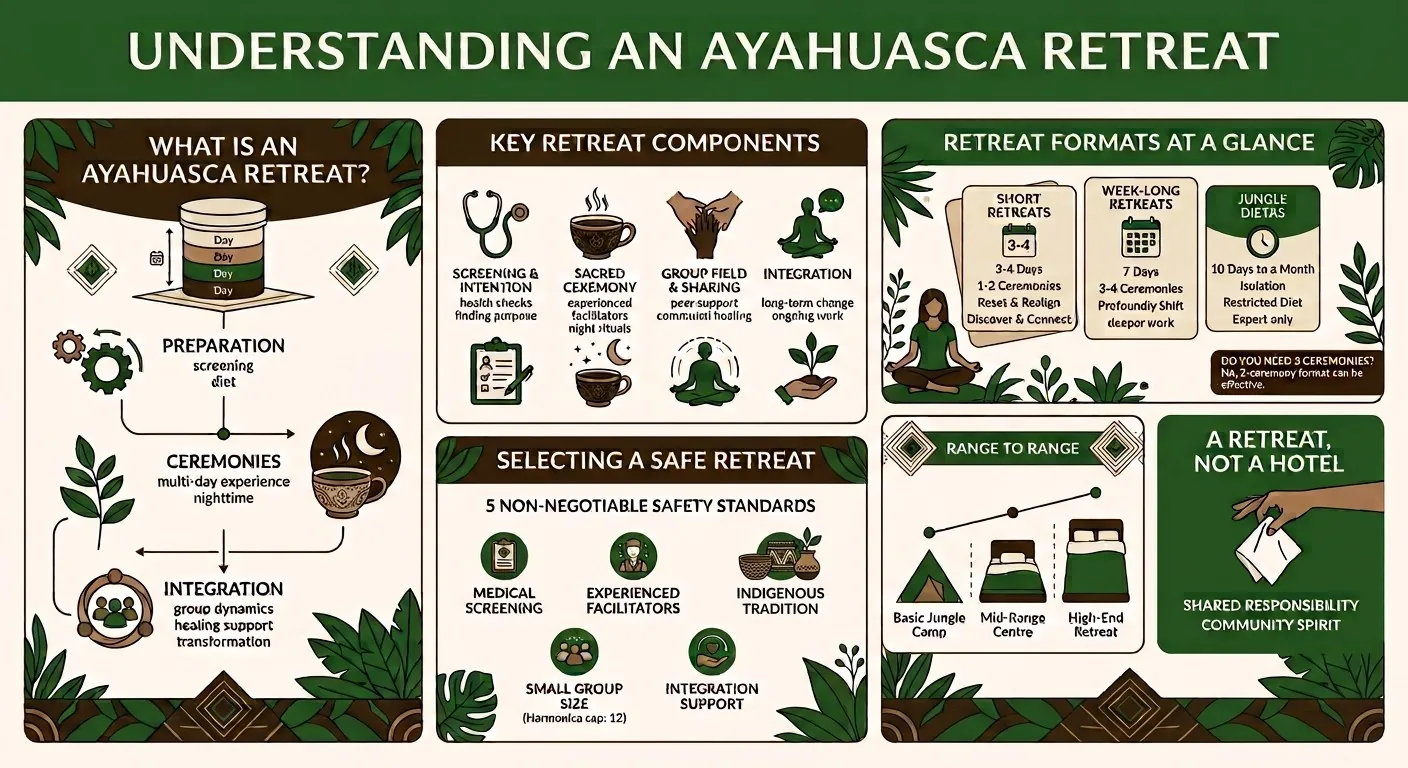
A retreat is a container, and the ceremony is one night inside it. A serious one has four parts: screening of your health and medication before you arrive; preparation, with a diet and some work on what you are actually coming for; the ceremonies themselves, with facilitators awake and sober; and integration, the weeks afterwards when the thing either becomes a change or becomes a story you tell at parties.
People underweight the fourth part almost universally. A shattering night may change nothing if you go home and do no homework, and a quiet ceremony may reorganise things slowly because you continue working with it. The ceremony on its own is not the thing you are buying.
A one-night ceremony usually means a quick briefing, the ceremony and a departure the next day. Honestly, from my point of view that is not ideal unless you already have plenty of experience with the plant. For many people the decision to drink has been building for years, with doubts and worries but also a lot of hope, and a retreat gives that decision structure, starting with the first message and a call about your intention.
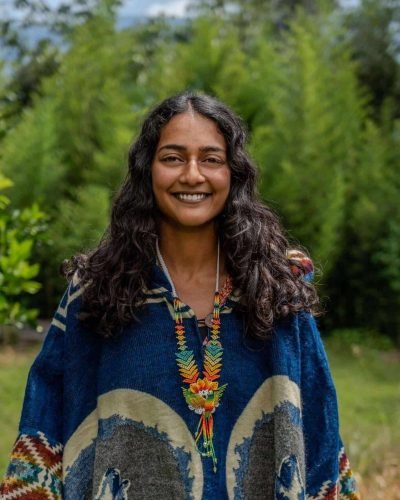
You could fly to Iquitos or the Putumayo and find a ceremony on your own, but in a way, a centre with a track record and a reputation to lose is equipped to handle what comes up. And because most guests are from the West and ayahuasca is an Indigenous medicine, I think it helps a lot to have a foot in both worlds: I have studied in the Kamsá Biyá tradition for more than five years, and before that I had a corporate career and was an entrepreneur.
What Happens at an Ayahuasca Retreat
At an ayahuasca retreat you arrive, prepare your body and mind, drink in one or more ceremonies, share in a circle the morning after, and close the experience before you leave.
On our four-day and seven-day retreats, the schedule develops like this:
- You are picked up in Medellín during the afternoon and arrive at the finca for a welcome circle on the first evening.
- The first full day begins with a cold immersion, a guidance circle and Conscious Connected Breathwork, to get you from your head into your body and heart before the cup.
- The ayahuasca ceremony begins in the late afternoon at 4:00 p.m. and continues into the night.
- A sharing circle takes place on the morning after each ceremony.
- The seven-day retreat also includes yoga, art therapy, miracle mornings and a cacao ceremony.
- The final morning has a closing circle, followed by drop-off in Medellín at 1:00 p.m.
I think a big part of what happens is the group itself. People arrive with similar intentions, and in a sharing circle somebody says "I'm going through something similar." You learn a lot about yourself through other people.
That is why so many guests feel a shift before they even drink. For the night itself, read what to expect in an ayahuasca ceremony.
“An Ayahuasca Retreat allows for a more individualised process with the plant and the necessary support around it.”
 Oliver GlozikFounder of Harmonica Retreat
Retreat Formats
Short retreats: three to four days, one or two ceremonies
The most common entry point. Long enough to prepare, drink, and land before you fly. Suits somebody whose life is basically intact, who wants to see something more clearly, and who cannot disappear for two weeks. This is the format we run most.
Ours are Reset & Realign (three days) and Discover & Connect (an extended four-day weekend), both with two ceremonies.
Week-long retreats: seven days, three or four ceremonies
Each ceremony builds on the one before, and the middle of the week is usually where the real thing surfaces. Suits people carrying something older, whether that is trauma, a long depression or an addiction pattern, where one night is not going to be enough to get underneath it.
Our Profoundly Shift programme has four ayahuasca ceremonies and a cacao ceremony. Ayahuasca does not build tolerance the way psilocybin or LSD do; people tend to become more sensitive, and each ceremony goes deeper.
Dietas: ten days to a month, in the jungle
The traditional Shipibo-style format: isolation, a restricted diet, work with individual master plants alongside the brew. Demanding, and not a beginner format. Suits people who are already deep in this and know why they want it.
A longer dieta can have a place for burnout, deep personal issues or a real need for time away, but longer is not automatically better. I once did a ten-day retreat with seven ceremonies, and after the fourth ceremony my experiences started to feel repetitive. At some point you have to go back and bring the teaching into your daily life, and the time between retreats is also part of the work.
Do you need three ceremonies?
No. The idea comes up often online and around Peru, and it may fit certain traditions, but it is not a fixed rule.
Colombian yagé is generally described as more concentrated than what most people encounter in Peru, as we explain in our yagé guide, so a number taken from one setting does not automatically transfer to another.
More than half of our retreats use two ceremonies, and we see it do the work for people again and again. The number is personal; read more on how many ceremonies you need.
Private and one-to-one ceremonies
More facilitator attention, no group field. Useful where somebody genuinely cannot be in a group, for instance certain trauma histories, and less useful than people expect otherwise, because the group is doing more of the work than it looks like. See private ayahuasca retreats.
The Range: From a Jungle Camp to a Jacuzzi
Ayahuasca retreats range from deep jungle immersions with a tribe to high-end centres where every part of the stay is arranged for you.
| Type | Typical setting | Where you sleep | Price compared |
|---|---|---|---|
| Jungle immersion with a tribe | Deep in the jungle with an Indigenous community, especially in Brazil | However the community lives | Varies |
| Basic jungle camp | Simple camp, sometimes without plumbing or hot water | Dorm-style accommodation | Cheapest |
| Mid-range retreat centre | Nature with real comfort: beds, hot water, a proper ceremonial space | Shared or private rooms | Middle of the range |
| High-end retreat | Usually Costa Rica or Mexico, everything curated, sometimes a jacuzzi | High-end room | Highest |
Honestly, the useful question is: what kind of experience am I looking for? Some people want the simplest possible jungle setting. Others know they will settle more easily if they can sleep on a mattress, take a hot shower and contact home when needed.
Group size obviously makes a big difference as well, because it decides how much attention each person receives.
Harmonica caps every group at 12 people, on a mountainside finca next to a nature reserve. The finca has a custom-built maloka, comfortable mattresses, hot water and WiFi.
Why We Don't Mix Medicines
We do not recommend retreats that combine ayahuasca with other medicines in the same week, such as San Pedro, bufo or psilocybin mushrooms. Obviously, we assume those retreats have their reasons, and we are not saying they are wrong; it is simply not something we are a fan of.
Each of these medicines affects your psyche, your body and your brain chemistry. Drinking ayahuasca several times in a week is one thing. Ayahuasca one day, mushrooms the next and bufo after that can overstimulate the brain, in some cases be dangerous for the body, and leaves no time to understand one experience before the next.
They also come from very different places: San Pedro from the Andes, ayahuasca from the Amazon and bufo from the deserts of Mexico and the United States, and they were never part of one tradition.
There is a hard safety reason as well. The caapi vine inhibits monoamine oxidase (MAO), which is why the medication list further down matters, and a published case report describes a death after 5-MeO-DMT, the compound also found in bufo, was taken in an ayahuasca preparation.
What It Costs
A serious multi-day retreat generally runs between roughly 450 and 3,000 US dollars. Colombia and Peru sit at the bottom of that range, Costa Rica higher, and anything in North America or Europe higher still, because it is pricing in legal risk.
The bottom of that range is a Colombian and Peruvian cost base rather than a warning sign, and our own retreats sit there. What a price cannot tell you is whether the medical intake is real, how many sober people stay awake through the night, and what happens if it goes badly. Ask those separately, at any price. The full breakdown by country is on how much an ayahuasca retreat costs.
Where Retreats Are Legal
Traditional use is recognised in law in Peru, Brazil and Colombia, while the brew is illegal in the United States, the United Kingdom and most of Europe. Where use is recognised, a retreat can be insured, medically staffed and held publicly accountable, which is why the serious centres work there; the full picture is on is ayahuasca legal and, for Americans, ayahuasca and US law.
How to Choose One
Choosing a retreat comes down to screening, facilitator experience, group size, medical cover, where the medicine comes from, and what happens after you leave. Those six things decide whether a container can actually hold you.
The long version, with the five non-negotiable safety standards, the twelve questions to ask before booking, and what different price bands signal, is on how to choose a safe ayahuasca retreat. If you read one page before booking anything anywhere, read that one.
We recommend having calls with several centres before deciding, and noticing who you resonate with and whether you feel pressure to book. The criteria we use to compare retreats give you something concrete to ask, and our free consultation call can be one of those calls.