The Criteria
There is no universal best ayahuasca retreat because every person coming to this work is an individual, and no two individuals are the same. At Harmonica Ayahuasca Retreat in Colombia, these are the eight criteria we look at when we assess any centre, including ourselves.
We are not handing down one winner. The best retreat for one person can be wrong for another, so weight each criterion against your own needs, your relationship to group space and the level of support you need. Every centre worth considering should already operate where ayahuasca is legal, and from that baseline these are the things I would look at before putting myself into their hands.
Two things we do not weight: how luxurious the accommodation is, and how transcendent the testimonials sound. Neither predicts anything about safety or outcome.
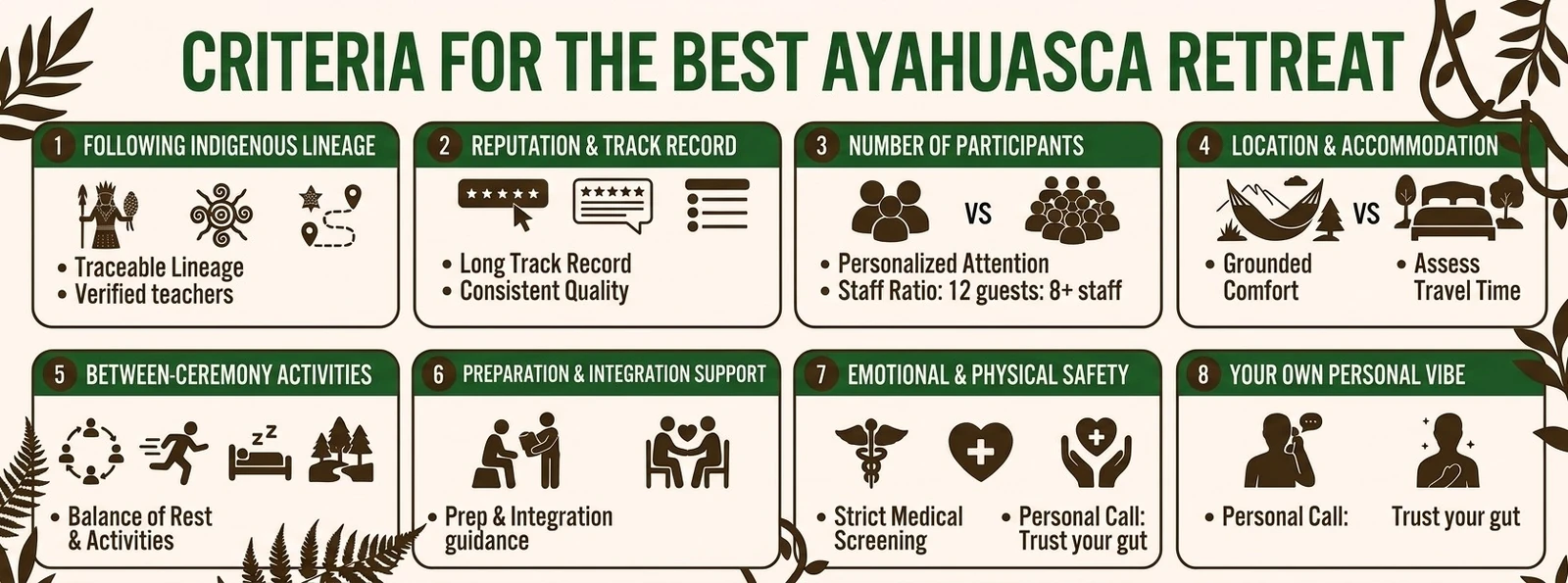
1. Following Indigenous Lineage
The first one is lineage. A centre should work inside an Indigenous lineage of ayahuasca, and this lineage should be traceable. It cannot be something implied by ceremonial language, jungle photographs, feathers, decor and all that kind of stuff. Ask which tradition they follow, who trained the people pouring the medicine and whether there is still a living relationship with their teachers.
In my own training, I keep on seeing that lineage is less about claiming a title and more about staying in a relationship where somebody can still correct you. If the answers stay vague, or everybody is suddenly a master after a short time, I would become careful. Spiritual ego can put on an old costume or a new spiritual costume. It is still the same ego underneath.
Authenticity also goes wider than lineage. A very luxurious centre where a large staff reads every wish off your lips can create a bubble. Inside that bubble, the ordinary truth that life is imperfect, people make mistakes and mistakes can teach us gets removed. This does not mean discomfort is more spiritual. It also does not excuse neglect, weak safety or people being treated badly. The question is whether the container stays grounded in real life rather than becoming a fantasy world.
2. Reputation and Track Record
The second one is track record, and the important word for me is consistency. One wonderful week in February says less if the facilitator changes and a person arriving in October receives a completely different experience. A good centre needs the inner maturity, systems and team to deliver a safe, individual and powerful experience across time, not only when the perfect people happen to be present.
From the outside, look at how long the centre has operated and how many people have passed through it. Then read reviews beyond the testimonials selected for its own website. Dig across several platforms. The two-star, three-star and four-star reviews are often the most useful because people tend to describe plainly what was strong, what was missing and where their expectations did not match the experience.
A one-star review can come from the heat of disappointment, and a five-star review can come from the opposite extreme. Both can contain useful information, but do not build your whole decision around either one. Look for patterns over time. If several people describe the same shortcoming, pay attention. If one person complains about something nobody else mentions, it can be a personal mismatch. Consistency is a large part of what makes a good ayahuasca retreat.
3. Number of Participants
The third one is the ayahuasca retreat group size. Ten, twenty-five and fifty participants create three completely different levels of individualisation and personal care. Smaller is better in the simple sense that there is more room to notice each person, understand what is happening with them and respond when their needs change.
Still, the guest number by itself does not tell you enough. The sweet spot depends on the size of the location, the ceremony space and how many capable people are supporting the group. Compare participants against the full team. Ask who is present during ceremony, who is available outside ceremony and whether the people supporting participants have clear roles.
As one worked example, Harmonica accepts a maximum of twelve participants, with a team of eight or more behind them, including facilitators, a shaman, musicians, a physician, cooks and cleaning staff. That ratio tells you more than the number twelve alone. It is not a magic formula every centre must copy, but you should always ask for both sides of the ratio.
4. Location and Accommodation
Location and accommodation are not background details. You will sleep there, spend the days between ceremonies there and return there after difficult moments. The place should let you settle rather than keep you busy managing basic discomfort.
At one end of the spectrum is a hammock deep in the rainforest with no mosquito net. Some people will come home and call it the best week of their life, and they are not wrong. There can be real surrender in living very simply and close to the jungle. But most people will not sleep well there, and pretending you are that person because it looks more spiritual is already a bad start.
At the other end are the luxury retreats that keep appearing, with beautiful design and sometimes a jacuzzi in the room. Comfort in itself is not a problem. The question is whether it supports the work or is decoration around it. A jacuzzi does not tell you who holds the container, how grounded the team is or what happens when a ceremony gets intense.
Most people want the middle. They want a comfortable bed and mattress, hot water, silence, privacy, genuine closeness to nature and not a ten-person dorm. Poor sleep and no privacy can keep the lid on. You spend energy protecting yourself instead of opening, and by removing those unnecessary frictions, the ayahuasca retreat accommodation can help you trust the room. Ask for clear details and current photos before you book.
When you compare an ayahuasca retreat location, look beyond the scenery. Count the flights, the total travel time and the transfer from the airport. Then imagine doing the same journey again on the way home, when you may feel raw and tired and have a great deal moving inside you. Somewhere an hour from a major airport is a different proposition from somewhere that takes two days of travel each way. Neither is wrong. For one person, the long journey into the jungle is part of the calling. For another person, it creates stress that does not serve the work. Accessibility is a real part of the decision, and it is worth asking about before you book.
5. Additional Activities Offered at the Retreat
The fourth one is what happens between ceremonies. A retreat is not arrive, drink and leave. The days in between are part of the container and also part of what you are choosing. Sharing circles, group activities, individual conversations, time in nature, movement and rest can all give space for what surfaced to settle.
Ask what an ordinary day looks like when there is no ceremony. Ask what participation is expected and what remains optional. There should be room to connect with other people, but also room to be alone. Some people regulate through conversation and community. Others need silence and distance before they can come back into the group in a grounded way.
More activities do not automatically mean a better retreat. A schedule packed from morning until night can also become a coping mechanism where nobody has to sit with what came up. The point is less about staying busy and more about having the right balance of support, reflection, rest and ordinary human contact.
6. Preparation and Integration Support
The fifth one is accompaniment before and after the ceremonies. Preparation extends backwards into how the centre helps you arrive, what information it asks from you and whether somebody understands your expectations. Ayahuasca retreat integration extends forwards into what support exists when you return home and your normal life, relationships and coping mechanisms come back into view. Ask exactly how far both forms of support go.
There are also two types of people I see quite often. One person comes home with a great deal of insight and collects more of it, but changes nothing. Another person is more compulsive and wants to quit the job, end the relationship and rebuild the whole life by Monday morning. The first person may need clear homework and accountability. The second may need patience, calm and grounded reflection before making major decisions.
I like to say ayahuasca is a conversation you are having with yourself in an extraordinary state through the plant. A centre can accompany that conversation, help you understand it and give you homework. It cannot take the driver’s seat of your life. Saying, “Ayahuasca told me to do this,” does not remove your responsibility. That sentence can begin an inquiry, but it should not finish one. Integration is less about protecting every vision and more about how you act afterwards. And by changing those actions, your life begins to respond.
7. Emotional and Physical Safety
The sixth one begins with physical safety, which is non-negotiable. There needs to be real screening so that people who should not drink ayahuasca for physical or psychological reasons are not sitting in the room. This protects the person, the circle and the centre. Disclose your medication and conditions instead of hiding them because a part of you is afraid that mentioning it will get you turned away. Speak with a doctor about your individual situation. A centre willing to slow down or say no can be showing a necessary level of seriousness.
Then there is emotional safety, which is the larger half of what you will feel during the retreat. It begins before anything starts, with clear agreements around confidentiality, respect, non-judgement and authenticity. It also depends on whether the people holding the room have registered your individual needs. Do they know what makes you shut down, where you need more space and when you may struggle to ask for help?
It can be that you need reassurance. It can also be that you need a clear boundary. Or you go very quiet while everybody assumes you are fine. Emotional safety means the team notices the individual inside the group and gives enough space for you to show your fear, your shortcomings and your unsureness without being made wrong for them. Being seen like that is the whole of it.
8. Your Own Personal Vibe Check
The last one is your own vibe check. Every person has their own vibe and energy, and so does every centre. A website can show information, photographs and credentials. It cannot show you the relationship you will have with the people there. Get on calls with several centres and pay attention to how each conversation feels.
Notice whether they take time to understand you, or whether the call stays on available dates and whether you are ready to commit. Do they ask about your situation, your expectations and your relationship to ayahuasca? Do they make space for you being unsure, or do they push you toward a quick decision? If you ask a difficult question, do they answer it clearly or move around it?
A vibe check is not about choosing the most charming person or the centre that says everything you want to hear. That can also feed the spiritual ego. Ask yourself after the call: Did I feel listened to? Could I speak openly? Did they try to understand whether this was right for me, or only whether I could attend? When you are learning how to choose an ayahuasca retreat, being treated as a person rather than a number is one of the clearest signals.
The Centres
Six centres clear the bar of operating openly, publishing a screening process and naming their facilitators. One of the six is our own retreat, which we flag rather than bury. These are centres we rate from the outside, not centres we have been through ourselves. Here is how each lands against the criteria above.
How We Picked These, and What This List Is Not
I have done a lot of research into different ayahuasca retreat centres, reading their websites and looking at many different things, including the vibe I got from those places. The centres named here are ones I resonated with. An impression formed online is not the same thing as having been at a retreat and having firsthand experience of it. I have met people at Harmonica who had been through some of these retreats. This is not a direct recommendation to go to any of them. You should do your own research. We like these places based on what we can see, and that is not an official endorsement.
| Centre | Country | Lineage & staffing | Group size | Medical cover | Preparation & integration |
|---|---|---|---|---|---|
| Temple of the Way of Light | Peru | Shipibo onanya, women and men, long-tenured | Not published | On-site, plus psychological support | Structured programme |
| APL Journeys | Spain and Peru | Shipibo; Maestro Pepe, 35+ years | Small groups | Red Cross certified, strict screening; Western therapists on site | Not published |
| Nimea Kaya | Peru | Western-owned, working with Shipibo maestros | Small groups | Limited on site | Light |
| New Life Rising | Costa Rica and Texas | Peruvian Mestizo; Matt and Jeanae | Max 14 guests | CPR and crisis-trained team | Not published |
| Soltara | Costa Rica | Shipibo, with icaros | 17–22 guests | Onsite clinic and doctor | One year, via Soltara Plus |
| Harmonica (ours) | Colombia | Kamsá Biyá lineage, Sergio Henao 16+ years | Max 12 guests, team of 8+ | Physician on the team | Online course, plus free monthly calls |
Temple of the Way of Light (Peru)
Temple of the Way of Light sits in the jungle outside Iquitos and is probably the best-known serious centre in the world. It works with Shipibo onanya, both women and men, on week-long and longer programmes, with extensive screening and a real integration programme. Expensive, remote and intense. Suits people who want the traditional Shipibo container and can commit to a week or more. Less good for a first short exploratory retreat.
APL Journeys (Spain and Peru)
APL Journeys operates in Spain and Peru and has been running since 2017. It works in the Shipibo tradition, and its lead healer is Maestro Pepe, who has more than thirty-five years of experience. The centre runs small groups, has Western therapists on site, uses Red Cross certified medical staff with strict screening, and has also been involved in published scientific studies. This can suit somebody who wants a smaller container, an experienced Shipibo healer, therapists nearby, and a structured screening process. For somebody comparing Spain with an ayahuasca retreat in Peru, the choice is less about which country sounds more spiritual and more about where the whole setup feels right. It does not suit somebody who is fixed on the Peruvian Mestizo tradition, a larger group atmosphere, or a location outside Spain and Peru.
Nimea Kaya (Peru)
Nimea Kaya, near Pucallpa, is smaller and Western-owned, working with Shipibo maestros, and it runs small groups. Less institutional than the Temple. Suits people wanting the traditional setting at a smaller scale. Less good for anybody who needs substantial medical infrastructure on site.
New Life Rising (Costa Rica)
New Life Rising is an ayahuasca retreat in Costa Rica that also operates in Texas. It has been running since 2014 and works in the Peruvian Mestizo tradition. Matt and Jeanae lead the retreat as a two-person team, the centre accepts a maximum of fourteen guests, and its team is CPR and crisis trained. The Costa Rica setting is in the jungle and includes a pool and jacuzzi, so it can suit somebody who wants this tradition with a comfortable place to come back to between ceremonies. One person may feel grounded with a fourteen-person maximum, while another person needs a much smaller container, so ask on the call how support works around the group. It does not suit somebody specifically looking for Shipibo icaros, a beachfront setting, or a participant cap far below fourteen.
Soltara (Costa Rica)
Soltara operates two locations in Costa Rica and works in the Shipibo tradition with icaros. It hosts between seventeen and twenty-two guests and has an onsite clinic and doctor. There is also a year of integration support through the Soltara Plus platform, which may suit somebody who wants a longer relationship to the integration homework after leaving. The setting is beachfront luxury glamping, so this can fit a person who values comfort and the ocean as part of the overall container. For me, the decision here is less about whether luxury is good or bad and more about whether this group range, tradition, setting, and support structure match you. It does not suit somebody who wants fewer than seventeen guests, an inland jungle setting, or the Peruvian Mestizo tradition.
Harmonica (Colombia)
This one is ours, so read it knowing that. Twelve people maximum, with a team of eight or more behind them: facilitators, our shaman, musicians, a physician, cooks and cleaning staff. Ceremony runs in the Kamsá Biyá tradition of the Putumayo under Sergio Henao, a yagecero of more than sixteen years, which is a living Indigenous lineage rather than a Western adaptation of one. The finca sits beside a natural reserve in Girardota, creek and waterfall on the property, a custom-built maloka at its centre, en-suite bathrooms and hot water. Preparation and integration activities run either side of the ceremony, and afterwards an online course and free monthly calls.
Longer head-to-head write-ups of these and others sit under alternatives.
When a Centre Comes Off This List
A centre comes off this list if any of the eight criteria stops holding. Concretely: a documented screening failure, or a participant harm event the centre does not account for openly. A change of ownership or lead facilitators, because the container is the people and not the property. A loss of whatever legal footing it had. Integration support quietly dropped while the price stays the same. Or a shift to volume, meaning bigger groups against the same facilitator count.
Weighting is why this is a table and not a ranking. A centre that is strong on integration and looser on group size will land differently for you than it does for us, depending on which of the eight you care about most.
Why the Most Expensive Retreat Might Not Be the Best One
I understand the instinct. You open ten retreat websites, you do not know any of these people, and the most expensive one starts to look like the safe bet. Price gives the mind a clean ranking, and the highest number can feel like proof that you found the best.
But one needs to slow down. A higher price can leave more profit. More profit can fund more marketing, more marketing can bring more guests, and those guests can fund more marketing again. It is a loop that feeds itself. From outside, what looks like one of the best ayahuasca retreats is sometimes the retreat with the best marketing.
That does not mean an expensive ayahuasca retreat is bad. The ayahuasca retreat cost can reflect strong staffing, a physician on the team, better facilities or an expensive country to operate in. Part of it can equally be branding, and it is often both at once. Price is not a quality score in either direction.
There are two types I see often. One assumes expensive means careful. The other sees a cheap option and reads it as more pure precisely because it costs less. Neither story is enough. Expensive does not prove care, and cheap does not prove neglect.
The first one is to compare what is provided, not the feeling of the brand. Another one is to ask how many people support the group and what their roles are. Ask who holds the container, what experience stands behind it and whether medical support is part of what you are paying for. The last one is to look at what happens after you leave. Is there follow-up, integration support or a clear way to reach the team? This is less about buying the fanciest week and more about understanding the care around the ceremony.
For more detail, use this breakdown of what an ayahuasca retreat costs while comparing what each centre provides.
Then ask yourself what you are paying for. Are you choosing the top price because fear wants a guarantee? Are you choosing the lowest because you want to feel less committed? Do the homework. No price can do the integration for you, and no marketing can take the driver's seat. Be patient with yourself while comparing, but do not outsource the decision.
How to Choose Between Them
Sort yourself before you sort the centres. There are broadly two people reading this. The first has a life that is basically intact and wants to see something more clearly, and for them a shorter structured retreat with good integration usually fits better, because a month-long jungle dieta is not the answer to a question they have not asked yet. The second is carrying something heavy and old, and there the longer traditional formats earn their length.
Then ask every centre the same questions and watch how they answer rather than what they answer. Do they ask about your medications before you ask about theirs? Do they say no to anybody? Can they tell you where the medicine comes from without a speech? Is there anything at all after you fly home? A place that welcomes those questions is a good sign, and one that treats them as a lack of trust is telling you something too.
The twelve questions worth asking, and what the answers mean, are on how to choose a safe ayahuasca retreat.
Integration Decides More Than the Centre Does
The centre matters less than most people booking one believe. A good container reduces the chance of harm and raises the chance something useful surfaces. It does not do the work.
What decides the outcome is what you do in the weeks afterwards. Ceremony without homework very rarely changes a life. I have watched people have an extraordinary night at an excellent centre, go home, change nothing, and end up back where they started. I have also watched somebody have a quiet, unremarkable ceremony and slowly reorganise their life around what they saw, because they took the after seriously.
So pick a place that screens you properly and can hold you if the night gets hard, and then plan the after. Integration is the page that carries that. All the best with the decision, wherever you land.