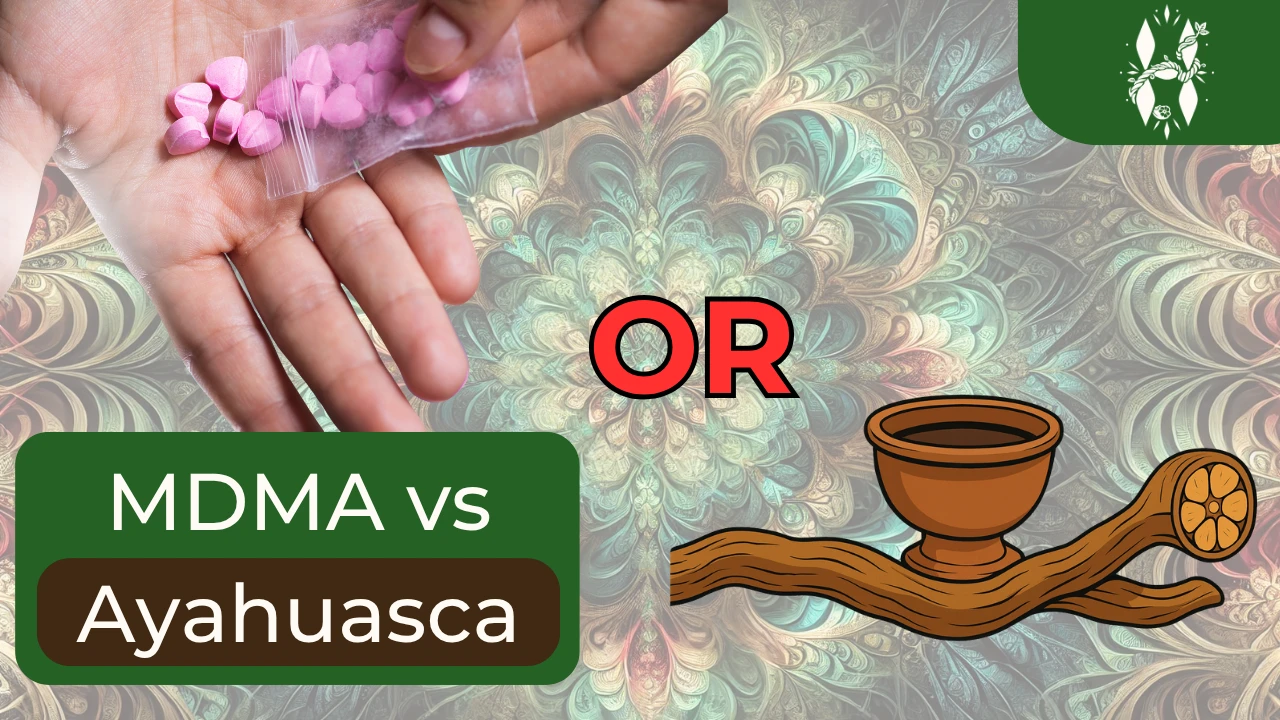
In an ayahuasca vs MDMA comparison, the two experiences are fundamentally different. MDMA can feel euphoric and heart-opening, while ayahuasca may involve physical discomfort and confronting difficult parts of yourself.
At Harmonica, our rule is to avoid MDMA and other substances for at least seven days before ayahuasca, and ideally for 14 days. The two should never be taken together because the ayahuasca vine inhibits monoamine oxidase.
Key Points About Ayahuasca vs MDMA
- Lab versus ceremony. MDMA was made in a laboratory and is usually taken alone, at a party, or in a therapeutic context, while ayahuasca is an ancestral Amazonian plant medicine shared in a ceremony. MDMA usually creates euphoric, heart-opening experiences. Ayahuasca is a holistic medicine that can create physical discomfort and bring up psychological challenges as an invitation to look deeper within ourselves and resolve the internal conflict we carry.
- Drug or medicine. Context helps determine whether MDMA is being approached as recreational drug use or within a therapeutic process.
- Never together. MDMA and ayahuasca should never be taken together. Harmonica requires at least seven days without other substances and ideally 14 days.
Looking to attend a Ceremony? Book a free 30-minute phone call.
MDMA in Plain Terms
MDMA is a synthetic psychoactive drug that acts on serotonin, dopamine, and norepinephrine. It increases the release of these chemicals and can also block their reuptake. Serotonin has a role in mood, sleep, appetite, and pain.
MDMA is also called ecstasy or molly, so ayahuasca vs molly is the same comparison.
The pharmaceutical company Merck first synthesized MDMA in 1912 as a by-product of work on a styptic. It was not invented as a party drug.
Alexander Shulgin re-synthesized MDMA and published the first report of its effects in humans in 1978. According to the Transform Drug Policy Foundation, an estimated half a million doses were given in North American psychotherapeutic settings during the late 1970s and early 1980s.
The United States placed MDMA in Schedule I in 1985, and it was added to the 1971 United Nations Convention in 1986. MDMA then became closely associated with European rave culture in the late 1980s.
The National Institute on Drug Abuse (NIDA) describes MDMA as affecting several neurotransmitter systems. That is part of why people report emotional openness, energy, and euphoria.
My First Experience With MDMA
My first MDMA experience happened in my early 20s after a breakup. I was in a very bad headspace. I do not want to call it depression, but I felt weighed down and far away from my normal self.
I took MDMA at home, and for me it was very heart-opening. I felt that some of the weight connected to the breakup had lifted. That was my personal experience, and it was positive.
Obviously, we have also had many people come to our retreats who had used MDMA before. Some describe their experiences in a similar way. They talk about warmth, euphoria, and easier access to positive emotions.
I think this helps explain why somebody may be drawn to MDMA-assisted therapy. For some people, accessing warmth and emotional connection feels like a gentler entry into personal work.
The Core Difference in Ayahuasca vs MDMA
The difference between MDMA and ayahuasca includes the substance, the setting, the emotional direction, and the safety considerations.
| Comparison | MDMA | Ayahuasca |
|---|---|---|
What it is | A synthetic psychoactive drug | A plant brew containing a DMT source and an MAOI-containing vine |
Where it comes from | First synthesized by Merck in 1912 | An ancestral plant medicine used in ceremonial traditions |
How it is usually taken | Often self-administered, used recreationally, or given in therapy research | Drunk within a ceremony or retreat |
Shape of the experience | Often euphoric, energetic, and heart-opening | Can include visions, discomfort, purging, and difficult emotions |
The day after | Anxiety, sadness, irritability, depression, and lethargy are reported | Some people report relief after working through difficult material |
Risk of dependence | Tolerance and substance-use symptoms are reported by NIDA | Oliver has not met anyone dependent on ayahuasca; the physical difficulty limits repeat use |
Regulatory status | MDMA-assisted therapy for PTSD is not FDA-approved | No regulatory approval as a treatment; taken ceremonially |
Interaction concern | Acts strongly on serotonin | The vine inhibits monoamine oxidase, creating serious interaction concerns |
The ceremonial setting also changes the experience. MDMA may be taken at home, at a party, or within a therapy setting. Ayahuasca is usually held within a longer process of preparation, ceremony, and integration.
At Harmonica, we drink ayahuasca in the Kamsá Biyá tradition of the Putumayo. Our retreats in Girardota are capped at 12 participants, and a team of more than eight people supports each ceremony. The team includes facilitators, a shaman, musicians, and a physician.
That setting does not guarantee a gentle experience. It means you are held within a ceremony while going through it. You can read more about what ayahuasca is and what happens during an ayahuasca ceremony before deciding whether that setting suits you. If you are weighing other plant medicines too, we compare it with magic mushrooms in the same way.
Context Changes How MDMA Is Used
The distinction between a drug and a medicine is very important to me. I think the same substance can be approached differently depending on the setting, intention, frequency, and support around it.
Somebody using MDMA at a rave is in a different situation from somebody receiving it within a structured therapeutic process. The chemical risks remain, but the purpose and container are different.
You need to ask yourself a straight question: am I approaching MDMA as medicine, or am I using it for an easy emotional release? Calling something medicine does not automatically make the relationship to it healthy.
NIDA states that some people report symptoms of an MDMA-related substance use disorder. Those symptoms include tolerance, where increasingly larger amounts are needed for the same effect.
I know of people who have become dependent on the quick release MDMA gives them. For me, this is part of the danger. If a difficult emotional state can be changed quickly, a person may begin reaching for that change again.
I do not know anyone who is addicted to ayahuasca. That is my own circle, not a study, but I feel like ayahuasca has a built-in resistance because drinking it can be physically and emotionally difficult.
Why Ayahuasca Can Feel Harder
Ayahuasca can feel harder because warmth and relief may come after discomfort rather than before it. You may purge, feel physical pain, or see parts of yourself that you have avoided.
With MDMA, many people experience emotional warmth quite quickly. Afterward, NIDA reports that some people experience anxiety, irritability, sadness, depression, or lethargy in the following days.
Ayahuasca can move in the opposite direction. You drink it and may first feel sick, frightened, or physically uncomfortable. You may need to look at yourself and acknowledge choices or coping mechanisms that you would prefer to avoid.
For me, it is like opening a wound so the dirt can come out and it can heal properly.
I feel like this process can be more painful. The difficult effects of ayahuasca deserve as much attention as visions, love, or emotional release. If you only want the warm part, ayahuasca may be the wrong choice right now.
Choosing Between Assisted Therapy and Ceremony
MDMA-assisted therapy and an ayahuasca retreat suit different situations. My depth of experience is with ayahuasca, so I am mindful of the weight of any recommendation I make about MDMA.
There are people who want a heart-opening experience and are not ready to confront everything that may come up with ayahuasca. For somebody in that position, a professionally supported MDMA therapy setting may feel more appropriate.
There are also people who feel ready to look within, accept physical discomfort, and take responsibility for the work after a ceremony. I think ayahuasca may fit that person better, as long as the medical screening and preparation support it.
For me, the ancestral and ceremonial parts of ayahuasca are important. I also see more benefit in ayahuasca for my own path. But that is my personal view, and I am speaking from much deeper experience with ayahuasca.
MDMA-assisted therapy for post-traumatic stress disorder (PTSD) is not approved by the U.S. Food and Drug Administration (FDA). The FDA issued a Complete Response Letter on August 9, 2024, which meant the application was not approved.
The application was resubmitted in August 2026 by its sponsor, according to a statement from MAPS. A resubmission is not an approval, and it does not predict what the FDA will decide.
In the end, your decision has to come from you. Nobody can decide whether you are ready for an ayahuasca ceremony, and you are allowed to decide that you are not.
MDMA Before Ayahuasca Requires a Safety Gap
MDMA and ayahuasca should not be taken together. The ayahuasca vine contains harmala alkaloids that inhibit monoamine oxidase, which makes the DMT in the leaf orally active.
This monoamine oxidase inhibitor (MAOI) action also creates interaction risks with serotonergic substances and many medications. MDMA acts strongly on serotonin, so combining the two is unsafe.
A peer-reviewed 2020 risk assessment of ayahuasca use in a religious context states that recreational drugs with inherent risks, including MDMA, should be avoided until co-use with ayahuasca has been shown to be safe.
Our rule at Harmonica is no MDMA or other substances for at least seven days before ayahuasca. Ideally, we want a gap of 14 days. We have not had to turn anybody away because of recent MDMA use.
Medication needs separate attention. Selective serotonin reuptake inhibitors (SSRIs) and other psychiatric medications can interact with ayahuasca, and you should never stop prescribed medication without speaking to the prescribing doctor. Our guide to ayahuasca and SSRI safety explains this in more detail.
If you take medication or have a medical or psychiatric concern, read who should not drink ayahuasca and discuss your situation with a doctor and the retreat team.
The Work After the Experience
Neither MDMA nor ayahuasca makes difficult life changes for you. An emotional opening may show you something, but you still need to make the phone call, change the habit, attend therapy, or have the conversation you have avoided.
An emotional opening can show you something, but it does not make the change for you. Feeling love, grief, or clarity in a ceremony does not mean daily life follows on its own.
Ayahuasca also requires preparation and integration after the ceremony. Give yourself some compassion if change takes time, and also look at whether you are doing the homework that the experience brought up.
FAQs
Is MDMA a psychedelic?
MDMA is often grouped under the psychedelic umbrella, especially in conversations about psychedelic-assisted therapy. Its pharmacology and typical emotional effects differ from ayahuasca. MDMA acts on serotonin, dopamine, and norepinephrine and is often associated with warmth, euphoria, and emotional openness. Ayahuasca combines DMT with an MAOI-containing vine and can produce a much more physically demanding experience.
What is the difference between MDMA and ayahuasca?
MDMA is a synthetic psychoactive drug that often creates euphoria and emotional openness. Ayahuasca is an ancestral plant brew commonly taken in ceremony, and it may involve purging, physical discomfort, visions, or difficult emotions. MDMA can leave some people feeling low in the following days. Ayahuasca may feel difficult first, with relief sometimes coming after the person has worked through what arose.
Can you take MDMA and ayahuasca together?
No. MDMA and ayahuasca should not be taken together. The ayahuasca vine contains harmala alkaloids that inhibit monoamine oxidase, while MDMA acts strongly on serotonin. This creates a serious interaction concern. Many medications and other serotonergic substances are also contraindicated. Share all medication and recent substance use with the retreat team and speak with a doctor before considering ayahuasca.
How long after taking MDMA can you drink ayahuasca?
Harmonica requires at least seven days between MDMA use and an ayahuasca ceremony, and we prefer a gap of 14 days. This is our retreat rule rather than personal medical advice. Your health, medication, frequency of MDMA use, and other substances may affect the decision. Discuss the timing with a doctor and the retreat team before booking.
Is ayahuasca stronger than MDMA?
There is no useful single strength scale for MDMA and ayahuasca. MDMA may feel more euphoric and socially open. Ayahuasca can be more physically uncomfortable and may bring up frightening or painful material. If by stronger you mean harder to go through, I feel like ayahuasca often is. That does not mean every ayahuasca ceremony will be intense.
What is MDMA-assisted therapy used for?
MDMA-assisted therapy has been studied for post-traumatic stress disorder. It involves MDMA being given within a structured therapeutic process rather than used recreationally. MDMA-assisted therapy for PTSD is not currently approved by the FDA. An application was resubmitted in August 2026, but that resubmission does not guarantee approval or predict the FDA’s decision.