Is Ayahuasca Addictive Like Daily Weed? My Own Comparison
I smoked weed every day for six years, and I was obviously running away from something. I was numbing my feelings, I did not know how to regulate my nervous system, and that was the best way I could cope with the stress and inner turmoil.
“Drugs create disease, addictions and an escape from reality. Ayahuasca confronts you with your reality, add in the physical discomfort and psychological challenges. It’s not the quick fix mechanism people are getting addicted to.”
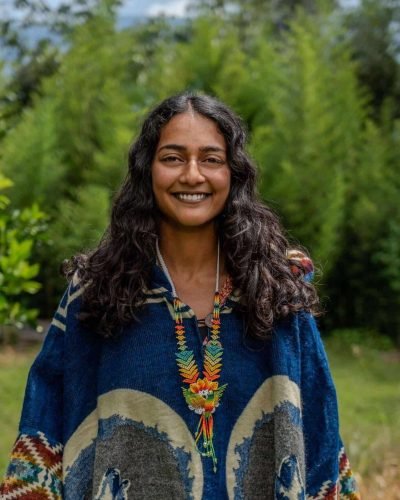
 Sergio HenaoYagecero at Harmonica Retreat
When you are in that phase of addiction, your day revolves around when you smoke the first joint. There is anxiety when you are running low, and you need to start organizing more for the upcoming days. Everybody knows that feeling when they have lived inside an addiction.
Today I do a lot of ayahuasca myself, and in a way it is the opposite for me. I am there to resolve my issues head on.
| My Experience | Daily Weed Use | Ayahuasca |
|---|---|---|
What it did with my problems | I was running away and numbing my feelings. | I was going closer towards my issues. |
The need | My day revolved around the first joint. | I do not feel the need to drink ayahuasca. |
What I went through | Stress and inner turmoil I was managing, and anxiety when I was running low. | I was able to resolve my internal turmoil through ayahuasca ceremonies. |
Going without it | I struggled to sleep well without it. | I have no problem going without it and take regular breaks. |
You can ask me about myself, but this is obviously only my own experience. I go deeper into that relationship in my guide to weed and ayahuasca.
Physical Dependence and Tolerance
A 2007 review by Robert Gable found no evidence that ayahuasca has substantial or persistent abuse potential. Gable concluded that the dimethyltryptamine (DMT) in the brew has minimal dependence potential when taken orally, but he also found no laboratory animal studies that had tested ayahuasca for abuse potential.
Kevin Zapata, MD, the physician on our team, puts his clinical view plainly: “There is no physical dependence with the use of ayahuasca.” He also says, “There is no tolerance built up between ceremonies.” In his experience, some people need less ayahuasca over time, but research has not confirmed that observation.
The trial by dos Santos and colleagues gave nine experienced users two doses four hours apart and found no clear tolerance in the psychological effects. That tells us about one day, not about months or years of ceremonies.
Why Ayahuasca Usually Does Not Hook People
Kevin talks about the purge, the discomfort, and the introspection afterwards. “With ayahuasca, you need to go down first,” he says. You may feel physically exhausted and bad first, and the understanding comes after.
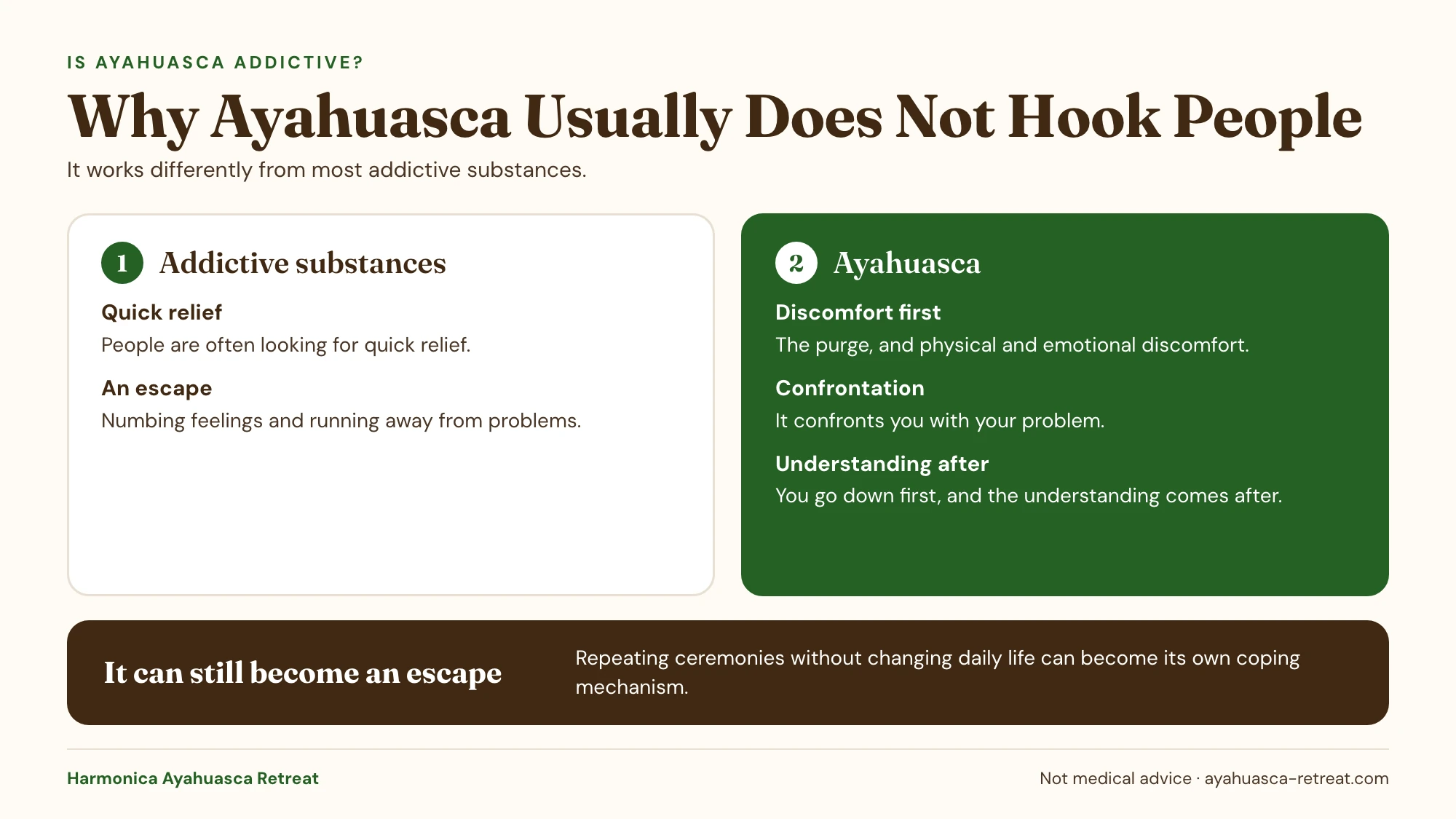
Obviously, parts of me do enjoy the moments in the ceremony and that deep connection with myself. But for me, the whole experience is not built around getting quick relief.
Why the Ceremonial Context and Intention Matter
How ayahuasca is used is a big part of why it rarely becomes a habit. Kevin names the set and the setting first, and the use of the plant “as a medicine and not as something that you can find on the street.” In his words, “The proper use of this plant requires this ceremonial context.”
Sergio Henao, the yagecero who leads our ceremonies, tells every retreat group at the beginning that ayahuasca is not a recreational activity. It is not something you take only to see colours or have an unusual experience. There needs to be a deeper reason for drinking it.
That deeper reason is your intention. Before drinking ayahuasca, ask yourself why you want to drink it: what you want to heal, understand, or let go of. A clear intention helps you stay focused and centered when the ceremony gets difficult, and it is important to approach the medicine with respect and humility. Our guide to setting an ayahuasca intention has questions that help you find yours.
The Man Who Went to Ceremony Almost Every Weekend
One man I know in Medellín went to ayahuasca ceremonies almost every weekend for a period of his life. He had been to at least six different retreat centres around Medellín, and people in those circles made jokes about how often he was going.
When somebody asked about integration, he would say, “My ayahuasca ceremonies are part of my integration too. Through the next ceremony, I learn more about the previous ones.” From the outside, it looked compulsive, and in a way he was ignoring parts of his life.
And also, tell me one person who is not ignoring certain parts of themselves. He had previously explored himself with harmful substances in other countries, while with ayahuasca he felt that he was getting to know himself more deeply. When he later met friends from that earlier period, they were, in his view, in the same place as five years before, or in worse places.
He drank ayahuasca often for two or three years. When I spoke with him recently, he had taken no plant medicine for six months. He found a place within himself where he was happy, where he was content, and he did not feel the same need to go deeper.
Healing is not a linear process. In the end, only the person deep within themselves can know how healing and supportive a practice is.
Can Ceremony Become Its Own Escape?
A person can develop psychological dependence around ceremonies, even if ayahuasca does not create physical dependence. Kevin says our brain tends to naturally become dependent on something: work, family, studying, success, working out. That does not automatically make it an addiction.
“There’s a very fine line between when it’s necessary to do another ceremony and when it’s not,” Kevin says. He looks at the reason behind the next ceremony: are you trying to understand trauma or a difficult period, or are you using the ceremony to hide from your reality?
Kevin does not give a fixed number of ceremonies that becomes unhealthy. He looks at whether you have enough time to rest, decompress, and live your normal life. “The fact that you are doing a ceremony doesn’t mean it has to become your whole life.”
He compares ceremony with going to church or having another spiritual practice. For Kevin, how you implement these things in your day-to-day life is the most important part of every ceremony. Our guide to ayahuasca integration goes deeper into that part.
Two Signs You May Be Running Away
The first sign is repeating the same ceremony without changing your actions. If the same relationship problem comes back again and again, I think the ceremony may already have given you the message.
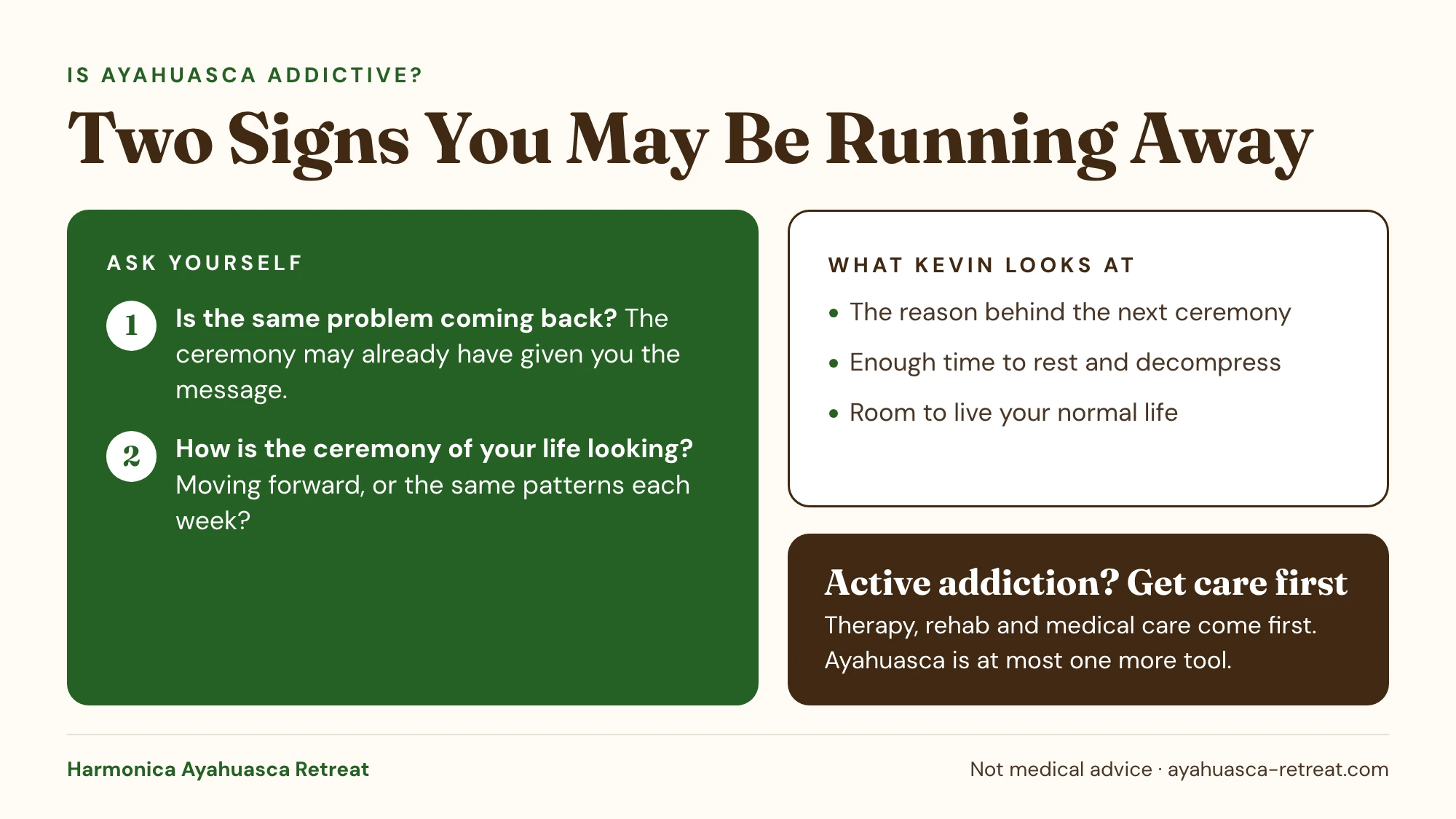
Then you are probably living the same day over and over without learning from the day. At some point, I need to live the day in a different way for my ceremony to start changing. Another ceremony cannot do that homework for me.
The second test is something I like to say quite directly: how is the ceremony of your life looking? Are you moving in the areas you are working on, or are you basically returning to the same patterns each week?
What I’ve seen is that people who drink a lot without moving forward usually have another vice leaking their energy. Very often it is cannabis. It might also be a porn addiction, which we discuss in our guide to ayahuasca and porn addiction, or some other thing that doesn't allow the ceremony to really shift them.
How Often Do People Come Back?
Most people who come to Harmonica travel from outside Colombia. The people we see more often might return around three times in a year, usually early in their ayahuasca journey and working through a deep topic such as losing a parent.
The pattern can look different when somebody lives around Pisac, Cusco, or Medellín. You can probably hear the attitude of, “What am I going to do today? I might as well do a ceremony.” For me, that is a very different thing than coming because you have a deep topic to work through.
Can Ayahuasca Help With Addiction?
Research into ayahuasca for addiction shows potential, but the studies are small and cannot establish that ayahuasca treats or cures addiction. What I’ve seen among guests falls into three broad experiences.
Some people feel an internal shift. One man returned to Harmonica after giving up weed and told us it was not even difficult for him. His body rejected it, and his spirit just was not drawn to it anymore. We have heard similar reports around alcohol, which we discuss in our guide to ayahuasca and alcohol addiction.
Other people return to weed and enter a negative feedback loop. The weed previously gave them relaxation and escape, but afterwards it brings anxiety and nervousness. If you do the things your spirit now knows are bad for you, the negative feedback becomes harder to ignore.
Then there are people whose alcohol use runs deeply through their family, friendships, and social activities. If your whole social dynamics revolve around drinking, stopping may require you to change much more of your life.
In our guide to Gabor Maté and ayahuasca you can read how he sees addiction as going back to the trauma underneath, and I think that is right. I believe ayahuasca can help with that trauma, and also you might need a conversation of reconciliation, or you might need to forgive and accept yourself. It might be a longer journey than you realize.
These are the main studies so far. None of them was a randomized controlled trial.
| Study | Who took part | What they found | The limit |
|---|---|---|---|
12 people with group counselling and two ceremonies | Self-reported alcohol, tobacco and cocaine use fell over six months; only the cocaine drop was statistically significant. Cannabis and opiate use did not fall. | No control group | |
40 crack cocaine users drinking ayahuasca in a religious setting | Participants reported reduced use and said ceremonies helped them address trauma. | Interviews, not measurement | |
53 first-time participants, followed for one month | Reported reduced alcohol and cannabis use. | No control group, short follow-up | |
127 regular ritual users compared with 115 non-users | Ritual users scored lower on alcohol problems. After one year the difference held in the jungle group but not the urban group, where family and social scores got worse. | A comparison cannot show ayahuasca caused it |
So I believe ayahuasca may be another tool, but it cannot carry the whole process. Kevin calls it “another tool in this world of many tools,” especially for people who have maybe tried everything else. Our longer guide looks at ayahuasca for addiction and coping.
Therapy, Rehab, and Medical Support Come First
Kevin is very clear about this: “The first step of treatment for someone who has an addiction has to be therapy. It has to be rehab or a recovery program.” He places plant practices in a second position, after the treatments with established evidence, and if those don't work, he says there are always more possibilities to look for help.
I think that is especially important when the substance itself creates medical danger during withdrawal. MedlinePlus explains that alcohol withdrawal can become life-threatening when someone who drinks heavily stops suddenly. Speak with a doctor before stopping heavy alcohol use. Ayahuasca is not a detox, and a ceremony does not replace medical supervision.
Low Addiction Risk Does Not Mean Risk Free
A low risk of addiction does not mean ayahuasca is risk free, and obviously it is not for everybody. Ayahuasca can interact with medications, and Gable’s review warns that adverse effects may occur with casual use, particularly alongside serotonergic substances.
Read our guides to ayahuasca and SSRIs, who should not drink ayahuasca, and whether you can die drinking ayahuasca before making a decision. Talk to a doctor about your medication, your physical health and your psychiatric history.
Responsibility After the Ceremony
I like to say that ayahuasca is a conversation you are having with yourself in an extraordinary state. After the conversation, the actions you take or avoid are your responsibility.
Give yourself compassion because some patterns take time to change. And also, do not use compassion as an excuse to repeat the same ceremony while your daily life stays frozen.
If you are asking yourself whether your own ceremonies have become an escape, talk to a doctor or a therapist, and you can also bring the question to a free consultation call. I wish you all the strength on your path.