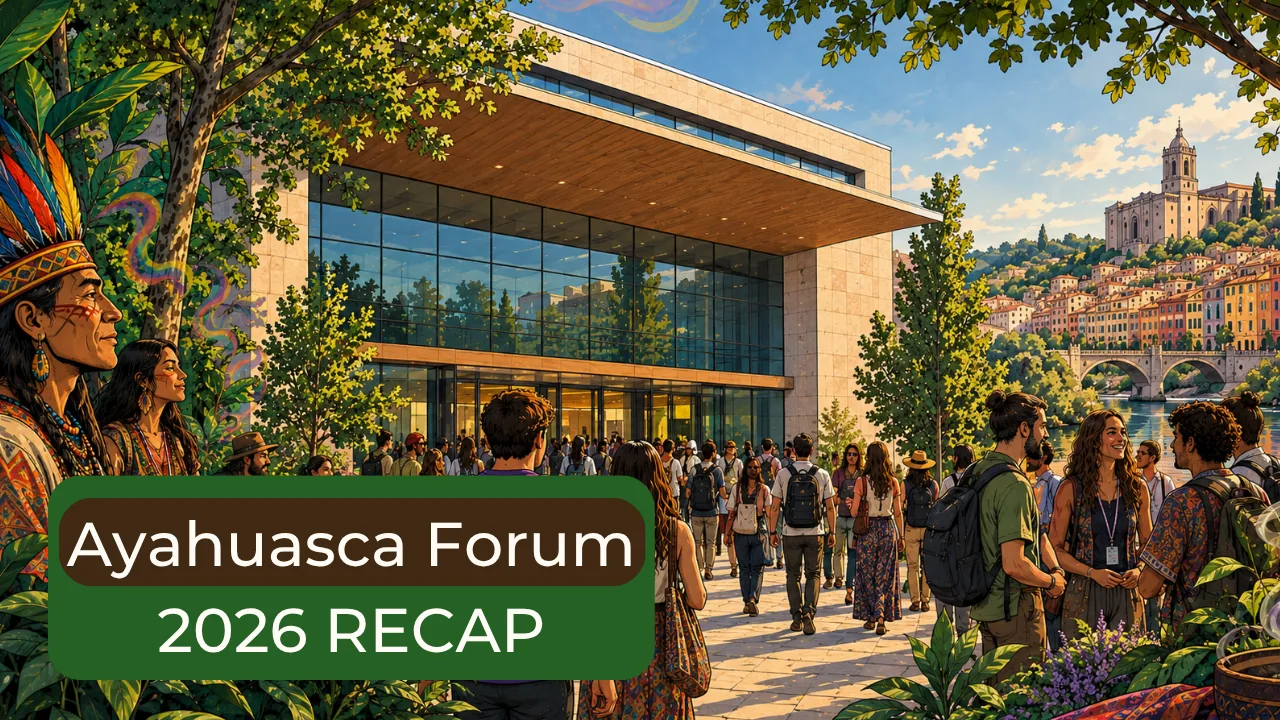
The World Ayahuasca Forum 2026 was the first World Ayahuasca Forum, a global gathering led by Indigenous knowledge keepers, with scientists, practitioners, researchers and artists invited into the conversation. The World Ayahuasca Forum, or Foro Mundial de la Ayahuasca, ran from 11 to 13 September at the Auditori Palau de Congressos in Girona, Spain, following two days of pre-forum events.
Its focus was the future of ayahuasca, especially Indigenous stewardship, care for nature, reciprocity and the risk of taking sacred plants out of their cultural context. The forum also produced a wave of viral clips, including speeches from Benki Piyãko and Paul Stamets. Then, during the closing, a man stood up from the audience and told the Indigenous leaders that they did not own ayahuasca either.
Key takeaways
- Indigenous-led. The World Ayahuasca Forum 2026 placed Indigenous knowledge keepers in a decision-making role and invited scientists into the conversation.
- Four themes. Care for nature, Indigenous stewardship, reciprocity and the risks of patents or laboratory extraction without Indigenous participation.
- The closing flashpoint. Sergio Sanz Navarro argued that ayahuasca belongs to humanity, while Indigenous leaders defended stewardship built across generations.
- Choosing a retreat. Talk with retreat centres about safety, reciprocity and their conditions, and see whether they match what you are looking for. Our guide to choosing a safe ayahuasca retreat lists the questions to ask.
Looking to attend a Ceremony? Book a free 30-minute phone call.
The Main Themes I Heard From the Forum
What I kept hearing, speaker after speaker, was that ayahuasca cannot be separated from the forest, the people and the generations of knowledge around it. In a way, that was the centre of the forum.
The event included the Ashaninka, Yawanawa, Puyanawa, Huni Kuin, Tukano and Inga peoples. Scientists were present, but Indigenous spiritual leaders had a decision-making role rather than appearing as guests at a scientific event.
Caring for Nature as a Living Being
Several speakers described nature as a community of living beings rather than a supply of resources. Txana Tuwe of the Huni Kuin spoke about the land, forest, water and sun as beings that belong to one connected spirit.
Puwe Puyanawa carried a similar message: we are water, we are rivers. Imika Tarirú also placed responsibility on all humanity for failing to care for Earth.
I think this is important because ayahuasca does not grow in isolation. It comes from an ecosystem, and also from communities whose lives are connected to that ecosystem. A conversation about ayahuasca therefore becomes a conversation about water, land and the forest.
Indigenous Stewardship of Ayahuasca
Benki Piyãko argued that wisdom keepers should retain stewardship over how sacred plants move through the world. He objected to ayahuasca being removed from its environment and studied only as a substance because part of its meaning gets lost.
Taita Luciano Mutumbajoy, a traditional yagé healer and spiritual leader of the Inga people, also said the word psychedelic does not exist in his village; it comes from outside. In his community, ayahuasca is understood as medicine and a plant of wisdom through which people learn about life.
Obviously, ayahuasca has already travelled far beyond the Amazon. That makes the question of stewardship more difficult, and it is why the conversation about ayahuasca and cultural appropriation matters.
Avoiding the Scientification of Ayahuasca
The concern around scientification was about what gets lost when ayahuasca becomes a laboratory substance. Benki pointed to tobacco and coca as warnings of plants taken out of their original context and turned into something harmful.
The forum’s stated concerns also included extracting compounds and registering patents without Indigenous participation. This fear has a real history. In 1986, Loren Miller received US Plant Patent 5,751 for an ayahuasca vine variety called Da Vine.
The Coordinating Body of Indigenous Organizations of the Amazon Basin challenged the ayahuasca patent. The United States Patent and Trademark Office revoked it in 1999, reinstated it in 2001 on procedural grounds, and the patent expired in 2003. The history of the patent case shows why Indigenous leaders become concerned when people start talking about ownership through patents.
Paul Stamets spoke about a meeting between science and spirituality. He described the forum as the most important conference he had attended because Indigenous knowledge keepers led it and invited scientists into the space.
Reciprocity With Indigenous Territories
Daiara Tukano spoke about extraction through the history of colonisation. She connected the psychedelic renaissance with the removal of knowledge and sacred plants from their original context, and also with the loss of Indigenous languages.
Reciprocity asks what returns to the communities after ayahuasca leaves their territories. Money is one part of this. Respect for Indigenous decision-making, intellectual property and living traditions is another part.
Quotes From Indigenous Leaders and Speakers at the World Ayahuasca Forum 2026
These passages were transcribed from the English subtitles of clips shared from the forum and lightly cleaned for spelling.
Putanny Yawanawa, Yawanawa
We need to stop fighting with weapons. Our weapon is our words, your love. Your weapon is humility and patience, not arms that destroy. When somebody dies, nothing changes. We need a new approach.
Putanny Yawanawa, vice president of the Nixiwaka Institute, also said ayahuasca is not a hallucinogen.
Taita Luciano Mutumbajoy, Inga
Taita Luciano Mutumbajoy said that the word psychedelic does not exist in his village and that ayahuasca is a medicine and plant of wisdom for learning about visible and invisible life. You can read more about what a taita is.
Bruno Brandão, Shanenawa
Bruno Brandão spoke about the difficulty of travelling with their culture, customs and medicines, and asked politicians to accept their way of being and sharing with the world.
Benki Piyãko, Ashaninka
Our hope is that there is certain respect between knowledge, wisdom and science. That wisdom is not only found in the academic but also in practical knowledge lived by all people.
Today there is a calling, a calling for us to rethink what it is that we are really living on this earth. And we are also showing up in this world because there is no place left for us anywhere to run away and hide. Because if we hide, we will die faster.
He objected to laboratory extraction and used tobacco and coca as warnings, saying wisdom keepers should retain stewardship over how sacred plants travel.
Daiara Tukano, Yepá Mahsã / Tukano
Daiara Tukano connected the European Renaissance with invasion and genocide, and described the psychedelic renaissance through a similar history of extraction, dispossession and disappearing Indigenous languages.
Paul Stamets, Mycologist
Paul Stamets called the gathering the most significant conference he had attended, because Indigenous knowledge keepers led it and invited scientists to speak. He saw it as a convergence of science and spirituality that gives him enormous hope, and said the wisdom of these plants is something artificial intelligence can never replicate.
Txana Tuwe, Huni Kuin
The advice that I have to share with humanity, with the world, is that we must understand that nature is life. Land is life, water is life, forest is life, the sun is light that illuminates. We have to understand and respect all these elements of life that are beings. That is sacred. Nature is a great spirit. Everything is connected; nothing is disconnected from the great spirit.
Puwe Puyanawa, Puyanawa
It doesn't matter how or in what way we change. What is most important is the spirit in defending our life. Because we are water, we are rivers.
Imika Tarirú, Tubú Hummurimasa Center
We, as humanity, no matter who we are, whether white, black, mixed, yellow, indigenous, we have all made mistakes in taking care of our great house, that is planet Earth.
We do not realise that we are exterminating ourselves, the existence of the human species, which is the great house we know as planet Earth.
Sergio Sanz Navarro’s Intervention at the Closing
Sergio Sanz Navarro stood up from the audience during the closing and challenged the idea that Indigenous leaders could control ayahuasca’s future. According to the forum poster, 1,700 people were present.
"Vosotros tampoco sois los dueños del ayahuasca ni tenéis la patente. Queréis apropiaros de ella, de su destino y de su manera de usarse, pero la ayahuasca es de todos, es patrimonio de la humanidad. ¡Viva la libertad!"
In English:
"You are not the owners of ayahuasca either, and you do not hold the patent. You want to appropriate it, its destiny and the way it is used, but ayahuasca belongs to everyone, it is the heritage of humanity. Long live freedom!"
One reading of his intervention is about freedom. Ayahuasca is part of nature, so no individual, institution or people can own the plant itself. People who take this position worry about one group deciding who may use ayahuasca and in which form.
The Indigenous response begins from stewardship and history. Sacred plants and knowledge have repeatedly been taken from Indigenous communities, changed into commercial products and separated from the people who protected them.
So I understand part of Sanz Navarro’s argument. Ayahuasca belongs to nature, and nature is shared. And also, saying that something belongs to everyone does not answer who carries the responsibility for protecting the plant and its knowledge.
My Personal Take as an Ayahuasca Retreat Host
I stand mostly on the Indigenous side of this discussion. I followed the forum through the speeches and clips on social media, and for me the strongest message was that sacredness and intention cannot be removed without changing the medicine.
In a way, I also agree with part of Sergio Sanz Navarro’s position. Ayahuasca is part of nature, and in that sense it belongs to humanity. At the same time, we receive it from keepers of knowledge who have worked with these plants across many generations.
I think it's important to note that ayahuasca left the jungle a long time ago. We are living in the world as it exists today, so dialogue between Indigenous leaders, scientists and retreat practitioners needs to happen. I think the forum created a useful space for that dialogue because the Indigenous presence was so strong.
Sacredness Has a Physical Form
For me, sacredness in ceremony is connected to the fire, chants, prayers, tobacco and harmonica. It is also connected to humility.
You approach ayahuasca knowing you do not have every answer about your life. You are trying to understand your relationship with yourself, with other people and with Mother Nature. In a way, you remember that you are a small part of something much larger.
Our ceremonies follow the Kamsá Biyá tradition of the Putumayo. When you look at where ayahuasca comes from, you also see how unusual it is that people can receive this medicine closer to a city today. Twenty or thirty years ago, somebody might have travelled into the Amazon and still found that a community was unwilling to share ayahuasca.
A pill cannot carry the fire, the prayers and the chants. This is one reason I am against ayahuasca patents and putting ayahuasca into a pill. The mind can isolate compounds, but the ceremony also works with emotions, spirit and human relationships.
A Ceremony Cannot Become a Buffet
You cannot approach ayahuasca as a service you buy. It is wisdom being shared, and that changes the relationship between the person receiving the medicine and the person conducting the ceremony.
At Harmonica, we meet the needs of the patient, but we cannot meet all of their wants. One person may ask for more drums, another wants guitar, and somebody else wants complete quiet. If every request controls the ceremony, the ceremony turns into a buffet.
Obviously, the patient’s well-being comes first. The shaman also needs room to conduct the ceremony and maintain harmony according to what is happening in the group. Paying for a retreat does not mean the shaman should follow every preference as if taking an order from a menu.
Reciprocity Must Continue After the Ceremony
For us, reciprocity begins with the medicine itself. We buy the medicine from the tribe at a fair price for every ceremony, so money flows back into the Putumayo each time we hold one.
We also buy handcrafts from the community. When that money is spent on guitar lessons or whatever it might be, it circulates in the region rather than stopping with the first payment.
It sounds a bit weird to say, but financial opportunity can also give younger people another reason to continue a tradition. Internet, electricity and other possibilities exist in Indigenous communities too. Young people may want to move to Medellín or become a DJ, and we cannot romanticise them as people who only want to live in the jungle.
And also, the vine is replanted as it is harvested. The sourcing has to be sustainable too, which is why the question of how sustainable ayahuasca is in Colombia belongs in this discussion.
The Practice Carries More Weight Than the Conference
I spoke about the forum with Sergio Henao, our lead shaman. He said traditions need to be followed with love and care, while the patient’s well-being remains the priority.
He also said that if people do things in the right way, life, the universe and the great spirit will reward that.
He also said conferences have real value, but sometimes the person who shouts the loudest gets the attention, and what matters in the end is that the people practising these traditions do it the right way.
Indigenous Art, Craft and Song at the Forum
The forum treated culture as something living. Its programme included music, dance, visual arts, cinema screenings, exhibitions, craft markets and dialogue circles.
Daiara Tukano, who spoke at the forum, is also a visual artist with an M.A. in Human Rights. The presence of art and craft made reciprocity more concrete because buying work from Indigenous artists allows money to reach communities directly.
We do something similar by buying handcrafts from the tribe we work with. It is a small part of the wider relationship, but it connects appreciation with an actual exchange.
FAQs
When and where was the World Ayahuasca Forum 2026?
The World Ayahuasca Forum ran from 11 to 13 September 2026 at the Auditori Palau de Congressos in Girona, Catalonia, Spain. Pre-forum events took place on 9 and 10 September. It was the first World Ayahuasca Forum. Indigenous leaders, researchers, practitioners, scientists and artists participated.
Who organised the World Ayahuasca Forum?
The World Ayahuasca Forum was organised by the Yorenka Tasorentsi Institute, the Nixiwaka Institute and the International Center for Ethnobotanical Education, Research and Service, known as ICEERS. Its stated goal was to shape ayahuasca’s future through Indigenous leadership and intercultural dialogue. Indigenous leaders had a decision-making role in the event.
What did Sergio Sanz Navarro say at the World Ayahuasca Forum?
Sergio Sanz Navarro said that Indigenous leaders did not own ayahuasca or hold its patent. He argued that ayahuasca belongs to everyone and forms part of humanity’s heritage. He made the intervention from the audience during the closing. Sergio Sanz Navarro is a different person from Sergio Henao, our lead shaman at Harmonica.
Has anyone ever patented ayahuasca?
Loren Miller received US Plant Patent 5,751 in 1986 for an ayahuasca vine variety called Da Vine. Indigenous organisations challenged the patent, and the United States Patent and Trademark Office revoked it in 1999. The patent was reinstated in 2001 on procedural grounds and expired in 2003. The case involved one vine variety rather than ownership of every ayahuasca plant or Indigenous knowledge surrounding its use.
How can I tell if an ayahuasca retreat practises reciprocity?
Ask the retreat concrete questions about where the medicine comes from and how the relationship with the source community continues. Useful questions include: - Who prepares or supplies the ayahuasca? - Is the medicine bought from the community at a fair price? - Is the vine replanted as it is harvested? - Does money return to the region through medicine, craft or continuing relationships? - Which tradition guides the ceremonies, and who carries that knowledge? A retreat should be able to discuss these questions clearly during a call before you book.